
Table of Contents
- How Solar Pool Heaters Work and What Affects Performance
- Step 1: Size and Position Your Solar Collector for Maximum Sun Exposure
- Step 2: Optimize Solar Pool Heater Circulation and Flow Rate
- Step 3: Control Pump Speed and Operating Schedules
- Step 4: Adjust Bypass Valve Settings for Optimal Temperature Rise
- Step 5: Use a Solar Pool Cover for Heat Retention
- Solar Pool Heater Maintenance and Troubleshooting
- Seasonal and Climate Adjustments
- Frequently Asked Questions
Last Updated: October 8, 2026
How Solar Pool Heaters Work and What Affects Performance
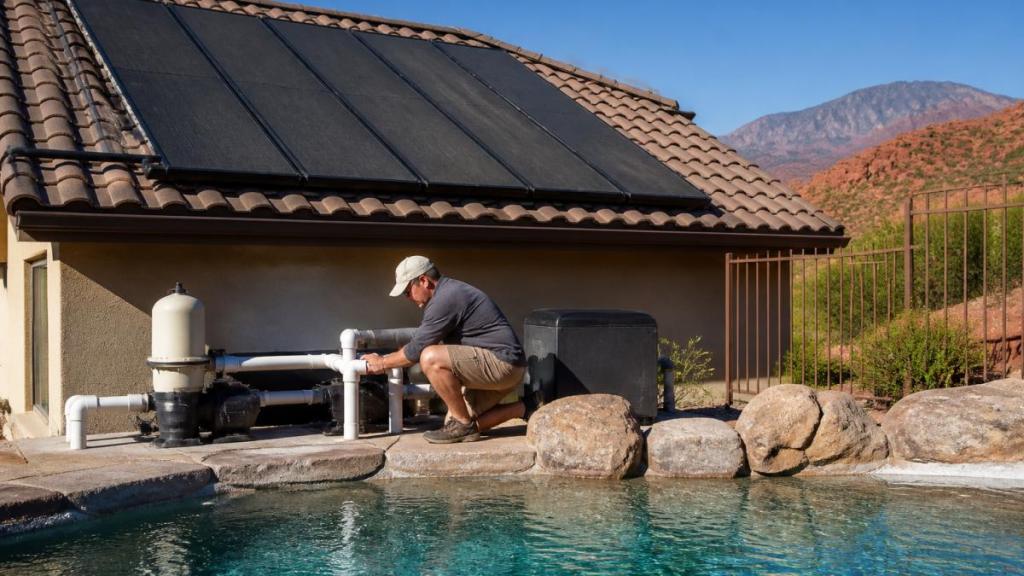
A solar pool heater captures the sun’s energy and transfers it directly to your pool water. The system works by circulating pool water through solar collectors mounted on your roof or ground.
At Dixie Pool Solar Heating & Misting, we help Southern Utah homeowners extend their swimming season from March through November using this proven technology.
Understanding these factors is crucial because small adjustments can dramatically improve how much heat your system captures and retains.
The core principle is straightforward: more sun exposure on the collector, proper water flow through it, and better heat retention in the pool all equal warmer water. But getting each piece right requires specific knowledge that most pool owners don’t have when they start.
Step 1: Size and Position Your Solar Collector for Maximum Sun Exposure
Collector sizing determines how much solar energy you can capture. A collector that’s too small won’t heat your pool adequately. One that’s oversized wastes materials and money.
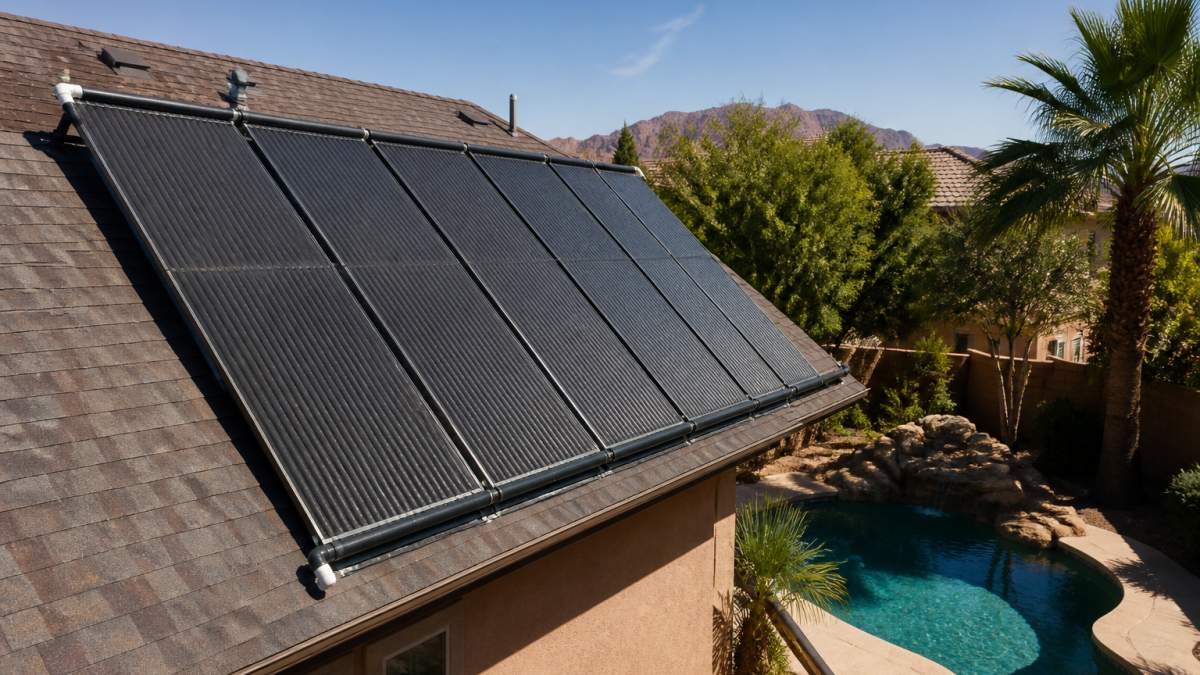
The right collector size depends on your pool’s surface area, your target temperature rise, and your local sun conditions.
Positioning matters as much as size. Your collector must face the sun’s strongest rays:
- South-facing orientation captures maximum solar energy in the Northern Hemisphere
- Roof angle should match your latitude (roughly 30-40 degrees in Southern Utah)
- Shade avoidance is critical, even partial shade from trees or buildings cuts efficiency significantly
- Unobstructed exposure means no chimneys, vents, or structures blocking sunlight during peak hours
Check your roof’s sun exposure throughout the day and across seasons. Morning and afternoon sun angles change dramatically from March to November. A location that gets full sun in summer might have tree shade in spring.
Proper collector positioning directly impacts solar pool heater efficiency. Poor placement can reduce your system’s output by 30-50%, even if everything else is optimized correctly.
Step 2: Optimize Solar Pool Heater Circulation and Flow Rate
Water circulation is the delivery system for your solar pool heater efficiency gains. If water moves too slowly through the collector, it gets too hot and you lose efficiency.
The ideal flow rate depends on your collector type and size.
Check your existing pool pump’s output capacity. Many residential pumps run faster than optimal for solar heating.
Your plumbing configuration affects flow rate too:
- Collector placement, distance from pump to collector and back
- Pipe diameter, smaller pipes create more resistance and reduce flow
- Valve positions, open isolation valves completely to minimize pressure drop
- Filter condition, a dirty filter restricts flow and reduces efficiency
Measure your actual flow rate using a simple method: time how long it takes to fill a bucket from your return line. Calculate gallons per minute and compare it to your target range.
Proper water circulation ensures your solar pool heater efficiency stays high throughout the heating season.
Step 3: Control Pump Speed and Operating Schedules
When you run your pump matters as much as how fast it runs. Most pool owners leave their pumps running 24/7, but solar heating works best during peak sun hours.
The warmest time of day is typically 10 AM to 4 PM. Running your pump during these hours maximizes heat capture. Running it at night or in early morning wastes energy and doesn’t heat your pool effectively.
Variable-speed pumps let you optimize operating schedules:
- Peak sun hours, run at full speed to maximize heat collection
- Morning startup, run at reduced speed to warm the system gradually
- Evening operation, reduce speed or stop to prevent nighttime heat loss
- Off-peak hours, stop the pump to avoid pushing cool water through collectors
This schedule captures maximum heat during peak sun exposure and prevents your heated water from cooling at night. You’ll see noticeable temperature improvements compared to continuous operation.
Many pool controllers now include programmable schedules. Set yours to match your local sun patterns. Seasonal adjustments are necessary because sunrise and sunset times shift throughout the year.
Step 4: Adjust Bypass Valve Settings for Optimal Temperature Rise
The bypass valve is a critical control point that many pool owners overlook. It diverts water around the collector when the water is already warm enough, preventing overheating and reducing unnecessary circulation.
A bypass valve works by sensing water temperature. When the collector is warmer than the pool, the valve opens and sends water through the collector.
Proper bypass valve settings prevent several problems:
- Overheating, stops water from becoming too hot on sunny days
- Nighttime cooling, prevents warm pool water from flowing through cold collectors at night
- Equipment protection, keeps water temperature within safe operating ranges
- Energy efficiency, reduces unnecessary circulation when heating isn’t needed
Check your valve’s temperature differential setting.
Test your bypass valve by observing water temperature at the collector inlet and outlet. The difference should match your system’s design specifications. Adjust the valve’s sensitivity dial gradually and monitor results over a few days.
Correct bypass valve settings ensure your solar pool heater efficiency operates at its design capacity without wasting energy or risking equipment damage.
Step 5: Use a Solar Pool Cover for Heat Retention
A solar pool cover is one of the simplest and most effective ways to improve solar pool heater efficiency. It prevents evaporation, which is one of the largest sources of heat loss from pools.
Evaporation removes significant heat energy from your pool water. On a warm, dry day with low humidity, evaporation can cool your pool by 5-10 degrees. A cover blocks this heat loss and keeps your water warmer longer.
Solar covers (also called solar blankets) work two ways:
- Heat retention, they trap warmth in the water, reducing nighttime cooling
- Additional heating, transparent covers allow sunlight through, providing minor additional warming
- Evaporation prevention, they eliminate the primary cooling mechanism
Use your cover during off-hours:
- Cover the pool at night to retain daytime heating
- Cover during windy conditions when evaporation increases
- Uncover during peak sun hours to allow solar heating to work
- Keep the cover clean so sunlight penetrates effectively
Combined with your solar heater, this means swimming from March through November in Southern Utah.
The investment in a good pool cover pays for itself through reduced heating needs and extended usable pool season.
Solar Pool Heater Maintenance and Troubleshooting
Routine Maintenance Tasks
Regular maintenance keeps your system running efficiently year after year. Most solar pool heating systems require very little upkeep.
Perform these routine checks monthly during the heating season:
- Inspect collector panels for visible dirt, debris, or algae buildup
- Check water flow visually, look for reduced flow at the return line
- Monitor pool temperature, track whether you’re seeing expected temperature rise
- Listen for unusual sounds, grinding or rattling indicates pump problems
- Verify pump operation, confirm it’s running on your intended schedule
- Check valve positions, ensure isolation valves are fully open
Clean your collectors annually or when you notice reduced heating performance. Most dirt can be removed with a soft brush and water. Avoid harsh chemicals or abrasive scrubbing that could damage the collector surface.
Inspect plumbing connections for leaks, especially at the pump discharge and collector inlet. Small leaks waste water and reduce system pressure.
Test your bypass valve function by observing temperature changes. If the valve isn’t responding to temperature differences, it may need adjustment or replacement.
Solar Pool Heater Troubleshooting Common Issues
Most problems have simple solutions. Start with these diagnostic steps when your system isn’t heating as expected.
Problem: Pool temperature isn’t rising
Check these factors in order:
- Is the pump running during peak sun hours? Verify your schedule is correct.
- Is water actually flowing through the collector? Feel the return line, it should be warm.
- Is the collector getting direct sunlight? Check for new shade from trees or structures.
- Is the bypass valve stuck closed? Test the valve manually.
- Is the pool water circulating through the filter and back to the collector? Confirm plumbing connections are correct.
Problem: Collector gets too hot but pool stays cool
This indicates water isn’t flowing through the collector properly:
- Check filter cleanliness, a clogged filter restricts flow
- Verify pump speed is adequate for your collector size
- Inspect plumbing for kinks or blockages
- Confirm all isolation valves are fully open
Problem: Heating works in summer but not in spring or fall
Lower sun angles in shoulder seasons reduce collector output. This is normal but can be improved:
- Verify collector orientation hasn’t changed
- Clear any seasonal shade from deciduous trees
- Run the pump longer during available daylight hours
- Use your pool cover more consistently to retain heat
Problem: Pump is noisy or not running
Check these mechanical issues:
- Verify electrical connections and power supply
- Inspect pump intake for debris or blockages
- Listen for cavitation (high-pitched whining) indicating low water pressure
- Check that the pump isn’t running dry due to low pool water level
Most solar pool heater efficiency problems trace back to three causes: inadequate sun exposure, improper water flow, or incorrect valve settings. Address these systematically and your system will perform reliably.
Seasonal and Climate Adjustments
Southern Utah’s climate offers excellent solar heating potential, but seasonal changes require adjustments to maintain consistent performance.
Spring (March-May) adjustments:
- Increase operating hours as sun angle improves and daylight lengthens
- Monitor for spring storms that reduce available sunlight
- Clear any winter debris from collectors
- Gradually increase target pool temperature as air temperatures rise
Summer (June-August) adjustments:
- Reduce operating hours if pool temperature exceeds your comfort level
- Use bypass valve settings to prevent overheating
- Maintain pool cover for nighttime heat retention
- Monitor evaporation, it increases dramatically in summer heat
Fall (September-November) adjustments:
- Extend operating hours as daylight decreases
- Lower bypass valve temperature differential to capture more marginal heat
- Use pool cover consistently to prevent nighttime cooling
- Expect slower temperature rise as sun angles decline
Winter (December-February) considerations:
- Solar heating becomes minimal in winter months
- Consider supplemental heating if you want year-round use
- Maintain your system but don’t expect significant temperature gains
- Plan collector maintenance during this low-activity period
Climate factors specific to Southern Utah affect performance:
- High altitude, stronger sun intensity but cooler air temperatures
- Low humidity, increases evaporation, making covers more important
- Clear skies, excellent for solar heating most of the year
- Temperature swings, large day-night differences affect heat retention
Adjust your expectations seasonally. March and April heating will be slower than June and July. This is normal and expected. By understanding these patterns, you can optimize your system’s operation throughout the year and maximize your swimming season.
Extending your swimming season while reducing heating costs is achievable with proper solar pool heater optimization. The steps we’ve covered, sizing your collector, optimizing water flow, controlling pump schedules, adjusting bypass valves, and using pool covers, work together to maximize your system’s performance. Dixie Pool Solar Heating & Misting specializes in helping Southern Utah homeowners implement these strategies with industry-leading Heliocol panels and expert installation.
Frequently Asked Questions
How do I know if my solar pool heater efficiency is actually improving?
Track your pool temperature daily at the same time each day, and monitor your pump operating hours. Record water temperature before and after the collector. A properly optimized system should raise water temperature by 5-10 degrees Fahrenheit on sunny days. Compare energy costs month-to-month during the same season across years. If your pool reaches target temperature faster or maintains warmth longer with fewer pump hours, your optimization is working.
What flow rate should I use for my solar pool heater circulation?
Check your system’s manual for the manufacturer’s recommended flow rate range. Too-fast flow prevents water from absorbing enough heat; too-slow flow causes stagnation and overheating. Use a flow meter to verify your actual rate, and adjust your variable-speed pump accordingly. Your bypass valve helps maintain this range by diverting excess water when pressure rises.
Should I run my solar pool heater at night or turn it off?
Turn off your solar pool heater at night. Running the system after sunset causes water to lose heat through the collector back to the cold air. Use your bypass valve to prevent water circulation through the collector once sun exposure drops significantly, typically 1-2 hours before sunset. Combine this with a solar pool cover at night to minimize heat loss through evaporation.
How does a solar pool cover improve solar pool heater efficiency?
A solar pool cover reduces evaporation, which is a major source of heat loss. It also helps trap solar heat absorbed during the day. Use a clear or translucent cover during the day to allow solar penetration, and remove it during peak heating hours if water temperature exceeds your target. Combining a cover with optimized circulation and pump scheduling maximizes your solar pool heater’s overall efficiency.


Leave a Reply