Table of Contents
- How Solar Pool Heaters Work and Why Performance Matters
- Sunlight Exposure and Weather Conditions
- Solar Pool Heater Shade and Collector Sizing
- Solar Pool Heater Efficiency and Collector Performance
- Solar Pool Heater Circulation and Water Flow
- Solar Pool Heater Pool Cover and Heat Retention
- Calculating Expected Temperature Rise and System Performance
- Common Mistakes That Reduce Solar Pool Heater Performance
- Frequently Asked Questions
Last Updated: October 9, 2026
How Solar Pool Heaters Work and Why Performance Matters
A solar pool heater harnesses the sun’s thermal energy to warm your pool water without operating costs or gas consumption.
The principle is straightforward: water circulates through roof-mounted solar collectors, absorbs heat, and returns to your pool warmer. But performance varies based on factors you can control and others you cannot, from collector sizing to weather to circulation.
This guide covers the core factors affecting solar pool heater performance: sunlight and weather, collector design, circulation, and heat retention, plus how to estimate realistic temperature rise and diagnose underperformance.
Sunlight Exposure and Weather Conditions
Direct sunlight is the engine of solar pool heating. Without it, even the most efficient collectors produce minimal heat gain.
Direct sun versus cloud cover
The difference between a clear day and an overcast one is dramatic. Cloud cover reduces solar radiation reaching the panels by 50-80%, depending on density. A partly cloudy day produces inconsistent heating: your pool might gain 5 degrees in the morning, then plateau as clouds move in.
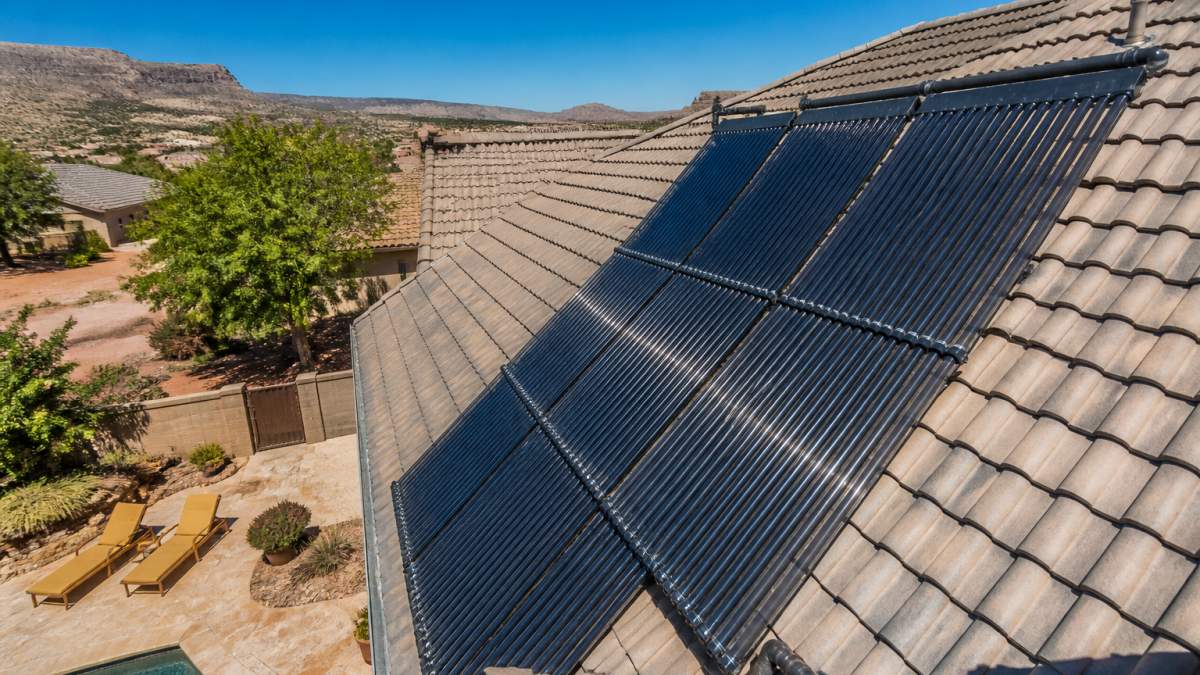
Location matters enormously. Southern Utah’s high desert climate delivers approximately 300 days of sunshine annually, an advantage that compounds over a heating season.
Seasonal variation and ambient temperature
Spring and fall present different challenges. In March, the sun angle is lower, days are shorter, and ambient air is cold, so collectors work harder against cooler surroundings.
Summer offers longer days, higher sun angles, and warmer air that reduces heat loss. June and July typically deliver 5-8 degrees per day under ideal conditions.
Winter heating is generally impractical, not because collectors stop working, but because low sun angle, short days, and cold air mean gains barely offset nighttime losses. Most systems operate March through November, matching when families use their pools.
Solar Pool Heater Shade and Collector Sizing
Shade is the silent killer of solar pool heater performance. Even partial shade on your collector array crushes heating output.
How shade reduces heat gain
A shadow covering 25% of your collector area doesn’t reduce output by 25%, it reduces it by roughly 40-50%. Shaded panels run cooler, shrinking the temperature differential between collector and pool water and reducing heat transfer across the entire array.
Full shade on any portion of your collectors for several hours daily can cut seasonal heating by 30-40%. A professional site assessment matters: many homeowners assume their roof gets “mostly sun” without realizing a neighbor’s tree or roof peak casts shadow during peak afternoon hours.
Matching collector area to pool size
Undersizing your collector array is the most common performance mistake. Too small a collector area heats slowly and struggles to maintain temperature on cooler days.
The general rule: collector area should be 50-100% of your pool’s surface area, depending on goals and climate. A 400-square-foot pool typically needs 200-400 square feet of collector. Larger collectors heat faster and hold temperature better on marginal days.
But there’s a practical limit: collectors cost money and occupy roof space. A collector at 150% of pool surface area heats faster with diminishing returns. Most residential installations target a 75-100% ratio as the efficiency sweet spot.
Solar Pool Heater Efficiency and Collector Performance
Not all solar collectors are equal. Material type, design, and construction significantly affect how much heat they capture and transfer to your pool.
Collector type and material impact
At Dixie Pool Solar Heating & Misting, we install Heliocol industrial-grade panels, which combine durability with high thermal performance. These panels are engineered to last 20+ years and maintain consistent efficiency across Southern Utah’s temperature swings. The difference in long-term solar pool heater efficiency between budget collectors and premium ones compounds over decades.
Panel orientation and tilt angle
Collectors must face the sun directly. South-facing orientation is standard in the Northern Hemisphere. Deviations of 15-30 degrees from true south reduce output by 5-10%; more than 45 degrees off-south loses 20%+ of potential heat gain.
Tilt angle is equally critical. The ideal tilt equals your latitude (roughly 37-38 degrees in Southern Utah). Too shallow reduces winter and spring heating; too steep sacrifices summer performance.
Professional installers calculate optimal orientation and angle for your roof and latitude. A poorly angled system underperforms for its entire lifespan and can’t be adjusted without reinstalling the collectors.
Solar Pool Heater Circulation and Water Flow
Your collectors are only as effective as the system that moves water through them. Circulation mechanics directly determine solar pool heater circulation efficiency and temperature rise.
Pump operation and flow rate
The pump must run during daylight hours when solar intensity is sufficient, typically peak sun hours of roughly 10 AM to 4 PM in summer, shorter in spring and fall.
Flow rate matters. Too slow limits total daily heat gain; too fast means water doesn’t absorb enough heat per pass. Optimal flow is typically 2-4 gallons per minute per 100 square feet of collector area, balanced by a professional.
Running the pump longer rarely helps. Operating during low-sun hours (before 10 AM or after 4 PM) usually wastes energy because solar intensity is too low to overcome circulation losses.
Solar controller and temperature sensors
The solar controller monitors collector and pool water temperatures. When the collector is warmer by a set differential (typically 5-7 degrees), it turns on the pump; when the differential drops below that threshold, the pump shuts off.
This automation prevents wasting energy on cool collectors. A faulty sensor or controller that fails to shut off the pump on cool days wastes energy and reduces performance, so check sensors annually.
Solar Pool Heater Pool Cover and Heat Retention
Heating your pool is only half the battle. Retaining that heat overnight and on cool days determines whether you maintain temperature or lose gains to the environment.
Evaporation and nighttime heat loss
Water evaporates continuously, especially on warm days and in low-humidity climates like Southern Utah’s high desert. Evaporation carries away latent heat, each pound of water that evaporates removes significant thermal energy from your pool. On a hot, dry day, evaporation alone can cool your pool by 2-3 degrees overnight.
A pool cover, even a simple bubble cover, reduces evaporation by 95% and cuts nighttime heat loss by 70-80%. If you’re serious about extending your season and maintaining temperature with solar heating, a cover is essential. Many homeowners skip this step and wonder why their pool won’t stay warm.
Wind and humidity effects
Wind accelerates evaporation and increases convective heat loss from the water surface to the air. A windy day in spring, even with strong sun, may result in minimal net temperature gain because wind-driven evaporation offsets solar heating. Humidity works in the opposite direction, high humidity reduces evaporation and improves heat retention.
Southern Utah’s typical low humidity (often 20-40%) means evaporation is aggressive. This is another reason a cover becomes critical for maintaining temperature, especially during shoulder seasons when ambient air is cool.
Calculating Expected Temperature Rise and System Performance
Understanding how to estimate realistic temperature gain helps you set expectations and diagnose underperformance.
A rough calculation: daily temperature rise (in degrees Fahrenheit) can be estimated based on collector area, pool surface area, and sun conditions.
This assumes full sun, no wind, and good circulation. Cloud cover, wind, or lower sun angle (spring/fall) reduces this figure by 20-50%.
Estimating heating time based on pool volume
If your pool requires a significant temperature rise, it will take several days of consistent sun. Starting your heating early in the season can allow your system to ramp up gradually.
Diagnosing underperformance
If your system isn’t delivering expected temperature rise, check these factors in order:
Shade coverage is the most common culprit. Walk your roof in morning, noon, and afternoon to identify shadows. Even small shadows on collectors significantly reduce output.
Verify pump operation. Does the pump run during sunny afternoons? Listen for it or check your controller display.
Check for debris on collectors. Leaves, dust, or bird droppings reduce solar absorption. Most collectors need occasional rinsing, especially after storms.
Confirm your pool cover is removed during the day. A cover blocks solar radiation from reaching water directly, though most heat comes through the collectors anyway.
Verify temperature sensor readings. If your controller shows collector temperature far warmer than it should be, the sensor may be faulty and the pump isn’t running when it should.
Common Mistakes That Reduce Solar Pool Heater Performance
Understanding what goes wrong helps you avoid costly oversights.
Undersizing the collector array is mistake number one.
Neglecting shade analysis before installation is equally damaging.
Running the pump during low-sun hours wastes energy without meaningful heat gain.
Skipping a pool cover is a hidden performance killer.
Ignoring system maintenance allows sensors to drift, controllers to malfunction, and collectors to accumulate debris.
Not accounting for seasonal variation leads to unrealistic expectations. Your system will heat faster in June than March.
Assuming all solar collectors are equivalent causes people to choose budget options that degrade quickly.
Understanding factors affecting solar pool heater performance helps you to make informed decisions about sizing, placement, and operation.
Frequently Asked Questions
Does shade significantly reduce the performance of a solar pool heater?
Yes. Even partial shade dramatically cuts heat gain. A solar pool heater in full sun generates maximum temperature rise, but shade from trees, buildings, or structures can reduce output by 50% or more. If your pool or collector area receives shade during peak sun hours (10 a.m. to 3 p.m.), performance will suffer. Assess your site’s sunlight exposure year-round before installation to ensure the collector area gets adequate direct sun for your target heating season.
How does pool circulation affect solar heater performance?
Proper circulation is essential. Water must flow through the solar collector at the right rate, too slow and it doesn’t pick up enough heat; too fast and it doesn’t stay in the collector long enough to absorb warmth. Your solar controller uses temperature sensors to run the pump only when the collector is warmer than the pool, maximizing efficiency. A clogged filter, undersized pump, or malfunctioning controller can cut performance significantly.
Will a solar pool cover improve my solar heater’s efficiency?
Yes, dramatically. A cover reduces evaporation and nighttime heat loss, which can account for 30-50% of energy loss. By keeping water warm overnight and reducing the need to reheat lost water, a cover extends your heating season and reduces the workload on the solar collector. Use a cover when the pool is not in use, especially during shoulder seasons (spring and fall) when ambient temperatures are cooler.
How much temperature rise can I expect from a solar pool heater?
Temperature rise depends on collector area, pool volume, sunlight hours, and weather. A properly sized system typically raises pool temperature 2-4°F per day in good conditions. To estimate: consider your pool surface area, desired temperature rise, and collector area. Cloudy days, wind, and cool ambient temperatures reduce this gain.
Does wind reduce solar pool heater performance?
Wind increases heat loss from the pool surface and can cool the collector. Strong wind can reduce efficiency by 10-20% or more by accelerating evaporation and lowering water temperature in the collector. Windbreaks (landscaping or structures) around the pool help retain heat. Wind impact is greatest during cooler months and in open, exposed locations, making spring and fall heating more challenging in windy areas.
How do I know if my solar pool heater is underperforming?
Monitor water temperature daily. If your pool isn’t reaching expected temperatures or is heating much slower than it did when installed, check for: shade creeping over collectors, dirty panels (clean with soft brush and water), low water flow due to a clogged filter, leaks in the system, or malfunctioning temperature sensors. Compare actual heating rates to initial performance estimates. A significant drop warrants professional inspection to diagnose the issue.
Should I turn my solar pool heater off at night?
Yes. At night, the collector is cooler than the pool, so water circulating through it will lose heat rather than gain it. Your solar controller automatically shuts off the pump when the collector temperature drops below the pool temperature, preventing this heat loss. If you have a manual system, turn it off at sunset. Always use a pool cover at night to minimize heat loss to the atmosphere.


Leave a Reply