Table of Contents
- How Long Does Solar Pool Heating Take to Warm Water?
- Solar Pool Heater Efficiency Factors That Determine Heating Speed
- Solar Pool Cover Impact on Heating Time
- Durable Solar Panels for Salt Pools: What to Know
- Solar vs Gas vs Heat Pump: How Heating Times Compare
- How to Speed Up Your Solar Pool Heating System
- Frequently Asked Questions
Last Updated: September 22, 2026
How Long Does Solar Pool Heating Take to Warm Water?
Most solar pool systems raise water temperature by 1 to 2 degrees per day under good sun. So a pool sitting at 68°F in early spring might reach a comfortable 80°F in roughly six to eight sunny days. That timeline shifts with pool size, weather, and cover use.
Solar pool heating is the practice of circulating pool water through roof-mounted collectors that absorb the sun’s thermal energy and return warmed water to the pool. It works best in warm, sunny climates with long swimming seasons.
At Dixie Pool Solar Heating & Misting, we install systems built around Heliocol panels and see this pattern play out across the region every spring. The honest answer to “how long does solar pool heating take to warm water” is that it depends on a handful of variables you can actually control.
Below, we break down each one and show you how to speed up the process.
Typical Heating Timeline for a 1-2 Degree Daily Increase
A well-sized solar array adds 1 to 2 degrees Fahrenheit per day during peak sun. That is the realistic range for most residential pools in a sunny climate.
Several conditions shape where you land in that range:
- Full sun all day: closer to 2 degrees daily
- Partial shade or haze: closer to 1 degree
- No cover overnight: cuts gains by half or more
- Cool nights below 55°F: slows morning warm-up
The U.S. Department of Energy guide to solar pool heating notes that a solar cover is essential to hold heat overnight, since uncovered pools lose most of their gain after dark.
So a 12,000-gallon pool starting at 65°F might reach 78°F in about a week of good weather. A larger pool takes longer. A covered pool gets there faster.
Solar Pool Heater Efficiency Factors That Determine Heating Speed
Heating speed comes down to how much solar energy your collectors capture and how much heat your pool loses. The balance between the two decides your daily temperature gain.
Three big variables drive that balance: pool size, local climate, and sunlight exposure. Get those right, and the system does its job. Get them wrong, and even a good array underperforms.
Pool Size, Gallon Capacity, and Surface Area
Bigger pools need more energy to warm up. A 20,000-gallon pool holds far more thermal mass than a 10,000-gallon pool, so each degree takes roughly twice the energy.
Surface area matters too. A wide, shallow pool loses more heat to evaporation than a deep, narrow one with the same volume. That is why collector sizing is based on surface area, not just gallons.
A common rule of thumb:
- Collector area should equal 50% to 100% of pool surface area
- Colder climates push toward the higher end
- Warmer climates can use less
If your array is undersized, expect slower gains and a shorter effective season.
Climate, Sunlight, and Ambient Temperature
Ambient air temperature and UV index set the ceiling on how fast water warms. Warm air and strong sun mean faster gains. Cool, cloudy days mean little progress.
Your local climate zone matters here. A region with mild winters and plenty of sun supports a longer heating season. A region with cool spring mornings will need more collector area to hit the same target temperature.
Water temperature also affects heat transfer. Cold water absorbs heat faster than warm water, so the first few degrees come quicker than the last few. That is why reaching 70°F feels fast and pushing past 85°F feels slow.
Solar Pool Cover Impact on Heating Time
A solar cover is the single cheapest upgrade for faster heating, and it is also the variable most pool owners underestimate. The reason is that heating speed is not just about how much heat your collectors add, it is about the net balance between daytime gain and nighttime loss. Most articles focus on the gain side. The loss side is where covers do their work, and it is the primary reason solar heating takes days rather than hours.
An uncovered pool loses heat through three mechanisms at night: evaporation, convection, and radiation. Evaporation is the largest of the three. As water evaporates off the surface, it carries latent heat away with it, and on a cool, breezy night an uncovered pool can lose 3 to 5 degrees Fahrenheit or more. That loss can wipe out an entire day’s solar gain. A solar cover, the bubble-style blanket that floats on the surface, blocks evaporation almost entirely, cuts convective loss by trapping a layer of still air against the water, and reduces radiative loss to the sky.
What a cover changes in practice:
- Cuts nighttime heat loss by roughly 50 to 95 percent depending on thickness and fit
- Raises net daily gain by 1 to 2 degrees compared to an uncovered pool
- Extends the swimming season by several weeks at both ends
- Reduces pump run time needed to hold temperature, since the system is not fighting overnight loss
- Reduces chemical demand, because less evaporation means less water replacement and less stabilizer loss
The physics explains why covers often beat bigger arrays.
Run your pump during the sunniest hours, typically late morning to mid-afternoon. Circulating water through the collectors when the sun is strongest captures the most solar gain per hour of operation. Then put the cover on before sunset, the cover is what converts a good solar day into a net temperature gain.
The cover is not an accessory to solar heating, it is half the system. Without it, nighttime evaporation erases much of what the collectors add. With it, the same array can cut your heat-up time nearly in half.
Durable Solar Panels for Salt Pools: What to Know
Saltwater pools need panels built to handle corrosion. Salt systems are popular because they feel gentler on skin, but the same salt that helps swimmers can shorten the life of poorly made collectors.
A few things to check before buying:
- Confirm the panel is rated for saltwater use
- Check the warranty length and what it covers
- Ask about freeze protection if you get hard winter nights
- Verify the panel uses polymer, not metal, in the flow path
Skipping a salt-rated panel to save money often backfires. Corrosion eats through the flow tubes, and you end up replacing the array years earlier than expected.
Solar vs Gas vs Heat Pump: How Heating Times Compare
Solar is the slowest to warm a cold pool but the cheapest to run once installed. Gas heats fastest. Heat pumps sit in the middle on both speed and cost.
| System | Warm-Up Speed | Operating Cost | Best For |
|---|---|---|---|
| Solar | 1-2°F per day | Near zero after install | Long seasons, sunny climates |
| Gas | Fast, hours | Highest | Occasional quick heat-ups |
| Heat Pump | Moderate | Moderate | Mild climates, steady use |
How to Speed Up Your Solar Pool Heating System
You can shorten your heat-up time without buying bigger panels. Small adjustments to orientation, flow, and water care make a real difference.
Optimize Panel Orientation and Roof Pitch Impact
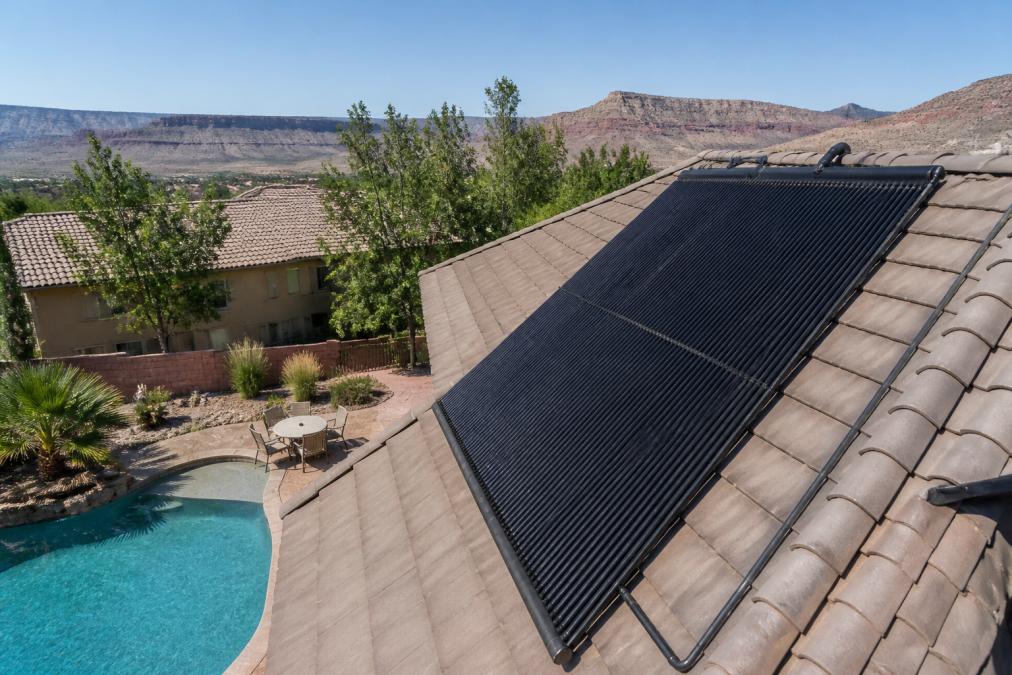
Orientation and roof pitch decide how much solar radiation your collectors actually capture. A south-facing roof at the right pitch captures the most energy across the season.
A simple check:
- Confirm panels face the sunniest direction available
- Set tilt near your latitude for balanced output
- Match pump flow to the collector spec
- Run the system during peak sun hours
Manage Water Chemistry and Circulation
Balanced water chemistry keeps heat transfer working at full strength. Scale and debris on the inside of the collectors act like insulation, blocking heat from reaching the water.
Keep these in range:
- pH: 7.4 to 7.6
- Alkalinity: 80 to 120 ppm
- Calcium hardness: 200 to 400 ppm
- Cyanuric acid: 30 to 50 ppm
Faster heating comes from three things working together: good sun exposure, a solar cover at night, and balanced water with steady flow. Fix the cover and chemistry first, since both cost little and pay off immediately.
Frequently Asked Questions
Should I turn my solar pool heater off at night?
Yes, turning off your solar pool heater at night is recommended. Without sunlight, the system cannot collect heat, and running it can actually cool the water as it circulates through panels exposed to cold night air. Instead, use a solar cover to trap the heat gained during the day. This simple step can reduce overnight heat loss by up to 50%, helping your pool stay warmer for the next day’s swimming.
How long does it take to heat a pool from 60 to 80 degrees with solar?
Heating a pool from 60°F to 80°F with solar typically takes several days to a week, depending on conditions. A well-sized system might achieve a 1-2°F increase per day in good sunlight, so a 20-degree rise could take 10-20 days. However, using a solar cover and ensuring optimal panel orientation can speed this up. For a more precise estimate, consult a professional who can assess your specific pool and climate.
What factors affect the efficiency of solar pool heating systems?
Key factors include pool size (gallons and surface area), solar panel efficiency and total square footage, sunlight hours and intensity, ambient temperature, and whether a pool cover is used. Water circulation and pump flow rate also matter. Proper sizing and installation are critical. For example, a system in a sunny climate with a cover may heat faster than one in a shaded area without a cover. Regular maintenance ensures continued efficiency.
How many hours of direct sunlight are needed to heat a pool effectively?
Most solar pool heating systems need at least 6-8 hours of direct sunlight per day to effectively warm a pool. The exact amount depends on your system’s size and pool volume. In regions with frequent cloud cover, performance drops. To maximize sun exposure, ensure panels face south (in the Northern Hemisphere) and are not shaded by trees or buildings. A professional installer can help optimize panel placement for your location.


Leave a comment