Table of Contents
- Do Solar Pool Panels Actually Increase Home Value?
- How Solar Pool Heater Resale Value Works
- Solar Pool Heating System Cost vs. Long-Term Financial Gain
- Solar Pool Heater Lifespan and Durability Impact on Resale
- Solar Pool Heating vs Gas Heater: Which Adds More Value?
- Regional Market Differences and Buyer Appeal
- What Buyers Actually Look For When Evaluating Solar Pool Systems
- Frequently Asked Questions
Last Updated: October 10, 2026
Do Solar Pool Panels Actually Increase Home Value?
The question homeowners ask most often about solar pool panels isn’t whether they work, it’s whether do solar pool panels increase home value when you sell. Do solar pool panels increase home value? The answer is yes, but with important nuances that depend on your market, system type, and how you position the upgrade to buyers.
Solar pool heating systems extend your swimming season from March through November in Southern Utah, which adds genuine appeal to potential buyers. However, the resale value increase varies significantly based on regional demand, system age, and buyer preferences. At Dixie Pool Solar Heating & Misting, we’ve helped homeowners understand that the real value lies in both the energy savings during ownership and the long-term appeal of a low-maintenance heating solution.
The key distinction most guides miss is this: solar pool panels are thermal systems, not photovoltaic electricity generators. This matters for resale value because pool heating is seen as a lifestyle amenity, not an energy independence investment. Buyers evaluating your home will notice the extended pool season, the absence of monthly heating bills, and the professional installation, but they’re asking different questions than they would about rooftop solar electricity panels.
How Solar Pool Heater Resale Value Works
Solar pool heaters increase home value through two distinct mechanisms: extended usable pool season and documented operating-cost elimination. However, the resale premium for solar pool heating differs fundamentally from rooftop photovoltaic systems because appraisers and buyers treat pool heating as a lifestyle amenity rather than an energy-generation asset.
Measurable Resale Premium
While comprehensive national data on solar pool-heater resale premiums is limited compared to PV electricity systems, real estate professionals report that homes with functioning solar pool heating systems sell faster and attract more qualified buyers than comparable homes with gas or electric heating.
A solar pool heating system that saves $1,500-$2,000 annually creates a compelling financial narrative for buyers. Over a 10-year ownership period, a buyer purchasing your home avoids $15,000-$20,000 in cumulative gas heating costs, a benefit that justifies a price premium at sale.
How Appraisers Value Pool Heating Systems
Appraisers typically value solar pool heating by comparing the property to recent sales of similar homes with and without pool heating. If homes with solar pool heating in your market sell for 2-4% more than comparable homes with gas heating, that premium reflects buyer demand for the system.
The appraiser’s assessment depends on three factors: (1) whether the system is professionally installed and permitted, (2) whether the remaining warranty or lifespan is documented, and (3) whether the system’s condition and performance can be verified. A 5-year-old system with 15+ years of remaining life and full maintenance records will appraise higher than a 15-year-old system nearing end-of-life.
Regional Market Variation
In high-sun regions (Southern Utah, Arizona, Southern California, Florida), solar pool heating is a recognized amenity and buyers expect it to add measurable value. In cooler climates or regions with shorter pool seasons, the premium is smaller because fewer buyers prioritize extended-season heating. Markets where pool ownership is common and affluent buyers dominate see stronger premiums than markets where pools are rare or viewed as maintenance liabilities.
The key insight: solar pool heating adds resale value by reducing the buyer’s operating costs and extending pool usability, but the premium is regional, condition-dependent, and smaller than the system’s installed cost. Position the system as a long-term cost-avoidance tool, not a dollar-for-dollar investment recovery.
Solar Pool Heating System Cost vs. Long-Term Financial Gain
The financial case for solar pool heating rests on the gap between upfront installation and annual energy savings. Homeowners typically save $1,500 to $2,000 per year on heating costs, depending on pool size, climate exposure, and usage patterns.
For resale purposes, this matters because buyers can calculate their own return on investment. A system that costs less upfront but saves significantly annually becomes attractive to the next owner. Additionally, homeowners in Southern Utah are eligible for a 25% state tax credit (up to $2,000) and may be eligible for a $750 rebate from Enbridge Gas, which reduces the effective cost considerably.
The payback period influences how buyers perceive the investment. A system that pays for itself in 5-7 years of energy savings appears more valuable than one requiring 10+ years. This timeline affects resale negotiations because buyers will expect to recoup some of the investment through reduced heating expenses during their ownership period.
Solar Pool Heater Lifespan and Durability Impact on Resale
System age directly affects resale value. A solar pool heating system with 15+ years of remaining lifespan is far more attractive to buyers than one nearing the end of its serviceable life. This is where panel durability becomes critical.
Heliocol panels, the industry standard for residential pool heating, are engineered to last 20+ years with minimal maintenance. A 12-year warranty on panels provides buyers with documented protection and peace of mind. This durability translates directly to resale appeal because the next owner won’t face replacement costs for a decade or more.
Buyers evaluating a home with an aging solar pool system may negotiate a price reduction to account for imminent replacement. Conversely, a newer system with years of warranty remaining becomes a selling point that justifies premium pricing.
Solar Pool Heating vs Gas Heater: Which Adds More Value?
Buyers comparing homes often ask themselves: would I prefer solar pool heating or a gas heater? The answer shapes resale value significantly. Solar heating appeals to environmentally conscious buyers and those prioritizing long-term cost savings. Gas heating appeals to buyers who want immediate heat and don’t prioritize energy efficiency.
Solar systems win on operating cost elimination. Gas heaters require monthly fuel expenses that continue indefinitely. Over a 10-year ownership period, the cumulative cost difference between solar and gas heating becomes substantial, potentially $15,000 to $20,000 in gas expenses that a solar system eliminates entirely.
However, gas heaters heat water faster and work reliably in any weather condition. Some buyers prefer this certainty, particularly if they use the pool year-round. The resale value premium for solar heating is strongest in markets where extended-season pool use is valued and energy efficiency matters to the buyer demographic.
Regional Market Differences and Buyer Appeal
Southern Utah’s climate is ideal for solar pool heating, which amplifies resale value in this region. The consistent spring, summer, and fall sunshine means solar systems perform reliably and deliver promised energy savings. Buyers in this market understand solar heating because it’s common and proven locally.
Markets with less consistent sun exposure see smaller resale premiums because buyers are skeptical about energy savings claims. Additionally, regions where pool season is shorter (northern climates) see less value in extended-season heating because the market demand for March-to-November pool use is lower.
Buyer demographics matter too. Affluent, environmentally conscious homebuyers in Southern Utah are more likely to view solar pool heating as a premium feature. First-time pool owners or budget-conscious buyers may view it as an unnecessary luxury.
What Buyers Actually Look For When Evaluating Solar Pool Systems
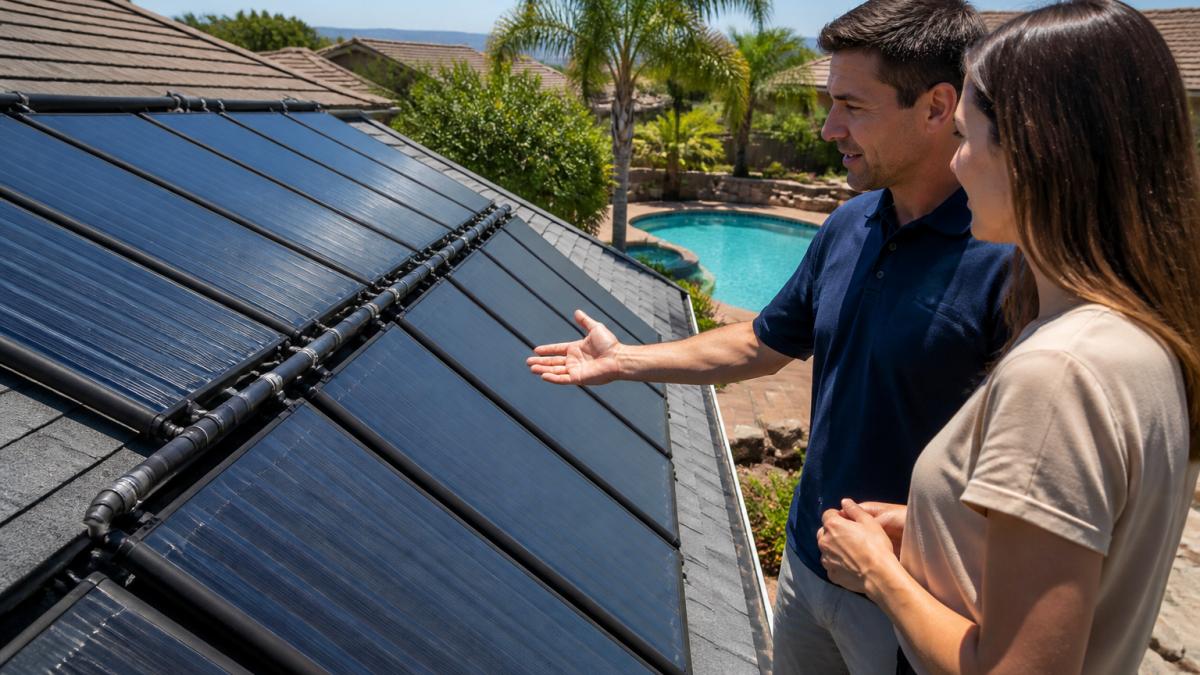
When buyers and appraisers evaluate a home with solar pool heating, they assess system age, installation quality, ownership status, and documentation. The difference between a system that adds measurable resale value and one that raises questions often comes down to how well you’ve documented and maintained the installation.
Critical Documentation Checklist for Sellers
Before listing your home, compile the following documentation to maximize buyer confidence and appraisal value:
- Permits and Inspection Records: Obtain copies of the original building permit and final inspection sign-off. Permitted installations signal professional work and code compliance; unpermitted systems raise red flags for appraisers and may require costly remediation by the new owner.
- Warranty Documentation: Provide the original equipment warranty (typically 10-12 years for panels, 5-10 years for controls and plumbing). Include any extended warranty or service plan. A system with 8+ years of warranty remaining is far more attractive than one nearing expiration.
- Installation and Service Records: Compile maintenance logs, filter cleaning records, and any repairs or component replacements. A well-maintained system demonstrates responsible ownership and gives buyers confidence in remaining lifespan.
- Energy Savings Evidence: Document actual heating cost savings if available. Provide gas or electric bills from before and after installation, or a professional energy audit showing estimated annual savings. Concrete numbers ($1,500-$2,000 per year) are more persuasive than claims.
- System Specifications and Manuals: Include the manufacturer’s technical documentation, panel specifications, and control system manuals. This allows the buyer to research the system independently and understand its capabilities.
- Ownership Verification: Confirm that the system is owned outright (not leased). Provide proof of full payment or mortgage payoff. Leased systems complicate sales because the lease transfers to the new owner, potentially limiting their options.
What Appraisers and Buyers Verify
Appraisers will request or verify the following:
- Professional Installation: Evidence that a licensed contractor installed the system. Appraisers are skeptical of DIY or unlicensed installations because they may not meet code or perform reliably.
- System Condition and Age: Visual inspection of panels, plumbing, and controls. A 5-year-old system in good condition is valued higher than a 15-year-old system showing wear.
- Remaining Useful Life: Calculation based on manufacturer specifications and observed condition. A system with 10+ years remaining is a selling point; one nearing end-of-life may trigger a price reduction.
- Comparable Sales: Appraisers research recent sales of similar homes with and without solar pool heating to establish a local premium. If no comparable sales exist, the appraiser may not add value, even if the system is excellent.
- Ownership vs. Lease Status: Owned systems transfer as home assets and add value. Leased systems create liability and may reduce buyer appeal.
Positioning the System to Buyers
When marketing your home, highlight the system’s cost-avoidance benefit: “This solar pool heating system eliminates monthly gas heating costs and extends your pool season from March through November, saving approximately $1,500-$2,000 annually.” Emphasize professional installation, remaining warranty, and maintenance history. Provide the documentation checklist above to the buyer’s inspector and appraiser proactively; transparency builds confidence and justifies premium pricing.
Buyers evaluating your home will compare it to similar homes with gas heating or no heating. Your job is to make the financial case clear: the system costs less to operate, extends pool usability, and requires minimal maintenance. With complete documentation, you position the solar pool heating system as a verified asset, not a claim.
Frequently Asked Questions
Do solar pool panels increase home value when you sell?
Solar pool panels can increase appeal to environmentally conscious buyers and demonstrate energy-efficient upgrades, but resale value depends on local market demand, system age, and buyer preferences. Homes with solar pool heating systems often sell faster in regions where pool usage is valued year-round. The actual value increase varies by location and property type, some buyers view it as a premium feature, while others factor in installation costs. Documentation of energy savings and warranty coverage helps justify the investment during negotiations.
How much does a solar pool heating system cost compared to gas heating?
Solar pool heating systems require higher upfront installation costs than gas heaters, but operate with zero fuel expenses once installed. Gas heaters have lower initial costs but incur ongoing operating expenses through utility bills. Over 10-20 years, solar systems typically cost less to operate and maintain. Many homeowners offset the initial investment through federal and state tax incentives, including Utah’s 25% state tax credit or potentially up to $2,000 in rebates. Contact Dixie Pool Solar Heating & Misting for a free quote comparing your specific situation.
How long do solar pool heating panels actually last?
Quality solar pool heating panels like Heliocol systems are designed to last 20+ years with minimal maintenance. A durable system backed by a strong warranty, such as the industry-leading 12-year panel warranty, provides confidence in long-term performance and resale value. Panels that are well-maintained and properly installed continue operating efficiently well beyond warranty periods. When selling your home, newer systems or those with remaining warranty coverage appeal more to buyers than aging systems approaching end-of-life.
Should I choose solar pool heating over a gas heater to increase home value?
Solar pool heating adds value primarily through operating-cost savings and energy-efficiency appeal rather than immediate resale premium. Gas heaters offer faster heating but create ongoing fuel expenses. In regions with strong sun exposure and environmental awareness, solar systems attract premium-conscious buyers. The decision depends on your local market, pool usage patterns, and long-term ownership plans. If you plan to stay 5+ years, solar heating typically pays for itself through reduced energy bills while improving marketability. Buyers in Southern Utah increasingly value energy-efficient, low-maintenance pool solutions.


Leave a Reply