Table of Contents
- Why Pool Heating Costs More in Southern Utah Than You Think
- Comparing the Cost-Effective Pool Heating Options for Southern Utah
- Solar Pool Heating Benefits: Why It Wins on Long-Term Cost
- How to Size Your System: BTU Requirements and Pool Volume
- Extending Swimming Season in Utah: From March Through November
- Smart Features and Water Conservation: Getting More From Your Heating
- How to Get a Solar Pool Heating Quote in Utah and Qualify for Rebates
- Final Verdict: The Most Cost-Effective Choice for Your Pool
- Frequently Asked Questions
Last Updated: September 4, 2026
Pool heating in Southern Utah presents a unique financial paradox: the same intense sun that makes summer swimming glorious also drives utility costs through the roof when you try to extend your season with conventional methods. Heating a residential pool with gas or electric resistance can consume more energy per month than an entire household.
The real problem isn’t the heat you need, it’s how you generate it. Below, we break down the actual costs, the payback math, and the system sizing decisions that determine whether your heating investment pays off.
Why Pool Heating Costs More in Southern Utah Than You Think
Most homeowners underestimate how much heat a pool actually loses. A typical in-ground residential pool loses heat primarily through evaporation, which is relentless even on warm days.
The cost of running a gas heater for a full season can rival the total upfront cost of a solar system within just a few years. Many families use their pools only four months a year because heating costs for the shoulder months feel prohibitive.
That calculation changes completely when you eliminate the fuel bill. The most cost effective pool heating southern utah approach isn’t about finding a cheaper heater, it’s about finding a heater with no ongoing fuel consumption. [U.S. Department of Energy guidance on solar pool heating(/2026/08/26/solar-thermal-pool-systems-benefits-guide/) | energy.gov] confirms that solar systems typically pay for themselves within 1.5 to 7 years depending on local fuel costs, after which the heat is essentially free.
Comparing the Cost-Effective Pool Heating Options for Southern Utah
When evaluating pool heating southern utah options, you’re choosing between four primary technologies, each with a very different cost profile. Here are the real-world numbers for a typical 20×40-foot in-ground pool (roughly 800 square feet of surface area) kept at 84°F from April through October.
The Real Cost of Running a Gas Heater
Natural gas prices in Utah have averaged around $1.50 to $2.00 per therm over the past few years, though they spike during cold snaps. A standard 400,000 BTU gas heater running at 80% efficiency will consume roughly 1 therm per hour of operation.
That translates to roughly 150 therms per month during the shoulder seasons. At $1.75 per therm, you’re looking at $260 to $300 per month just for those transition months. Over a six-month season, a gas heater will easily consume $1,200 to $1,800 in fuel annually.
Heat Pumps: The Efficiency Middle Ground
Electric heat pumps are rated by Coefficient of Performance (COP), which measures how many units of heat they move per unit of electricity consumed. Modern units like the Pentair UltraTemp or Hayward HeatPro achieve a COP of 5 to 6 in mild conditions, but COP drops as air temperature falls.
With Washington County electricity rates around $0.12 to $0.14 per kWh, a 140,000 BTU heat pump running at a COP of 4 will consume about 10 kWh per hour of operation. Annual operating costs typically land between $600 and $1,000, but the equipment costs more upfront: expect to pay $4,500 to $7,500 installed.
Electric Resistance: The Trap to Avoid
Electric resistance heaters convert electricity to heat at a 1:1 ratio, a COP of 1.0. That means they consume roughly 3.4 times more electricity than a heat pump to deliver the same heat. At $0.13 per kWh, running a 120,000 BTU unit for 6 hours a day during shoulder season would cost about $27 per day, or over $800 per month. These units are only sensible for small above-ground pools.
Solar Thermal: The Capital Cost vs. Operating Cost Tradeoff
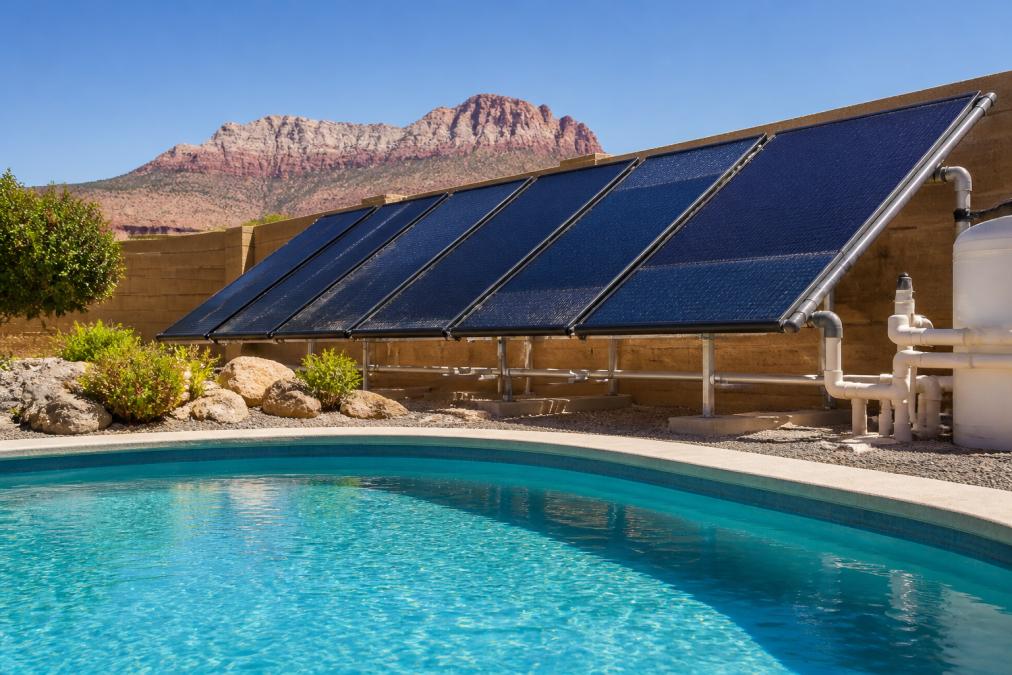
Solar thermal systems flip the equation entirely. A properly sized system for an 800-square-foot pool in Southern Utah requires roughly 400 to 600 square feet of collector area, which typically costs $6,000 to $10,000 installed. Once installed, the operating cost is essentially zero.
If solar replaces a gas heater that would cost you $1,500 per year in fuel, the system pays for itself in 4 to 7 years. If it replaces a heat pump with $800 per year in operating costs, the payback stretches to 8 to 12 years.
The Cost Comparison Table, With Real Numbers
| Heating Method | Upfront Cost (Installed) | Annual Operating Cost (6-mo season) | 10-Year Total Cost of Ownership | Lifespan |
|---|---|---|---|---|
| Solar Thermal | $6,000 – $10,000 | $50 – $150 (pump electricity only) | $7,000 – $11,500 | 20 – 30 years |
| Gas Heater | $3,000 – $5,000 | $1,200 – $1,800 | $15,000 – $23,000 | 8 – 12 years |
| Electric Heat Pump | $4,500 – $7,500 | $600 – $1,000 | $10,500 – $17,500 | 10 – 15 years |
| Electric Resistance | $1,500 – $3,000 | $3,000+ | $31,500+ | 5 – 8 years |
These figures assume current Utah utility rates and a typical 6-month heating season. Your actual numbers will vary based on pool size, desired temperature, and how much you use a cover. But the pattern is consistent: solar wins on total cost of ownership for anyone staying in their home more than 5 years.
Gas heater prices have been climbing as new federal efficiency standards took effect, and natural gas rates in Utah have shown an upward trend. Solar, by contrast, locks in your heating cost at the moment of installation, the fuel is free forever.
Solar Pool Heating Benefits: Why It Wins on Long-Term Cost
Solar pool heating benefits extend far beyond the obvious “free energy” pitch. The most important advantage is predictability: your heating cost stops fluctuating with gas prices or electricity rates.
Consider the maintenance angle. Gas heaters require annual servicing, and their heat exchangers eventually corrode. Heat pumps have compressors and fans that wear out. Solar panels have no moving parts, which is why they last so long with minimal attention. National Renewable Energy Laboratory research on solar thermal durability has documented solar thermal systems operating effectively for 20 to 30 years with proper installation.
By avoiding gas combustion or grid electricity, a solar pool system reduces your household’s carbon footprint substantially.
How to Size Your System: BTU Requirements and Pool Volume
Getting the size right is the difference between a system that works and one that disappoints. Pool heating capacity is measured in BTUs (British Thermal Units), and the requirement depends primarily on your pool’s surface area and your target temperature rise.
A practical rule for Southern Utah: you need roughly 30,000 to 50,000 BTUs per hour for every 500 square feet of pool surface area. A typical 20×40-foot in-ground pool has 800 square feet of surface, requiring a system capable of delivering around 100,000 to 130,000 BTUs per hour.
The most common sizing mistake is underestimating the panel area needed. A system that’s too small will struggle to reach temperature in the spring and fall, which leads homeowners to conclude solar “doesn’t work.” When in doubt, err on the side of more panel area.
Undersizing is the #1 reason [solar pool](/2026/08/25/solar-pool-heater-tax-credit-2026/) heating gets a bad reputation. A system covering only 40% of your pool’s surface will extend your season by only a few weeks, not months. Get a professional load calculation before you commit to any equipment.
Extending Swimming Season in Utah: From March Through November
The goal for most Southern Utah families isn’t just summer swimming, it’s a pool that’s usable when the school year starts and ends. Extending swimming season in Utah to the March-through-November window is entirely achievable.
Solar heating works by accumulating heat during the day. On a sunny March day with air temperatures in the 60s, a properly sized system can add several degrees to your pool. The key insight is that solar doesn’t heat your pool instantly like a gas heater.
Run your pool pump during peak sun hours to circulate water through the panels. Many homeowners also use a pool cover at night to reduce evaporation loss, which is the single biggest source of heat loss.
Smart Features and Water Conservation: Getting More From Your Heating
Modern pool systems can do more than just heat water. Pool automation systems can monitor water temperature, adjust flow rates, and coordinate with your home’s smart systems to optimize heating schedules.
Water conservation is a surprisingly important factor in heating costs. Every gallon of water that evaporates takes heat with it, forcing your system to work harder. A pool cover is the most effective conservation tool: research from the U.S. Department of Energy on pool covers indicates that covers can reduce evaporative heat loss by up to 95%. This means your solar panels spend less energy replacing lost heat and more energy raising the temperature.
A common question is whether solar heating can overheat a pool in July. In Southern Utah’s peak summer, the answer is sometimes yes. A well-designed solar system includes controls that bypass the panels when the pool reaches your target temperature.
How to Get a Solar Pool Heating Quote in Utah and Qualify for Rebates
If you’re ready to explore solar, the process of getting a solar pool heating quote in Utah is straightforward, but you should know exactly what financial incentives are available right now.
The Utah State Tax Credit: What It Actually Covers
Utah offers a residential alternative energy tax credit that applies to solar pool heating systems. Under current state law, the credit is calculated as 25% of the system cost, up to a maximum credit of $2,000 per residence.
The credit applies to systems installed on your primary residence in Utah. The system must be certified by the Utah State Tax Commission, and your installer should provide you with the necessary documentation.
One detail that surprises many homeowners: the credit is not refundable. If your state tax liability is less than $2,000 in the year of installation, you cannot get the difference back as a refund. However, Utah allows you to carry the unused portion forward for up to 5 years.
Local Utility Rebates: What’s Available in Washington County
Beyond the state tax credit, check with your local utility provider. Rocky Mountain Power, which serves most of Washington County, has periodically offered energy efficiency rebates for qualifying pool equipment. It’s worth asking your installer to check current program offerings.
Dixie Power, the municipal utility serving parts of St. George, has its own incentive programs that differ from Rocky Mountain Power’s. Don’t assume the incentives you read about online are current.
The Federal Solar Investment Tax Credit (ITC)
The federal government also offers a solar Investment Tax Credit that applies to solar pool heating. Under current law, the ITC provides a 30% credit on the cost of qualifying solar equipment and installation, with no maximum dollar cap.
The federal ITC for solar pool heating is available for systems that heat pool water, but the credit applies only to the solar equipment itself, not the entire pool heating system. For an $8,000 system, the federal credit would be approximately $2,400, and the Utah state credit would add another $2,000, bringing total incentives to $4,400, a 55% reduction in your effective upfront cost.
How to Calculate Your Actual Payback Period
Here’s the concrete math you should run before you schedule any installation. Start with your current heating costs. If you’re using a gas heater, pull your winter and shoulder-season gas bills and identify the pool-related consumption.
Let’s walk through a realistic example for Southern Utah:
- System cost: $8,000 installed for a 480-square-foot solar panel array
- Federal ITC (30%): -$2,400
- Utah state tax credit (25% up to $2,000): -$2,000
- Net out-of-pocket cost: $3,600
Now compare that to your annual operating cost for your current or alternative heating method:
- Gas heater annual fuel cost: $1,500
- Heat pump annual electricity cost: $800
- Solar annual operating cost: $100 (additional pump run time)
If you’re replacing a gas heater, your annual savings are $1,400. Divide your net cost of $3,600 by $1,400, and your payback period is approximately 2.6 years.
If you’re replacing a heat pump, your annual savings are $700, putting your payback at just over 5 years.
What to Ask During the Quote Process
When you schedule site visits with installers, come prepared with specific questions beyond just the bottom-line price:
- What is the exact panel area they’re proposing, and what temperature rise does that support? A reputable installer should be able to tell you how many degrees of temperature increase you can expect on a sunny April day.
- Are they including the federal ITC and Utah state tax credit paperwork in the quote? Some installers quote net pricing after incentives; others quote gross. Make sure you’re comparing apples to apples.
- What is the warranty on the panels, the manifold, and the installation labor? Quality panels like Heliocol carry a 12-year warranty, but the installation workmanship should be covered separately.
- How will they handle roof penetrations and flashing? This is the most common source of leaks and the most frequently skimped-on detail in cheap installations.
- Will the system integrate with your existing pool automation? If you have a Pentair, Hayward, or Jandy automation system, your solar controls should be compatible.
Before you schedule a site visit, have your last 12 months of utility bills handy. A good installer will use your actual energy consumption to estimate your savings, not just generic averages. This also helps you verify the payback period for your specific situation. And don’t forget to ask about current utility rebates, they can change mid-year, and a well-connected installer will know what’s available right now.
When you compare quotes, look beyond the panel price. Ask about the warranty on the panels themselves, the workmanship warranty on the installation, and how the installer handles roof penetrations. A quality installation with a 12-year panel warranty and a 2-year labor warranty protects your investment for decades.
Final Verdict: The Most Cost-Effective Choice for Your Pool
After weighing upfront costs, operating expenses, lifespan, and climate fit, the most cost effective pool heating southern utah solution for most homeowners is a professionally installed solar thermal system. It’s the only option that eliminates ongoing fuel costs.
Gas heaters make sense only if you need instant heat and rarely use your pool. Heat pumps are a reasonable middle ground but still cost money every time they run.
The key to success is professional design and installation. A system that’s correctly sized for your pool and your roof will extend your swimming season from March through November, add value to your property, and keep your utility bills predictable.
Frequently Asked Questions
What is the most cost-effective way to heat a pool in a desert climate?
Solar thermal pool heating is the most cost-effective option for Southern Utah’s desert climate. The region averages over 300 sunny days per year, which means your system generates free heat most of the year. While the upfront cost is higher than a gas heater, solar panels have no monthly fuel costs and typically pay for themselves within 3-5 years through utility savings of $1,500-$2,000 annually.
How does solar pool heating compare to gas heaters for energy efficiency?
Solar pool heating operates at 80-90% thermal efficiency using free sunlight, while gas heaters convert only 80-85% of purchased fuel into heat. The critical difference is operating cost: gas heaters require ongoing fuel purchases that fluctuate with market prices, whereas solar systems use no fuel after installation. For Southern Utah homeowners, this translates to predictable, near-zero annual operating expenses versus hundreds of dollars in monthly gas bills during peak heating months.
Can I extend my swimming season from March through November in Southern Utah?
Yes. A properly sized solar pool heating system can maintain comfortable swimming temperatures from March through November in Southern Utah. The key is sizing your system correctly to account for cooler spring and fall temperatures. Professional installers calculate your pool’s surface area, volume, and sun exposure to determine the right number of panels. Most homeowners with a correctly sized system enjoy water temperatures of 80-88°F throughout this extended season.
What are the long-term savings of installing solar thermal pool panels?
Solar thermal panels typically last 20+ years with minimal maintenance. Based on Southern Utah’s climate, homeowners save $1,500-$2,000 per year on heating costs compared to gas. Over a 20-year lifespan, that equals $30,000-$40,000 in total savings. Additionally, Utah offers a 25% state tax credit up to $2,000, which reduces your upfront investment. After the payback period of roughly 3-5 years, your pool heating is essentially free for the remaining system life.
Choosing the right pool heating system comes down to understanding your true cost of ownership, not just the purchase price. Dixie Pool Solar Heating & Misting specializes in designing and installing Heliocol solar thermal systems that eliminate operating costs and extend your season for 20+ years, backed by an industry-best 12-year panel warranty. Get a free quote today and see how much you could save on pool heating southern utah.
This article was written using GrandRanker


Leave a Reply