Table of Contents
- What Drives Swimming Pool Misting System Installation Cost?
- Misting System Cost Breakdown by Component
- High-Pressure Misting System Benefits for Pool Owners
- How to Cool Down Hot Pool Water With a Misting System
- Operating Costs, Water Usage, and Long-Term ROI
- Misting System Maintenance Tips to Protect Your Investment
- Conclusion: Is a Pool Misting System Worth the Cost?
- Frequently Asked Questions
Last Updated: September 5, 2026
Understanding the swimming pool misting system installation cost requires looking past the sticker price to the components, labor, and long-term value that determine what you actually pay. At Dixie Pool Solar Heating & Misting, we’ve helped homeowners across Southern Utah evaluate these systems, and the honest answer is that costs vary widely based on pressure type, coverage area, and site conditions.
What Drives Swimming Pool Misting System Installation Cost?
The total swimming pool misting system installation cost hinges on three primary factors: the pressure rating of the system, the number and quality of nozzles, and the labor required for professional installation. Low-pressure systems run off standard garden hose pressure and cost the least, while high-pressure systems with dedicated pump assemblies deliver a finer mist and command a premium.
System Type and Pressure Rating
Pressure rating is the single largest cost variable. Low-pressure systems typically operate below 40 psi and produce larger water droplets, which feel wetter and cool less efficiently. Mid-pressure systems range from roughly 100 to 250 psi and offer a better balance of cost and performance. High-pressure systems operate at 800 to 1,000 psi or more, atomizing water into a fog that evaporates instantly for the strongest cooling (the CDC).
| System Type | Pressure Range | Droplet Size | Cooling Effect | Relative Cost |
|---|---|---|---|---|
| Low-pressure | Under 40 psi | Large, wet | Mild | Lowest |
| Mid-pressure | 100-250 psi | Medium | Moderate | Mid-range |
| High-pressure | 800-1,000+ psi | Fine fog | Strong, dry | Highest |
Installation Labor and Site Conditions
Professional installation labor depends on how accessible your pool area is and what the system requires. Mounting lines along a pergola or fence is straightforward; running tubing under pavers, through existing landscaping, or across long distances adds time and materials.
Skipping professional installation on a high-pressure system is a frequent error. These systems store significant energy in the pump assembly, and an improper connection can fail under pressure, damaging tubing and fittings. The cost to repair that damage typically exceeds the labor savings.
Misting System Cost Breakdown by Component
A realistic budget accounts for each hardware piece, not just the headline price of a kit. The pump assembly is the most expensive single component in a high-pressure system, followed by the tubing material and the nozzles.
Key components include the pump and motor, misting line or tubing, individual nozzles, fittings and connectors, a timer control, and a water filtration system. A DIY kit lowers the initial cost but typically uses lighter-duty components and smaller line diameters.
The cost difference between a DIY kit and a professionally installed system is not just labor. It is the difference between thin plastic tubing that degrades in UV light and corrosion-resistant materials engineered for years of outdoor service.
High-Pressure Misting System Benefits for Pool Owners
A high-pressure misting system benefits pool owners by lowering the ambient temperature around the pool deck, not just the water. The fine fog produced at high psi evaporates quickly, drawing heat from the surrounding air and creating a thermal comfort zone. This effect can reduce the perceived temperature by a noticeable margin in dry climates like Southern Utah.
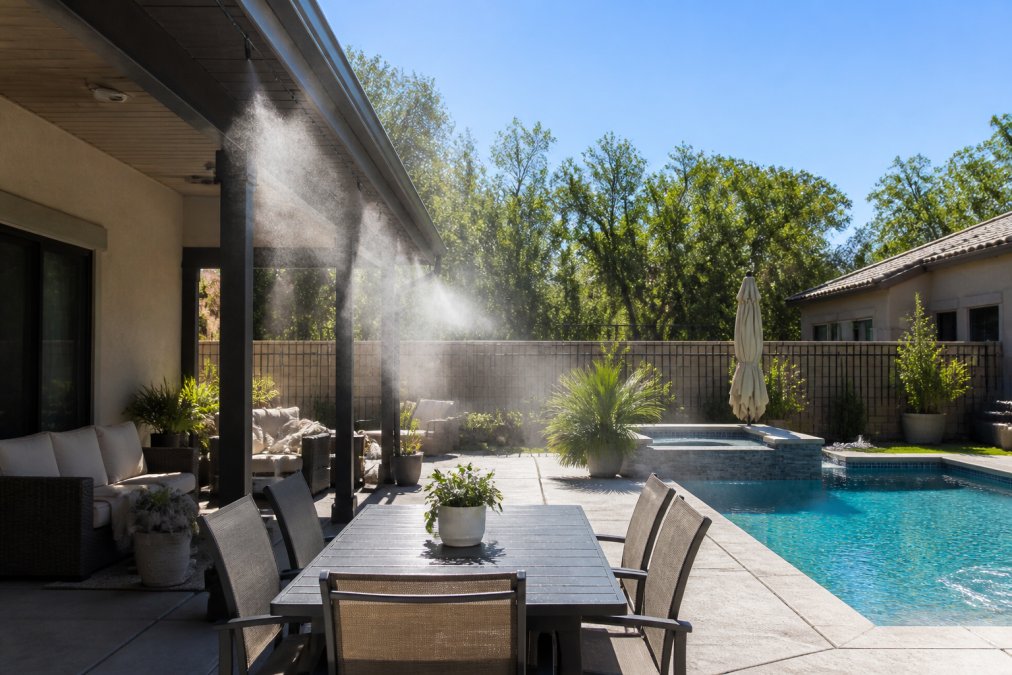
For families who live outdoors from spring through fall, this transforms the pool area into a usable living space during the hottest months and helps reduce heat stress for kids and pets. While the higher installation cost gives some owners pause, the dry, non-wetting mist and superior cooling justify the premium for most permanent installations.
How to Cool Down Hot Pool Water With a Misting System
Misting systems cool hot pool water indirectly by cooling the air and surfaces around the pool, slowing the rate at which the water absorbs heat. As fine water droplets evaporate, they absorb energy from the surrounding air, lowering the ambient temperature near the water surface.
But there is a pool-specific complication that most installation guides ignore: the mist that does not evaporate can alter your pool’s water chemistry and create slip hazards on surrounding hardscapes. Understanding these interactions is essential before you commit to a system.
The Water Chemistry Interaction
Misting systems use potable water from your hose or irrigation line, which is not chemically identical to your pool water. Municipal water supplies contain dissolved minerals, chlorine (or chloramine), and sometimes fluoride. When mist drifts over the pool surface, a portion of it lands in the water. Over a full summer of operation, this adds a measurable volume of untreated or minimally treated water to the pool.
The practical effect is dilution. Your pool’s cyanuric acid (stabilizer) level will drop faster than normal because you are adding unstabilized water. Most pool owners test stabilizer levels monthly; with a misting system running daily, test every two weeks. If the stabilizer level falls below 30 ppm, the chlorine will degrade rapidly in direct sunlight, leading to algae blooms (the CDC).
A second effect is mineral accumulation. If your municipal water has high calcium hardness, the mist that lands in the pool adds calcium. Over a season, this can push calcium hardness above 400 ppm, increasing the risk of scale formation on pool tile and inside the heater (the CDC). If you struggle with hard water, factor in periodic partial drain and refill cycles.
Slip Hazard Considerations for Pool Decks
A misting system that produces large droplets, typical of low-pressure units, can leave a fine film of water on travertine, concrete, or tile pool decks, reducing traction and creating a slip hazard. High-pressure systems that atomize water into a fog are less problematic because the droplets evaporate before they settle.
If your pool deck is made of polished stone or glazed tile, test the surface after running the system for 15 minutes. For surfaces that become slick, position misting lines so they direct the spray away from high-traffic walkways and toward the pool itself or open patio areas. Alternatively, install the system on a pergola or overhead structure so the mist falls vertically and evaporates before reaching the deck.
Positioning for Maximum Pool Cooling
For the most effective results, position misting lines along the perimeter of the patio or pergola so the mist drifts across the pool surface. The goal is to create a curtain of cool air between the pool and the house, which blocks radiant heat from the structure and shades the water surface.
A timer control or smart home integration lets you automate this schedule. Smart controllers like those from Rachio or Orbit can be programmed to start the system when the ambient temperature crosses a threshold, and some integrate with weather stations to shut off when humidity exceeds a set point.
If your pool water chemistry drifts out of balance during misting season, do not assume the misting system is the sole cause. Test your fill water’s pH, alkalinity, and calcium hardness before blaming the system. Many homeowners discover their municipal water supply changes seasonally, and the misting system simply accelerates the effect of what is already in the hose.
The Humidity Ceiling
This approach is most effective in arid climates; in humid regions, the evaporation rate slows and the cooling benefit drops considerably. If the afternoon relative humidity regularly exceeds 50% during your swimming season, a misting system will produce a wet, uncomfortable mist rather than a cooling fog. In that climate, the operating cost is better spent on a pool chiller or a larger shade sail. Check your local humidity data before installation.
Operating Costs, Water Usage, and Long-Term ROI
The ongoing cost of a misting system comes down to two consumables: water and electricity.
Calculating Cost-Per-Hour of Operation
To estimate your hourly operating cost, you need three numbers: the system’s flow rate in gallons per minute (GPM), the pump’s wattage, and your local utility rates. The average residential water rate in the United States is about $1.50 per 1,000 gallons, and the national average electricity price is roughly $0.17 per kilowatt-hour (kWh).
A typical high-pressure system uses a 1.5 HP pump drawing about 1,200 watts and delivers around 1.5 GPM through its nozzles. Running that system for one hour consumes 90 gallons of water and 1.2 kWh of electricity. At national average rates, that works out to approximately $0.14 for water and $0.20 for electricity, for a total of about $0.34 per hour. Running the system four hours a day for 90 days of peak summer adds roughly $122 to your seasonal utility bills.
A low-pressure system, by contrast, might use 3 GPM but draw only 300 watts because it relies on existing hose pressure. That same schedule consumes 180 gallons per hour, pushing the seasonal water cost to about $97, while electricity adds only about $18, for a total around $115. The difference between system types is not as large as most homeowners assume.
Water Utility Impact and the ‘Should I Install This’ Question
The real question is whether your local water rates and climate make the system a sensible investment. In the arid Southwest, adding 360 gallons per month for a high-pressure system is a rounding error. In regions with tiered water pricing or drought surcharges, that same usage could push you into a higher rate tier.
Long-Term ROI: Beyond the Utility Bill
The financial ROI of a misting system is rarely positive in dollar terms; the lifestyle ROI is where the value lives. A professionally installed high-pressure system with a 10-year expected lifespan costs $2,500 to $4,500 installed. At $0.34 per hour, running it 300 hours per season costs about $102 per year in utilities, or roughly $1,020 over 10 years. Compare that to a 5,000 BTU patio misting fan, which draws about 500 watts and costs roughly $0.09 per hour in electricity alone while delivering far less cooling coverage.
For homeowners who would otherwise run air conditioning in adjacent rooms or add shade structures, the comparison shifts. A single window AC unit drawing 1,200 watts and running 300 hours per season costs about $61 per year in electricity. The misting system’s $102 per year is competitive when you factor in that it cools a larger outdoor area. The honest conclusion is that a misting system is not a cost-saving device; it is a comfort upgrade with a predictable, modest operating budget.
Before installation, request a water audit from your utility provider. Many municipalities offer free audits that reveal your marginal water rate and whether you are already near a tier threshold. This single piece of information determines whether your system will cost $0.34 per hour or $0.90 per hour to operate.
Seasonal and Regional Variability
The operating cost also depends on how many hours you actually run the system. In a dry climate like Phoenix or Las Vegas, a misting system can run effectively from late May through September. In a transitional climate like Kansas City, the usable season might be only eight weeks.
If your region’s summer humidity regularly exceeds 60%, evaporative cooling slows dramatically, and the system will produce a wet mist that does not evaporate. In that case, the operating cost is pure waste.
Misting System Maintenance Tips to Protect Your Investment
A regular maintenance schedule protects the system components and preserves cooling performance. The most common issue is nozzle clogging caused by mineral deposits, especially in regions with hard water. Flush the lines and clean or replace nozzles at the start of each season.
Key maintenance tasks include checking the water filtration system and replacing filters as needed, inspecting tubing for UV damage or cracking, clearing clogged nozzles with a fine pin or cleaning solution, and draining and winterizing the system before freezing temperatures arrive. A system that receives basic seasonal care will outlast one that is ignored.
Conclusion: Is a Pool Misting System Worth the Cost?
A misting system is worth the cost for pool owners in dry, hot climates who want to extend the hours they can comfortably use their outdoor space. The installation cost is an investment in thermal comfort, and the ongoing water and power usage is modest when the system is properly sized and maintained. For owners who struggle with pool water that gets too warm in midsummer, a misting system pairs naturally with solar cooling strategies.
At Dixie Pool Solar Heating & Misting, we understand the full picture of pool comfort in Southern Utah. Our expertise spans solar thermal heating to extend your swimming season from March through November, along with professional integration and industry-leading Heliocol panels backed by a 12-year warranty. Get a free quote and let our team help you design a cooling and heating solution that keeps your pool enjoyable all year.
Frequently Asked Questions
How much does it cost to install a misting system?
The swimming pool misting system installation cost depends on several factors: system type (low, mid, or high-pressure), nozzle count, pump assembly, tubing material, and whether you choose professional installation or a DIY misting kit. High-pressure systems with stainless steel nozzles and a dedicated pump assembly cost more upfront than low-pressure options that connect to a garden hose. Labor for professional installation also varies based on your patio layout. For an accurate estimate tailored to your pool area, request a quote from a local installer.
Do misters waste a lot of water?
Misting systems use water efficiently for evaporative cooling, but consumption varies by system. High-pressure misting systems atomize water into ultra-fine droplets that evaporate quickly, using less water than low-pressure systems that produce larger, less efficient droplets. The evaporation rate depends on humidity levels and ambient temperature; in dry climates, the cooling effect is stronger and water evaporates faster. Adding a timer control or zoning allows you to run the system only when needed, helping manage water consumption and operating costs.
Do you need a pump for a misting system?
It depends on the system type. Low-pressure misting systems operate using standard household water pressure and do not require a separate pump. Mid-pressure and high-pressure misting systems need a dedicated pump assembly to achieve the psi rating required for fine mist atomization. A high-pressure system typically operates at 1000 psi or more, which produces a cooler, drier mist that evaporates fully rather than wetting the area. The pump assembly is a significant part of the total swimming pool misting system installation cost.
What is the difference between low-pressure and high-pressure misting systems?
Low-pressure misting systems run on standard household water pressure, typically around 40-60 psi, and produce larger water droplets that can leave surfaces damp. High-pressure misting systems use a pump assembly to pressurize water to 1000 psi or higher, creating an ultra-fine mist that evaporates quickly and cools the air more effectively. High-pressure systems with stainless steel nozzles are more durable and resist corrosion, but they cost more initially. Mid-pressure systems fall between the two, offering a balance of performance and price.
This article was written using GrandRanker


Leave a Reply