Table of Contents
- What You’ll Need Before You Cool Down Your Pool
- Best Time to Run Pool Pump for Cooling
- How to Use Pool Fountains to Cool Water
- Pool Water Cooling Systems: Permanent vs. Temporary
- Shade, Covers, and Evaporative Cooling Methods
- Climate-Specific Cooling Strategies for Hot, Dry Climates
- Water Chemistry and Conservation When Cooling Your Pool
- How to Cool Down a Hot Pool: Common Mistakes to Avoid
Last Updated: August 24, 2026
Pool water that feels like a warm bath is one of the most common complaints from homeowners during peak summer months. Learning how to cool down a hot pool is more straightforward than most guides suggest, but the right method depends on your climate, your equipment, and how much temperature drop you need. At Dixie Pool Solar Heating & Misting, we work with pool owners who face both ends of the temperature spectrum. Below, we’ll cover seven proven methods, from quick fixes you can try tonight to permanent cooling infrastructure worth the investment.
The core tension in pool cooling is this: the same thermal mass that makes a pool slow to heat up also makes it slow to cool down. Quick tricks help at the margins. Strategic equipment choices solve the problem for good.
What You’ll Need Before You Cool Down Your Pool
Before choosing a cooling method, assess what you’re dealing with. Pool water temperature is considered uncomfortable for most swimmers above 85°F, and problematic for water chemistry above 90°F. At elevated temperatures, chlorine dissipates faster, pH balance becomes harder to maintain, and algae growth accelerates.
Here’s what to check before you start:
- A reliable pool thermometer for accurate readings at the surface and depth
- Current water chemistry readings for pH, chlorine, and alkalinity
- Your pool pump schedule and runtime
- Ambient air temperature at night in your area
- Surface area of your pool
The single biggest mistake pool owners make is jumping straight to adding ice or cold water without understanding why their pool is overheating. A pool in full sun with no shade and a pump running midday will reheat faster than any cooling method can compensate. Fix the root cause first.
| Cooling Method | Best For | Effort Level | Permanent Fix? |
|---|---|---|---|
| Nighttime pump circulation | All pools | Low | No |
| Pool fountain or aerator | Most pools | Low-Medium | No |
| Shade sail or cover | Sun-exposed pools | Medium | Partial |
| Draining and partial refill | Overheated pools | Medium | No |
| Pool aerator attachment | Most pools | Low | No |
| Reverse-cycle heat pump | Any pool | High (install) | Yes |
| Pool chiller unit | Any pool | High (install) | Yes |
Best Time to Run Pool Pump for Cooling
Nighttime circulation is the single most underused cooling strategy available to pool owners. The best time to run your pool pump for cooling is between 9pm and 7am, when ambient air temperature drops and the pool surface can radiate heat into the cooler night air.
During daylight hours, running your pump circulates water actively absorbing solar radiation. At night, cooler air draws heat away from the water surface, and circulation ensures the entire pool benefits from that heat exchange rather than just the top few inches.
Practical steps for nighttime cooling circulation:
- Set your pump timer to run from approximately 9pm to 6am
- Confirm your filtration cycle still meets minimum requirements for your pool volume
- Run at medium speed overnight to maximize water turnover without spiking energy consumption
- Check water temperature first thing in the morning before sunrise for the clearest reading of overnight cooling progress
If your pool sits in strong afternoon sun, point your return jets slightly upward toward the surface during nighttime operation. This increases surface agitation and speeds up heat escape into cooler night air.
How to Use Pool Fountains to Cool Water
Pool fountains cool water through evaporative cooling. When water is sprayed into the air, it breaks into fine droplets that lose heat rapidly before falling back into the pool.
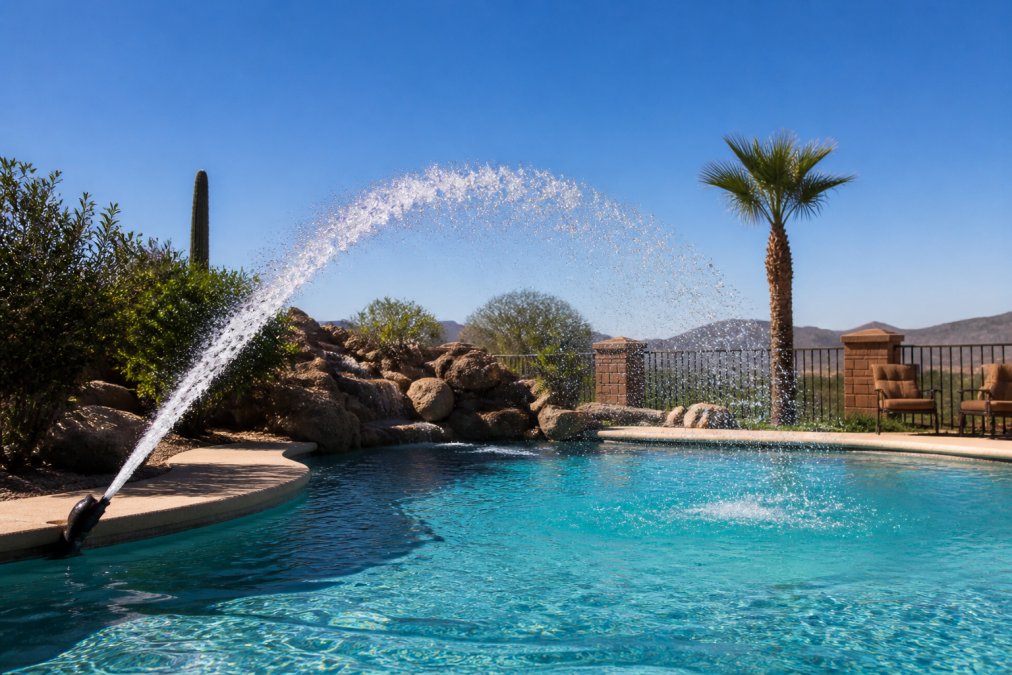
The key to using pool fountains effectively is maximizing the time water spends airborne. A fountain that throws water high and wide covers more surface area during the fall, which means more evaporative cooling per gallon circulated. Most floating fountain attachments connect directly to your existing return jets and require no additional plumbing.
For best results:
- Run fountains during evening hours when ambient air temperature begins to drop
- Position the fountain near the center of the pool to distribute cooled water evenly
- Check your water level every few days; evaporative cooling reduces water level
- Test pH balance and chlorine levels more frequently when running fountains, as increased evaporation affects water chemistry concentration
Many pool owners see a temperature drop of several degrees overnight when combining fountain operation with nighttime pump circulation.
Waterfall Features and Return Jets
Waterfall features work on the same principle as fountains but with a different aesthetic and often a higher flow rate. A waterfall that spills water down a surface before entering the pool creates significant air exposure and splashing, both accelerating heat transfer.
Return jets can also be angled to create surface agitation without additional equipment. Pointing return jets upward so they break the water surface creates a low-level aerating effect. According to the U.S. Department of Energy’s guidance on pool energy efficiency, increasing water circulation and surface agitation are among the most cost-effective ways to manage pool water temperature.
Pool Water Cooling Systems: Permanent vs. Temporary
Temporary methods such as fountains, nighttime circulation, and partial draining can drop pool water temperature by a few degrees. Permanent pool water cooling systems can maintain a target temperature regardless of ambient conditions. The right choice depends on how consistently hot your pool gets and how much temperature control matters to you.
Pool Aerators
A pool aerator is a device that attaches to a return jet and sprays water into the air in a controlled pattern before it re-enters the pool. Pool aerators are inexpensive, require no professional installation, and can be removed when cooling is no longer needed.
Pool aerators work best when overnight air temperatures drop significantly below pool water temperature, humidity levels are low, and the pool runs during evening and nighttime hours. In dry climates, a pool aerator running overnight can produce meaningful temperature drops. In humid climates, the evaporative cooling effect is reduced because the air is already saturated with moisture.
Running a pool aerator in high-humidity conditions for extended periods can raise your water level and dilute your water chemistry. Check pH balance and chlorine levels after each 48-hour aerator run.
Reverse-Cycle Heat Pumps and Pool Chillers
Reverse-cycle heat pumps and dedicated pool chillers are the permanent solution for pools that consistently overheat. A pool chiller is a refrigeration unit that pulls heat out of pool water and expels it into the surrounding air, working in reverse of how a pool heater operates.
Reverse-cycle heat pumps can function in both heating and cooling modes, making them a year-round thermal regulation tool. In cooling mode, the heat pump extracts thermal energy from the pool water and transfers it to the ambient air.
Key considerations for pool chillers and reverse-cycle heat pumps:
- Pool plumbing compatibility, the unit must be integrated into your existing filtration loop, typically requiring a licensed plumber
- Electrical load, these units draw significant power; confirm your electrical panel can support the additional load
- Sizing, a unit that’s too small will run constantly without reaching target temperature
- Placement, the unit needs adequate airflow around it to expel heat efficiently
As noted in the U.S. Department of Energy’s pool heater guide, heat pump efficiency depends heavily on ambient air temperature, so placement in a well-ventilated area is critical.
DIY vs. Professional Installation
Pool aerators and fountain attachments are genuine DIY territory. They attach to existing return jets with no plumbing modifications and can be installed in under an hour.
Reverse-cycle heat pumps and pool chillers require integration into your pool plumbing, electrical work that must meet local code, and correct refrigerant handling, which is regulated under EPA Section 608 regulations on refrigerant handling. A misplumbed chiller can damage your filtration system. A correctly installed one runs for years with minimal maintenance.
Shade, Covers, and Evaporative Cooling Methods
Preventing heat gain is more efficient than removing heat after the fact. A pool that absorbs eight hours of direct solar radiation will always be harder to cool than one that’s been partially shaded.
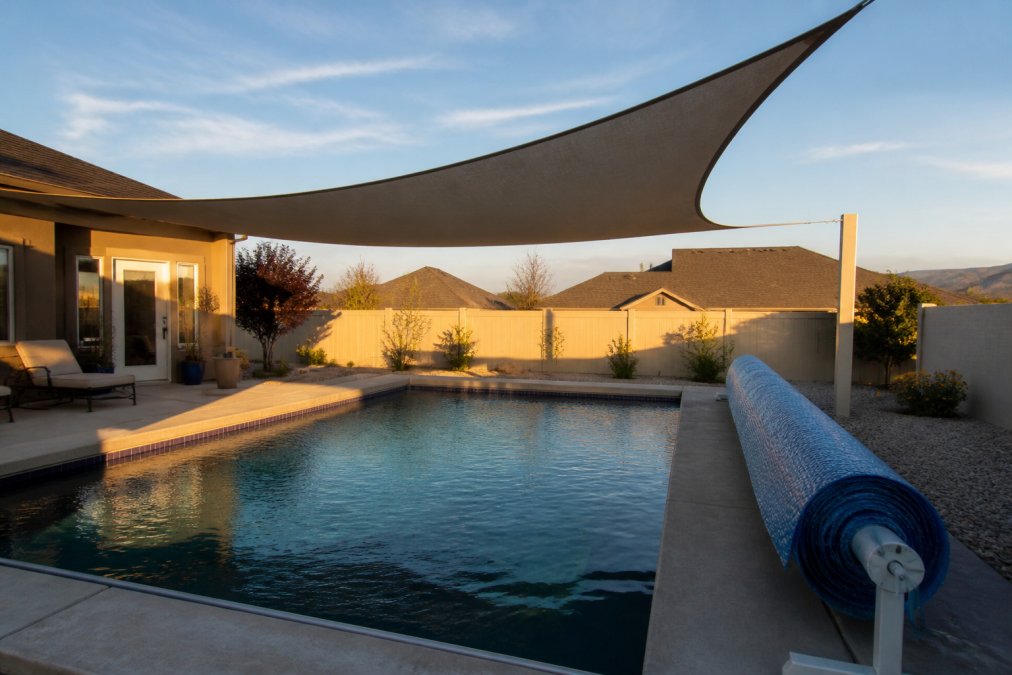
Shade sails are the most practical shading solution for most residential pools. They’re tensioned fabric panels anchored to posts or existing structures and can block a significant portion of direct solar radiation. Position them to shade the pool during peak solar hours of 10am to 4pm.
Pool covers serve a dual purpose. At night, a pool cover traps heat and prevents evaporative cooling. During the day, a light-colored or reflective pool cover reflects solar radiation and slows heat gain. The practical approach: remove the cover in the evening to allow overnight cooling, and replace it in the morning before peak sun hours.
Shading your pool during peak solar hours is the highest-use passive cooling method available. It reduces the thermal load your active cooling systems need to handle, making everything else more effective.
Climate-Specific Cooling Strategies for Hot, Dry Climates
Hot, dry climates present specific conditions that favor several cooling methods. Low humidity levels mean evaporative cooling works at maximum efficiency. The evaporation rate from a pool surface in dry air is significantly higher than in humid coastal climates, making pool aerators and fountains produce more temperature reduction per hour of operation.
Climate-specific strategies for hot, dry conditions:
- Prioritize evaporative methods, aerators and fountains perform best when relative humidity is below 30%. In desert climates, overnight humidity often drops to this range or lower.
- Account for high solar radiation, pools in high-altitude desert environments receive more intense UV and solar radiation. Shade sails need to be sized for sun angles that differ from lower-latitude locations.
- Watch your water level, high evaporation rates mean your pool water level drops faster. Check it weekly and top up as needed.
- Adjust chemical maintenance frequency, as water evaporates and you add fresh water, your pH balance and mineral concentration shift. Test more frequently during peak summer months.
- Consider thermal mass timing, in climates with extreme daytime heat but cool nights, a pool kept shaded during the day and aerated overnight can maintain comfortable temperature even when daytime air temperatures are extreme.
Water Chemistry and Conservation When Cooling Your Pool
Cooling your pool affects water chemistry in ways that catch many owners off guard. Higher water temperature accelerates chlorine dissipation, so as you bring the temperature down, your chlorine demand actually decreases. The transition period while the pool is cooling requires closer monitoring than steady-state operation.
Water conservation is a legitimate concern when using evaporative cooling methods. A pool aerator running for several hours per night will increase evaporation beyond the normal rate. Partial draining and refilling uses a significant volume of water.
Practical water conservation steps:
- Use a pool cover during daylight hours to reduce solar-driven evaporation when you’re not actively cooling
- Run aerators and fountains during the coolest part of the night, when evaporation is more efficient per degree of cooling
- When topping up water levels, do so in the morning before peak heat to reduce re-evaporation
- Track your water usage over a season to understand the actual consumption impact of your chosen cooling method
A partial drain and refill, replacing 20-30% of pool volume with cooler tap water, can drop pool temperature quickly and dilute accumulated minerals, which can improve water chemistry in older pool water.
How to Cool Down a Hot Pool: Common Mistakes to Avoid
Most guides focus on what to do. Here’s what not to do, because these mistakes either waste effort or create new problems.
Running the pump at peak solar hours for cooling. Midday pump operation circulates water actively absorbing heat and increases energy consumption without cooling the pool. Save circulation for nighttime.
Adding large amounts of ice. Ice melts quickly in a large pool volume and produces negligible temperature change.
Ignoring water chemistry during cooling. The transition period while your pool cools is when chemistry is most volatile. Skipping tests leads to algae blooms or chlorine lock.
Over-shading without planning for airflow. A shade sail that completely encloses the pool area can reduce the air circulation that nighttime cooling depends on. Shade the water surface from above, but keep the sides open for air movement.
Choosing a pool chiller that’s undersized. A chiller that can’t handle your pool’s heat load will run constantly without reaching your target temperature. Sizing matters more than upfront cost.
Neglecting the pool cover schedule. Using a pool cover only at night defeats its purpose. The cover’s job during cooling season is to block daytime solar gain, not trap overnight heat.
The right combination of these methods, applied consistently, can bring an overheated pool to a comfortable swimming temperature and keep it there. If your pool consistently overheats despite these measures, that’s a signal to look at permanent cooling infrastructure rather than continuing to fight the problem with temporary fixes.
Managing pool water temperature is an ongoing challenge for homeowners in high-heat climates, and temporary fixes only go so far. Dixie Pool Solar Heating & Misting helps pool owners find the right thermal management solution for their specific conditions, whether that means integrating a cooling system with an existing solar heating setup or advising on the most efficient combination of passive and active methods. Our Heliocol solar systems are designed to work year-round, and our team understands both sides of the temperature equation. Get a free quote from Dixie Pool Solar Heating & Misting and find out what a properly integrated pool thermal system looks like for your setup.
Frequently Asked Questions
Does running the pool pump at night help cool the water?
Yes. Running your pool pump between 9 PM and 7 AM moves warm surface water through the filtration system while ambient air temperatures drop. This nighttime circulation exposes more water to cooler air, gradually lowering water temperature by several degrees overnight. Pairing nighttime pump operation with a pool aerator or fountain attachment accelerates this effect by increasing the surface area exposed to the cooler night air and boosting evaporative cooling.
What is the most affordable way to cool down a pool?
The cheapest option is shifting your pool pump to run at night and adding a basic aerator attachment to an existing return jet, both cost very little. Shade sails reduce heat gain during peak sun hours. Ice is a popular idea but impractical: a standard pool holds 20,000 gallons or more, so the volume of ice needed to drop the water temperature even a few degrees makes it neither cost-effective nor a lasting solution.
Can I put ice in my pool to cool it down?
Technically yes, but it rarely works in practice. Dropping the water temperature in a 20,000-gallon pool by even 5°F requires an enormous quantity of ice, far more than is practical or affordable. The ice melts quickly, the thermal mass of the water absorbs it, and water temperature returns to baseline within hours. For a hot, sunny climate, address the source of heat gain instead: add shade, run the pump at night, and install a fountain or aerator for consistent evaporative cooling.
How do I keep my pool cool in 100-degree weather?
Combine several methods for the best result. Run the pool pump overnight to take advantage of lower ambient air temperatures. Add a fountain or aerator to increase evaporative cooling while the pump runs. Install a shade sail or pergola to block direct sun from hitting the water surface during peak hours. For a permanent solution in consistently hot climates, a reverse-cycle heat pump or pool chiller gives precise thermal regulation regardless of outdoor conditions.
This article was written using GrandRanker


Leave a Reply