
Table of Contents
- How Solar Pool Heaters Work and Why That Matters for the Planet
- The Environmental Impact of Traditional Pool Heaters
- How Solar Pool Heating Reduces Your Carbon Footprint
- Cost of Solar Pool Heating vs Gas: The Financial and Environmental Case
- Extending Swimming Season with Solar While Cutting Energy Waste
- Lifecycle Analysis: Materials, Recycling, and Long-Term Sustainability
- Smart Home Integration, Water Conservation, and Local Ecosystem Benefits
- Frequently Asked Questions
Last Updated: September 27, 2026
How Solar Pool Heaters Work and Why That Matters for the Planet
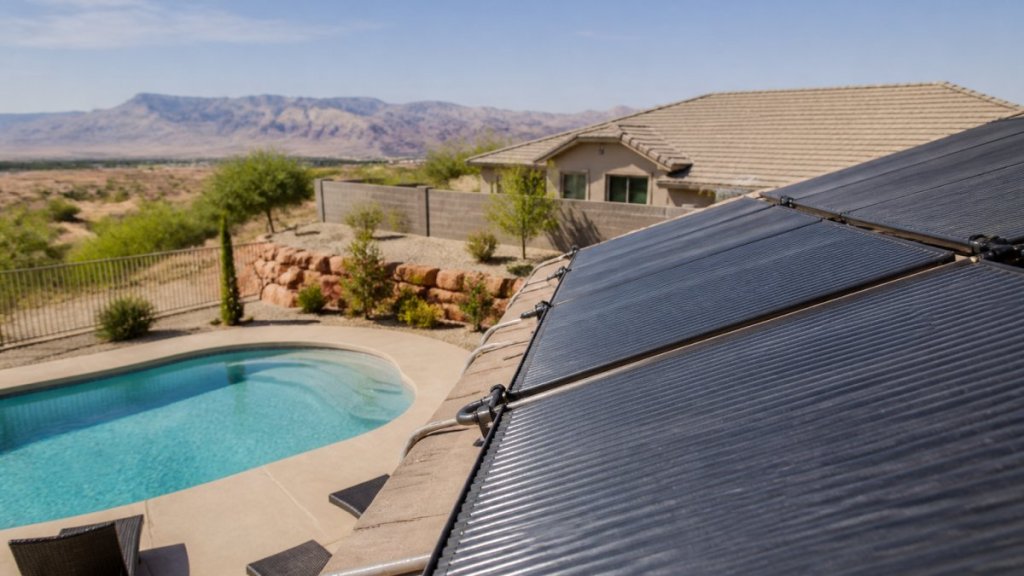
Solar pool heating is a system that circulates pool water through dark-colored collectors, where the sun’s thermal energy raises the water temperature before it returns to the pool. According to the U.S. Department of Energy’s solar heating overview, these systems can heat water to comfortable swimming temperatures without burning a single unit of fossil fuel.
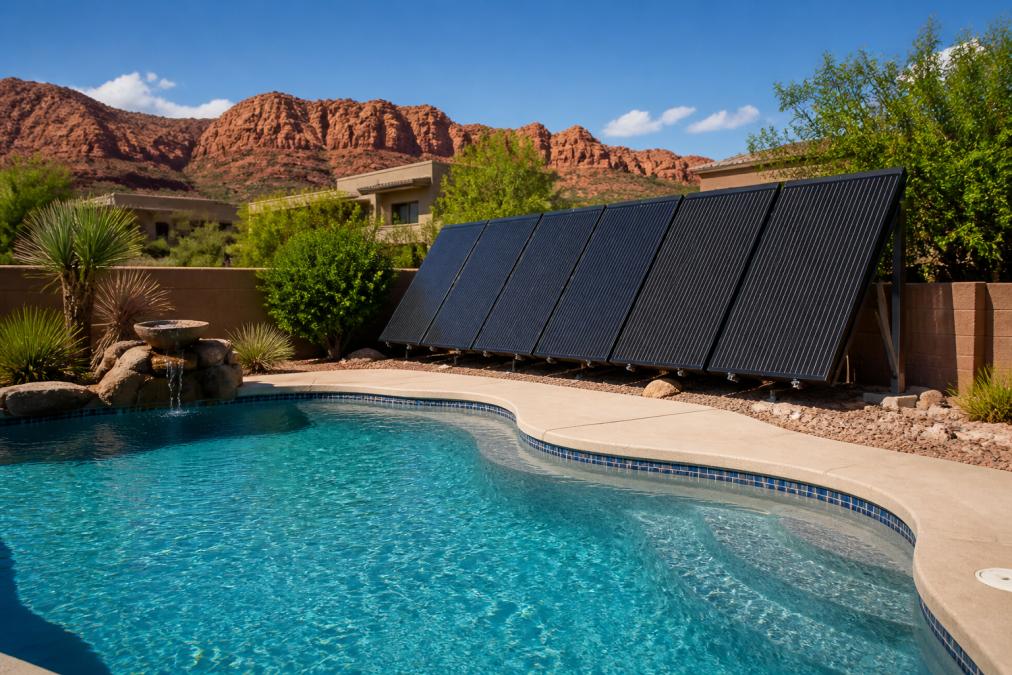
Solar Thermal vs. Photovoltaic: Two Different Technologies
Solar thermal systems capture heat directly, while photovoltaic systems generate electricity that must then be converted to heat. For pool heating, thermal wins on efficiency by a wide margin: a thermal collector converts most sunlight into usable heat, while a PV panel converts a smaller share into electricity that a heat pump then converts to heat at a fraction of the original energy.
The Environmental Impact of Traditional Pool Heaters
Gas and electric pool heaters carry a significant environmental burden. A natural gas heater burns fuel continuously while running, releasing carbon dioxide and nitrogen oxides directly into the air. Electric resistance heaters draw from the grid, where much of the power still comes from fossil fuel plants. According to the U.S. Environmental Protection Agency’s overview of greenhouse gas emissions, residential energy use is a meaningful contributor to national emissions.
Fossil Fuel Consumption and Greenhouse Gas Emissions
A gas pool heater consumes fuel every time it fires, adding up to substantial fossil fuel consumption and carbon footprint over a season. Electric heaters shift emissions upstream to power plants but don’t eliminate them.
How Solar Pool Heating Reduces Your Carbon Footprint
Solar pool heating reduces your carbon footprint by eliminating the fuel combustion traditional heaters require. A solar thermal system produces no direct emissions and draws no grid electricity to generate heat.
Energy Independence and Reduced Utility Demand
A solar pool heater also reduces demand on the electrical grid. During peak summer months, utilities fire up less efficient plants to meet strained capacity; heating your pool with sunlight lowers your draw exactly when the grid is most stressed.
Cost of Solar Pool Heating vs Gas: The Financial and Environmental Case
The cost comparison between solar and gas pool heating favors solar over time because solar has no ongoing fuel cost. A gas heater has a lower upfront price but charges monthly for fuel; a solar thermal system costs more initially, then operates fuel-free, so the environmental and financial benefits arrive together.
| Factor | Solar Thermal | Gas Heater |
|---|---|---|
| Upfront cost | Higher | Lower |
| Monthly operating cost | None | Ongoing fuel charges |
| Emissions during use | None | Continuous |
| Lifespan | 20+ years | Shorter |
| Maintenance | Minimal | Regular service |
A common mistake is comparing only the upfront price. Ask for a 10-year total cost of ownership instead: fuel, service, and replacement included. Solar usually wins that comparison by a wide margin.
Extending Swimming Season with Solar While Cutting Energy Waste
Extending your swimming season with solar works because the collectors keep producing heat whenever the sun is out, even in cooler months. A gas heater wastes energy reheating water that cools overnight; a solar system runs continuously during daylight, maintaining temperature with no fuel burn.
Lifecycle Analysis: Materials, Recycling, and Long-Term Sustainability
Most articles on solar pool heating stop at operating emissions, the easy half of the story. A defensible environmental case must also account for what happens before the panels touch your roof or rack, and after they come down. That full picture is where the honest math favors solar.
What Goes Into a Solar Thermal Collector
A typical unglazed solar pool collector is not a photovoltaic panel. It is a mat or panel of UV-stabilized thermoplastic, commonly polypropylene or a polyethylene blend, with an absorber surface and internal flow channels: no silicon wafer, no rare-earth dopant, no glass encapsulation, no silver paste. Its manufacturing energy and material intensity is a fraction of a PV module’s.
Manufacturing, Transport, and Embodied Carbon
Every manufactured product carries embodied carbon, emissions from extracting, forming, and shipping raw material. For solar thermal collectors that burden is real but modest, amortized over a service life most manufacturers rate at 20 years or more. The key comparison is not “solar vs. zero” but “solar’s one-time embodied carbon vs. a gas heater’s continuous combustion carbon.”
End of Life: What Actually Happens to the Panels
Thermoplastic collectors are, in principle, recyclable, the material can be reground and reprocessed, unlike a PV module’s complex laminate stack. In practice, recycling depends on local infrastructure and on separating panels from mounting hardware and plumbing first.
The realistic end-of-life paths are:
- Recycling where a facility accepts thermoplastics, which recovers the bulk of the panel mass.
- Repurposing for lower-demand applications, since a collector that underperforms for a pool may still work for a smaller body of water.
- Landfill as the fallback where no recycling stream exists, the least desirable outcome, but one that occurs once per 20+ years rather than continuously.
Why the Long Service Life Is the Whole Argument
A 20-year panel life is not a marketing line, it makes the lifecycle math work. If a collector lasted five years, embodied carbon per year of operation would be four times higher and the case would weaken. Because the panels outlast the heater they replace, per-year manufacturing cost shrinks toward negligible.
A full lifecycle view changes the question from “does solar emit anything?” to “how does one-time embodied carbon compare to 20 years of continuous combustion?” On that comparison, solar thermal wins, and the answer depends on service life, not on marketing claims.
Smart Home Integration, Water Conservation, and Local Ecosystem Benefits
This is where solar pool heating stops being a single appliance and becomes part of a household energy system. Competitors treat pool heating in isolation. The stronger environmental case treats it as one node in a broader net-zero setup, and adds two benefits most articles never mention: water savings and reduced chemical load.
Smart Home Integration and Net-Zero Home Ecosystems
Modern solar thermal systems can report collector output, pool temperature, and pump runtime to a smart home hub. That data changes how the system runs: when the pool is at target temperature and the sun is low, the controller idles the pump instead of circulating water that won’t gain heat. Fewer pump hours means less electricity for the circulation loop, the hidden energy cost of any pool system.
Water Conservation: The Evaporation Mechanism
Warmer water evaporates faster than cool water, that part is intuitive. Less obvious is the role of a solar cover or blanket, standard with most solar thermal installations, which traps heat and cuts evaporative loss by blocking the air-water interface.
Why this matters environmentally:
- Less refilling. Every gallon of evaporation is a gallon you replace from the municipal supply or a well.
- Less treatment. Replacement water has to be balanced, which means more chemicals and more pump runtime.
- Less heating energy. Cold replacement water drags pool temperature down, forcing the heater to work harder.
Chemical Load and Runoff
A warmer, more stable pool that loses less water needs fewer chemical adjustments, less chlorine, acid, and stabilizer, and less backwash water carrying them to the storm drain or yard. That directly reduces the chemical runoff reaching local waterways.
Local Ecosystem Impact: Thermal and Chemical Pollution
The ecosystem argument has two parts:
- Thermal pollution. Discharging warm, chemically treated pool water into a storm drain or creek raises the temperature of that water body. Even a few degrees can stress native fish and aquatic insects that are adapted to a narrow temperature range. Reducing backwash volume and frequency lowers that thermal load.
- Chemical runoff. Chlorine, algaecides, and pH adjusters that reach storm drains do not go through a treatment plant in most systems, they go straight to the nearest waterway. Lower chemical use means lower runoff.
The net effect: a solar-heated pool with a cover is not just cleaner to operate, it is gentler on the watershed it sits in, a local, measurable benefit a gas heater cannot claim.
| Benefit | Mechanism | Environmental Impact |
|---|---|---|
| Smart control | Controller idles pump when no heat gain is available | Lower circulation electricity use |
| Cover + warm water | Blocks evaporation at the air-water interface | Less refilling and treatment |
| Stable chemistry | Fewer adjustments needed | Less chemical runoff |
| Reduced backwash | Less warm, treated water discharged | Lower thermal pollution in local waterways |
If you want to maximize the environmental return, pair the solar array with a cover and a smart controller. The panels cut fuel emissions; the cover cuts water loss; the controller cuts pump runtime. Each one multiplies the benefit of the others.
Frequently Asked Questions
How does solar pool heating reduce carbon emissions?
Solar pool heating uses the sun’s thermal energy to warm your pool water instead of burning natural gas or drawing electricity from the grid. Because no fuel is combusted during operation, there are zero direct greenhouse gas emissions. Traditional gas heaters release carbon dioxide every time they run, while solar collectors simply absorb heat from sunlight and transfer it to your pool water. Over a full season, that difference adds up to a meaningful reduction in your household’s carbon footprint.
Is solar pool heating more eco-friendly than gas or electric heaters?
Yes. Gas heaters burn fossil fuels and produce greenhouse gas emissions with every cycle. Electric heat pumps still rely on grid electricity, which in many areas comes partly from coal or natural gas. Solar pool heating runs on renewable energy with no operating emissions at all. It also reduces demand on utility infrastructure and supports energy independence. For homeowners focused on environmental stewardship, solar thermal is the cleanest option available for pool heating.
Does a solar pool heater require electricity to operate?
A solar pool heating system uses a small amount of electricity to run the circulation pump, which you likely already operate for your pool’s filtration system. The heating itself requires no electricity, no gas, and no refrigerant. That is a key difference from heat pumps, which consume electricity every hour they run. Because the sun does the heating, your system’s energy consumption stays minimal compared to any fossil fuel or electric alternative.
What is the lifespan of a solar pool heating system, and are the panels recyclable?
Quality solar pool panels, like Heliocol, last 20 or more years with little to no maintenance. That long lifespan means fewer replacements and less material waste over time. At end of life, many solar panels are recyclable. The materials used in solar thermal collectors, including plastics and metals, can often be recovered and reprocessed. Choosing a durable system with a long warranty reduces the environmental cost of manufacturing and disposal.


Leave a Reply