Table of Contents
- How Solar Pool Heating Systems Fail (and Why It’s Usually Fixable)
- Troubleshooting Water Circulation and Flow Problems
- Sensor, Controller, and Pump Scheduling Malfunctions
- Roof Hardware, PVC Piping, and Panel Damage
- Your Solar Pool Heater Troubleshooting Guide for Salt Pools
- How to Choose Durable Solar Panels for Salt Pools
- Repair or Replace? Cost, Climate, and Smart Automation
- Preventing Solar Pool Heating Problems Before They Start
- Frequently Asked Questions
Last Updated: September 26, 2026
How Solar Pool Heating Systems Fail (and Why It’s Usually Fixable)
Most solar pool heating problems trace back to fixable issues: air in the lines, stuck valves, bad sensors, or worn roof hardware. This guide from Dixie Pool Solar Heating & Misting shows how to diagnose each fast.
Solar pool heating is simple: water moves through black roof panels, the sun warms it, and it flows back to your pool. Fewer moving parts means fewer breakdowns, but simple systems still have weak spots.
The good news: almost every failure is repairable.
Troubleshooting Water Circulation and Flow Problems
Water circulation problems are the most common complaint, and they show up as a pool that won’t heat. If water can’t move through the panels, the sun has nothing to warm.
Start with the basics:
- Check that the pump is running at full speed
- Confirm the filter isn’t clogged
- Look for a closed valve on the return line
- Listen for gurgling, which signals trapped air
Air Locks and Bubbles in the System
An air lock is trapped air blocking water flow through the panels. You’ll hear gurgling, see bubbles from the return jets, and notice the system never warms.
Valve Misalignment and Bypass Issues
A diverter valve stuck or turned the wrong way sends water around the panels instead of through them, system bypass, the quietest way a solar heater fails.
Sensor, Controller, and Pump Scheduling Malfunctions
Sensor and controller problems make a working system act broken. The panels heat fine, but the controller never tells the pump to send water up.
Watch for these signs:
- The pump runs at night but not during the day
- The display shows a temperature that doesn’t match the pool
- The system never switches to heating mode
Test your thermistor by comparing its reading to a handheld thermometer in the pool. A difference of more than a few degrees means it’s time to replace the sensor.
Roof Hardware, PVC Piping, and Panel Damage
PVC Pipe Melting and Warping
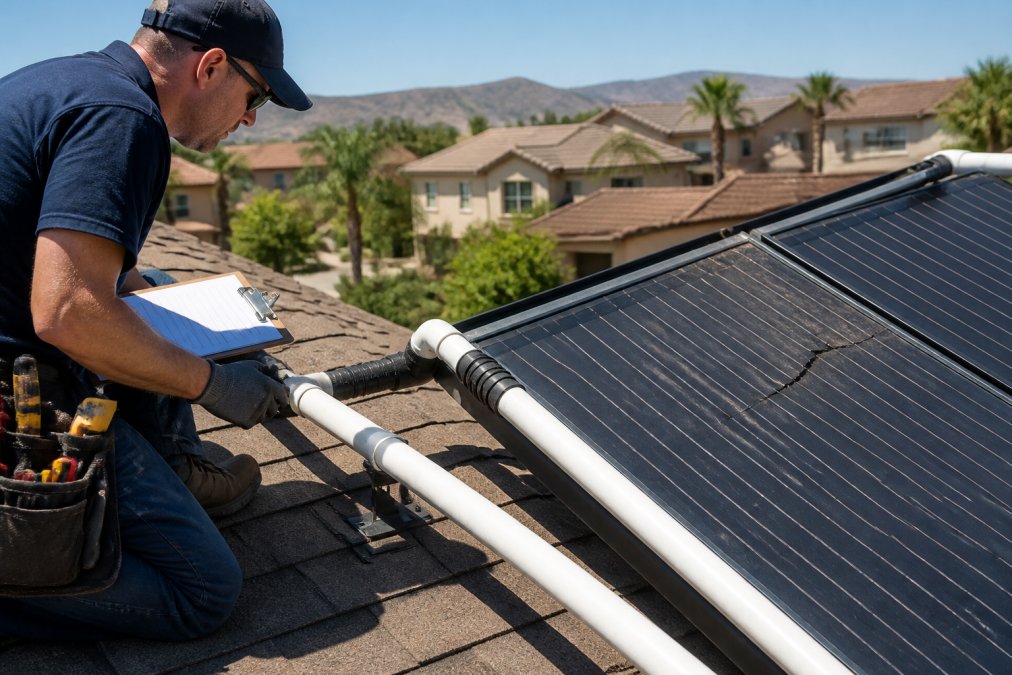
PVC pipe melting and warping happens when panels run dry. Schedule 40 PVC softens around 140°F, and a dry collector can exceed that within an hour on a clear summer afternoon. Once warped, it leaks at the weakest solvent-weld joint, often one you can’t see from the ladder.
Manifold Leaks and Pressure Loss
Manifold leaks come next. The manifold feeds water into each panel and carries full system pressure at the loop’s hottest point. A crack sprays water across the roof, drops system pressure, and starves downstream panels, so the controller reads a warm roof but the pool never heats. Look for wet shingles, mineral staining, or an unsteady pressure gauge.
UV Degradation and Thermal Expansion
UV degradation breaks down solar glazing and plastic fittings. After years in the sun, brittle parts crack under thermal expansion stress, the daily heat-and-cool cycle flexing every joint. A fitting often survives summer fine, then fails on the first cold fall morning when plastic is most brittle.
Panel Delamination
Panel delamination is the serious one: when collector layers separate, that panel stops absorbing heat and becomes dead weight. It usually means replacement, not repair, since the absorber can’t be re-bonded in the field.
The DIY-vs-Professional Risk Assessment
Before you climb up, run this assessment:
- Roof pitch and height. A single-story, low-slope roof is a different risk category than a two-story, steep-pitch one. Falls are the leading cause of serious injury in home maintenance, and panels are slick even when dry.
- Panel weight and fragility. Collectors are heavy and glazing cracks under a person’s weight, never walk on them.
- Electrical proximity. If controller, actuator, or pump wiring runs near the roof line, a misstep can put you into a live circuit.
- Water and ladders. A leaking manifold means wet roofing and a wet ladder footing.
If any of those four flags apply, it’s a professional job, not because the fix is hard, but because the access is dangerous. A stuck valve you can reach from the ground is DIY; a cracked manifold on a steep roof is not.
Never walk on solar panels to inspect them. The glazing cracks under a person’s weight, and a cracked panel leaks for the rest of its life. Use a ladder and inspect from the edge. If you can’t see the manifold from a stable position, that’s your signal to call a pro.
Mounting Hardware and Wind Load
Roof mounting hardware fails two ways: corrosion and loosening. Straps and clamps not rated for your climate rust through or work loose under wind loading and thermal cycling. Inspect attachment points each spring, a loose mount can lift roofing material and create a leak path unrelated to your plumbing.
Your Solar Pool Heater Troubleshooting Guide for Salt Pools
Salt pools add one more failure mode: corrosion. Salt water is harder on metal fittings and accelerates wear on any part not rated for it.
- Inspect metal clamps and screws for rust
- Look for white crust on fittings, a sign of corrosion
- Confirm the check valve is salt-rated
- Flush the panels if salt buildup is heavy
How to Choose Durable Solar Panels for Salt Pools
Durable solar panels for salt pools share three traits: corrosion-resistant headers, UV-stable glazing, and strong mounting hardware. Skip one and you’ll be repairing panels within a few seasons.
Here’s what to look for:
| Feature | Why It Matters | What to Avoid |
|---|---|---|
| Corrosion-resistant header | Resists salt-water breakdown | Bare metal fittings |
| UV-stable glazing | Survives years of sun exposure | Thin, brittle plastic |
| Reinforced mounting | Handles wind and thermal expansion | Weak clamps and straps |
| Long warranty | Signals real durability | Short or vague coverage |
Repair or Replace? Cost, Climate, and Smart Automation
The repair-or-replace call needs a framework, not a checklist. Here’s the framework.
The Three-Question Test
- How many components are failing? One sensor, valve, or actuator is a repair. Multiple delaminated panels, a brittle PVC run, and a failing controller together is a replacement.
- How old is the system? Quality collectors are rated for 20+ years, but PVC, fittings, valves, and sensors have shorter service lives. If panels are past their midpoint and the plumbing is original, you’re repairing a system that will keep asking for money.
- What does your climate do to it? This is the question competitors ignore.
Climate-Specific Failure Modes
High-UV and desert climates. Intense sun and wide day-night temperature swings accelerate UV degradation and thermal expansion fatigue. Panels may fail at the glazing and fittings before the absorber wears out, PVC embrittles faster, and dry-run events do more damage at higher ambient temperatures.
The Cost-Benefit Math
A single sensor or valve replacement is minor and always worth doing. A cracked manifold or one delaminated panel is usually still worth repairing, since the rest of the array is unaffected.
Smart Automation as a Repair Extender
Modern smart pool automation shifts the balance toward repair. New controllers tie your solar system into an app, adjust the pool pump schedule automatically, and track system pressure in real time. If your old controller is the weak link, drifting sensors, no remote monitoring, no freeze protection, upgrading adds years to otherwise healthy panels.
Repair when the problem is one part and the rest of the system has years left. Replace when multiple components are failing, the system is past its midpoint, or your climate has already claimed the plumbing. Smart controllers are the cheapest way to extend the life of a system you already own, and the best insurance against the dry-run and freeze failures that end systems early.
Preventing Solar Pool Heating Problems Before They Start
Preventative maintenance is the difference between a system that runs 20 years and one that fails in five. It takes less than an hour a season.
Build this routine:
- Check pool water level weekly
- Clean the filter monthly
- Inspect roof fittings each spring
- Test sensors before swim season
- Look for leaks after heavy storms
- Drain and winterize before the first freeze
- Confirm valve positions at season start
Frequently Asked Questions
Is it normal to see air bubbles in the pool when the solar heater is on?
A few bubbles right after the system kicks on are normal. They usually come from priming the pump or from air that entered the panels overnight. If bubbles keep streaming out for more than a minute or two, you likely have an air lock or a small leak on the suction side. Check the pump basket lid, the diverter valve o-rings, and any visible pipe joints for cracks or loose fittings.
What maintenance is required to prevent solar pool heater problems?
Keep the pool pump schedule long enough to move the full water volume through the panels each day. Clean the pump basket and skimmer regularly so flow stays high. Inspect roof mounting hardware and PVC piping once or twice a year for UV degradation or loose straps. Check the temperature differential controller and thermistor sensor readings against a handheld thermometer. Cover the pool at night to cut evaporative heat loss and reduce how hard the system has to work.
How long does a solar pool heater typically last?
Most quality solar collector panels last 20 or more years when they are properly installed and the pool water chemistry stays balanced. The panels themselves usually outlast the pumps, valves, and controllers connected to them. Salt pools need a bit more attention because saltwater is harder on metal fittings and some glazing materials. Choosing panels rated for salt systems, like Heliocol, and keeping up with basic maintenance extends the lifespan considerably.
How do I know if my solar pool heating system is losing efficiency?
Compare the temperature difference between the water going into the panels and the water coming back out. A healthy system on a sunny day should show a noticeable gain, often 3 to 5 degrees Fahrenheit or more. If that gap shrinks, check for air locks, a dirty pump basket, a failing thermistor sensor, or panel delamination. A flow meter can confirm whether water is actually moving through the system at the expected rate.


Leave a comment