Table of Contents
- Why Salt Pools Demand Specifically Designed Solar Panels
- Polypropylene vs Rubber Solar Pool Panels for Salt Water
- Saltwater Pool Solar Heating Compatibility: What to Check Before You Buy
- How Solar Pool Heaters Work and Why They Suit Salt Pools
- Energy Efficiency, Cost Savings, and Long-Term ROI for Salt Pool Owners
- Solar Pool Heater Maintenance Tips for Saltwater Systems
- Conclusion
Last Updated: August 21, 2026
Salt corrodes everything it touches, given enough time. For pool owners running a saltwater system, that reality shapes every equipment decision, including which solar panels are worth installing. At Dixie Pool Solar Heating & Misting, we work with salt pool owners regularly, and the question we hear most often is simple: will solar heating actually hold up against saltwater conditions? The short answer is yes, but only if you choose panels designed for the environment.
Durable solar panels for salt pools are not the same as standard solar pool heaters. The materials, fittings, and mounting hardware all face accelerated degradation when salt air and saltwater chemistry enter the picture. Below, we’ll walk through exactly what makes a panel salt-compatible, which materials win that contest, and how to evaluate your full system before you buy.
Why Salt Pools Demand Specifically Designed Solar Panels
Solar panels for salt pools must contend with chemical and electrochemical forces that standard freshwater systems never encounter. A conventional pool runs chlorine at 1-3 parts per million (PPM). A saltwater pool generates chlorine through a salt chlorinator that converts dissolved salt, typically maintained at 2,700-3,400 PPM, into active chlorine. That salt concentration travels through every pipe, fitting, and panel your circulation system touches.
How Salt Concentration Accelerates Corrosion
Salt is an electrolyte that accelerates oxidation on metal surfaces. Any solar panel component made from copper, aluminum, or standard steel will corrode when exposed to saltwater chemistry. Fittings discolor, connections weaken, and flow rate gradually drops as mineral deposits narrow internal channels. By the time visible damage appears, underlying degradation has often been underway for months.
Polymer-based panels avoid this problem entirely because they contain no reactive metals in their flow paths. Water contacts only plastic, polypropylene or similar chemically inert materials, which salt cannot oxidize.
Galvanic Corrosion and Electrolysis: The Hidden Threat
Galvanic corrosion occurs when two dissimilar metals are electrically connected in the presence of an electrolyte, exactly the conditions a saltwater pool creates. If your solar panel headers, fittings, or mounting hardware contain different metals in contact with each other, and saltwater completes the electrical circuit, you get accelerated corrosion on the less noble metal.
Electrolysis compounds this problem. Saltwater pools generate low-level electrical currents as a natural byproduct of the chlorination process. Those stray currents can attack metal components throughout your plumbing system, including any metallic connections in your solar heating loop. The fix is to ensure your solar panel system uses compatible, non-reactive materials throughout, and to verify that bonding and grounding are correctly installed per National Electrical Code pool bonding requirements standards.
Mixing metal types in your solar heating loop, for example, copper fittings connected to aluminum headers, creates a galvanic cell the moment saltwater flows through. This can destroy fittings within a single season. Specify all-polymer or compatible single-metal systems when buying.
Polypropylene vs Rubber Solar Pool Panels for Salt Water
The two dominant materials in residential solar pool heating are polypropylene (often called HDPE in higher-density formulations) and EPDM rubber. Both are polymer-based, so neither corrodes traditionally. But their behavior in saltwater environments, under UV exposure, and over a multi-decade lifespan differs significantly.
HDPE and Polypropylene: Built for Long-Term Exposure
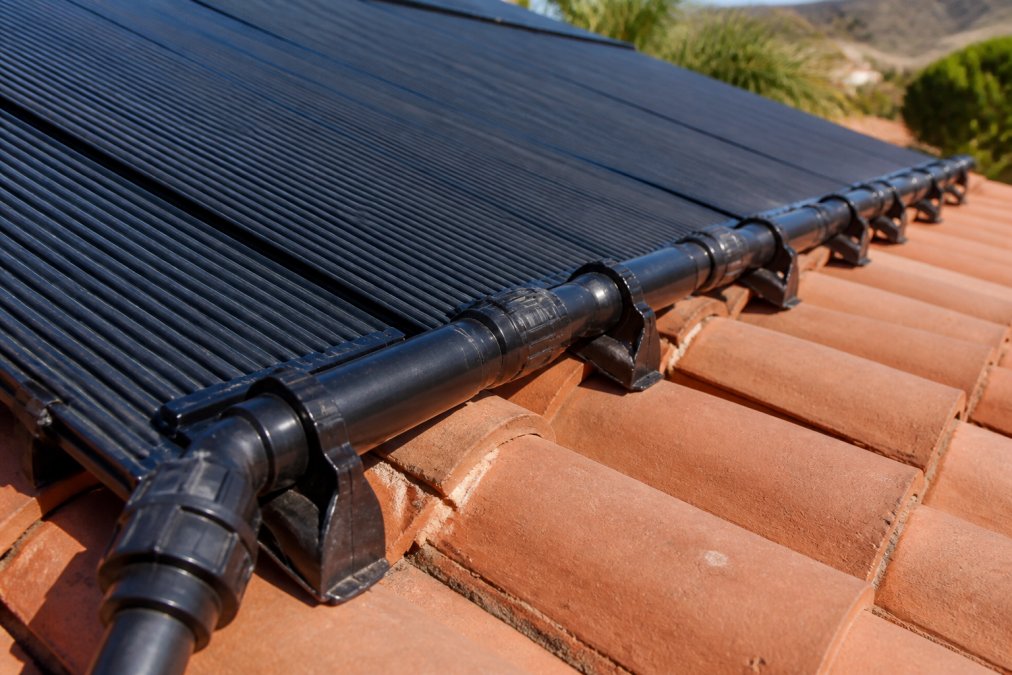
Polypropylene is a thermoplastic polymer with inherent resistance to chemical degradation, UV radiation (when UV stabilizers are compounded into the material), and salt exposure. High-density polyethylene (HDPE) shares these properties and is used in panels designed for demanding outdoor environments.
The structural advantage of polypropylene panels is consistency. Each flow tube maintains its diameter and wall thickness across decades of thermal cycling, the repeated expansion and contraction that happens every time the sun heats the panel and cool pool water flows through it. This dimensional stability preserves flow rate and heat transfer efficiency over the panel’s lifespan.
According to U.S. Department of Energy guidance on solar pool heating systems, the expected lifespan of a well-manufactured solar pool heater is 10-20 years depending on climate and maintenance. Polypropylene panels at the quality end of the market routinely reach the upper end of that range in high-UV climates.
For saltwater pool owners, polypropylene’s chemical inertness is the decisive advantage. Salt at 3,000 PPM does nothing to the polymer matrix, nor does the slightly elevated chlorine output a salt chlorinator produces during shock cycles.
Rubber Panels: Where They Fall Short in Saltwater Environments
EPDM rubber panels are effective in mild climates and freshwater pools. They’re flexible, making installation easier on irregular roof surfaces, and they handle freeze-thaw cycles well. The problem in saltwater environments is long-term UV degradation combined with chemical exposure.
In high-UV climates, exactly where solar heating makes the most sense, rubber panels develop micro-cracking on the surface over time. As the surface degrades, it becomes more porous, increasing exposure to salt air and saltwater chemistry. Panel longevity drops, and replacement cycles shorten.
The practical result: rubber panels may need replacement in 10-12 years in high-UV, high-salt environments, while quality polypropylene panels in the same conditions regularly exceed 20 years of service life.
| Feature | Polypropylene/HDPE Panels | EPDM Rubber Panels |
|---|---|---|
| Salt resistance | Excellent, chemically inert | Good, no oxidation, some surface degradation |
| UV durability | Excellent with UV stabilizers | Moderate, micro-cracking over time |
| Expected lifespan | 20+ years in high-UV climates | 10-15 years in high-UV climates |
| Thermal efficiency | High, consistent tube geometry | Moderate, flexibility can affect flow |
| Best for salt pools | Yes | With caveats in high-UV regions |
| Freeze-thaw performance | Good | Excellent |
Saltwater Pool Solar Heating Compatibility: What to Check Before You Buy
Saltwater pool solar heating compatibility is not just about the panel material. The full system, pump, controller, fittings, and mounting hardware, must all be evaluated before installation. A polypropylene panel connected to incompatible metallic fittings still creates a galvanic corrosion risk.
Chlorine Generator Output and Panel Flow Rate
Your chlorine generator (salt cell) operates within a specific flow rate range. Most residential units require between 15 and 40 gallons per minute to function correctly and avoid triggering low-flow shutoff. When you add a solar heating loop, you’re adding head pressure, the resistance the pump must overcome to move water through the additional circuit.
If your existing pump cannot maintain adequate flow rate through both the filter system and the solar panels simultaneously, you’ll face reduced heating efficiency and potential chlorine generator faults. Check the panel manufacturer’s recommended flow rate per panel and calculate the total flow requirement for your array size. Then verify your pump’s performance curve at the head pressure your system will actually see.
A brushless DC (BLDC) motor pump offers variable speed control, which lets you optimize flow rate for solar heating without running at full power continuously. Variable speed pumps also reduce operating costs compared to single-speed motors.
Pump and Mounting Hardware Compatibility
Mounting hardware deserves scrutiny. Standard roof mounting kits often include galvanized steel or aluminum components. In coastal or high-salt-air environments, galvanized steel corrodes within a few years. Aluminum fares better but still reacts galvanically if it contacts other metals in the presence of moisture.
Specify stainless steel (316 grade for saltwater environments) or UV-stabilized polymer mounting hardware. Verify that all pipe clamps, straps, and fasteners are compatible with your roof material and rated for outdoor exposure.
How Solar Pool Heaters Work and Why They Suit Salt Pools
Solar pool heating is a thermal transfer system, not a photovoltaic one. Pool water is pumped from the pool through the existing filtration system, then diverted through the solar panels mounted on the roof or ground. The panels absorb solar radiation and transfer that heat directly to the water flowing through them. Heated water returns to the pool.
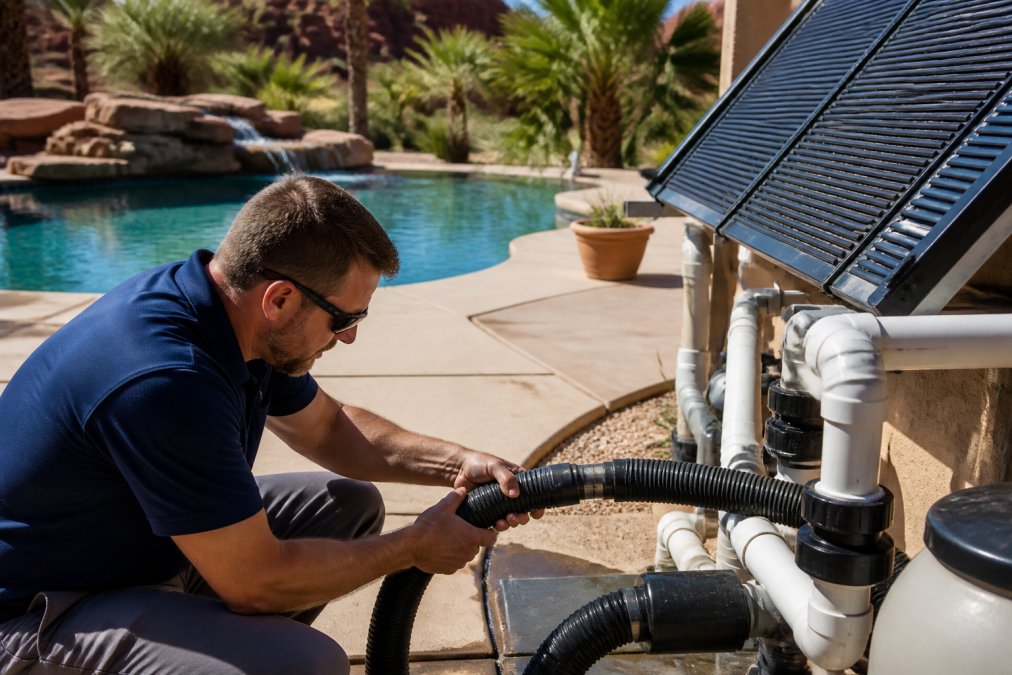
For saltwater pools, this direct-flow design is an advantage. Pool water flows directly through the panels with no intermediate heat exchanger surfaces to corrode and no secondary fluid loops to maintain. As long as the panels themselves are chemically compatible with saltwater, the system is inherently salt-tolerant.
A properly sized system can raise pool temperature by 8-12°F above ambient water temperature on a clear day, extending the usable swimming season substantially.
Energy Efficiency, Cost Savings, and Long-Term ROI for Salt Pool Owners
The efficiency argument for solar pool heating is straightforward: the fuel is free. Once installed, the only ongoing energy cost is the electricity consumed by the pump to circulate water.
Salt pool owners face an additional operating cost that freshwater pool owners don’t: salt cell replacement every 3-7 years. Keeping pool water temperature stable and within the recommended range (78-82°F) reduces stress on the salt cell and extends its service life. A solar heating system that maintains consistent water temperature contributes to that stability.
For a long-term ROI framework, consider these variables:
- Upfront installation cost: Varies by system size and roof configuration. Request a site-specific quote.
- Annual heating cost avoided: Replacing a gas heater with solar eliminates gas operating costs entirely.
- Tax incentives: The Utah State Tax Credit covers 25% of the system cost up to $2,000. The Enbridge Gas rebate adds $750 for qualifying installations.
- Panel lifespan: A panel warranted for 12 years and designed to last 20+ years means the payback period is followed by years of essentially free heating.
As documented in ENERGY STAR guidance on residential renewable heating, solar thermal systems for pool heating consistently rank among the most cost-effective renewable energy applications for residential properties.
The long-term ROI for solar pool heating in high-sun climates is compelling because the operating cost after installation is near zero. The calculation strengthens when you factor in available tax credits and the extended panel lifespan of quality polypropylene systems.
Solar Pool Heater Maintenance Tips for Saltwater Systems
Solar pool heater maintenance for saltwater systems is less demanding than most pool owners expect. The absence of combustion, refrigerant, or complex electrical components means fewer failure points than gas or heat pump systems.
Annual inspection checklist for salt pool solar systems:
- Inspect all panel connections and fittings for mineral deposits or early-stage corrosion
- Check flow rate through the solar loop and compare to baseline measurements
- Examine mounting hardware for rust, loosening, or UV degradation
- Verify that the automatic controller is accurately reading pool and panel temperatures
- Flush the panel array at the start of each season to clear debris
- Test salt concentration and pH before reopening the solar loop
- Inspect roof penetrations and seals around mounting hardware for water intrusion
The most common maintenance issue in saltwater solar systems is calcium scaling inside panel tubes. Hard water combined with elevated salt concentration can deposit calcium carbonate on internal surfaces, reducing flow rate and heat transfer. An annual flush with a mild citric acid solution (following manufacturer guidelines) addresses this before it becomes a significant efficiency problem.
According to Pool and Hot Tub Alliance guidance on solar pool heating maintenance, most solar pool heating systems require only annual inspection and occasional filter cleaning to maintain peak performance, a maintenance burden far lower than gas heaters or heat pumps.
For panels installed in areas with significant salt air exposure, inspect mounting hardware more frequently, every six months for the first two years, to establish a baseline for how quickly your specific installation environment affects hardware condition.
At the start of each season, run the solar loop for 30 minutes before checking flow rate. Panels that have been idle can have air pockets that give false low-flow readings until the system fully primes. A true low-flow reading after priming indicates a real problem worth investigating.
The panel surface itself requires minimal attention. Quality polypropylene panels shed debris with rain and do not require chemical cleaning. Avoid pressure washing at close range, which can stress fittings. A low-pressure rinse is sufficient if panels accumulate dust or pollen between seasons.
Salt pool owners who want to extend their swimming season without adding gas costs or complex mechanical systems have a clear path forward: polypropylene solar panels, compatible mounting hardware, and a pump sized for the combined flow demands of filtration and solar circulation. Dixie Pool Solar Heating & Misting installs Heliocol panels, industrial-grade polypropylene units backed by an industry-leading 12-year warranty and designed for 20+ years of service life, with professional integration into your existing pool system. The result is a heating system that works with your saltwater chemistry rather than against it. Get a Free Quote from Dixie Pool Solar Heating & Misting and find out what a properly specified solar heating system will do for your pool season.
Frequently Asked Questions
What type of solar panel is most durable for saltwater pools?
Polypropylene and HDPE panels are the most durable choice for saltwater pools. These materials resist the corrosion that salt water and UV exposure cause over time. Heliocol panels, for example, are manufactured from UV-stabilized polypropylene and carry a 12-year warranty, with an expected lifespan exceeding 20 years. Avoid standard rubber panels in salt environments, as they degrade faster under repeated exposure to salt-laden water and direct sunlight.
Do saltwater systems damage standard solar pool panels?
Standard solar pool panels made from rubber or lower-grade plastics can degrade faster in saltwater environments. Salt water at typical pool concentrations of 2,700-3,400 PPM accelerates oxidation in metal fittings and breaks down rubber compounds over time. Panels designed specifically for saltwater pool solar heating compatibility, using polypropylene or HDPE construction with corrosion-resistant hardware, avoid these failure modes and maintain thermal efficiency throughout their service life.
How long do solar pool panels last on a salt pool?
High-quality polypropylene solar panels installed on a salt pool typically last 20 or more years when properly maintained. The key factors are material quality, UV stabilization, and whether the mounting hardware and fittings are rated for salt exposure. Heliocol panels come with an industry-leading 12-year warranty and are engineered for long-term durability, meaning most homeowners will not face significant replacement costs within their panel's operational life.
Are there tax credits or rebates available for solar pool heating?
Yes. Homeowners may qualify for the Utah State 25% solar tax credit, up to $2,000, when installing a qualifying solar thermal heating system. An Enbridge Gas rebate of $750 is also available for eligible installations. Qualification depends on your specific system, installation details, and tax situation, so confirm eligibility with your installer and a tax professional before purchase. A free quote from your installer can clarify which incentives apply to your project.
What maintenance do solar pool heaters need in a saltwater system?
Solar pool heaters on saltwater systems require minimal maintenance compared to gas heaters. Key solar pool heater maintenance tips include flushing panels at the start and end of each season, checking fittings and mounting hardware annually for early signs of corrosion, and keeping pool chemistry balanced, especially salt PPM and pH levels, to reduce stress on panel materials. Panels should also be rinsed periodically if located near high-salt-air environments. Most polypropylene systems need no more than one annual inspection.
This article was written using GrandRanker


Leave a Reply