Table of Contents
- Why Saltwater Pools Corrode Heaters Faster Than You Think
- Choosing the Right Pool Heater for a Saltwater Pool
- Water Chemistry: The First Line of Defense Against Salt Corrosion
- How to Protect a Pool Heater from Salt Air in Coastal Environments
- Pool Heater Maintenance Schedule: A Step-by-Step Plan
- Installation, Ventilation, and Plumbing Details That Prevent Corrosion
- Warning Signs of Heater Damage and What They Mean for Pool Heater Lifespan
- Conclusion
- Frequently Asked Questions
Last Updated: October 8, 2026
Why Saltwater Pools Corrode Heaters Faster Than You Think
Salt corrosion is the breakdown of metal parts caused by salt in your pool water, and it hits pool heaters harder than almost any other equipment. Your heater holds hot metal, moving water, and dissolved salt together all season.
Salt also makes water a better conductor, so stray currents move through metal parts more easily, galvanic corrosion that eats heat exchangers from the inside. Add a salt chlorinator, and chemical byproducts attack the same metal.
Below is a step-by-step plan to prevent salt corrosion on pool heaters.
The most common mistake is assuming a “saltwater pool” means the water is like the ocean. It is not. A salt pool holds roughly one-tenth the salt of seawater, but even that small amount is enough to corrode a heater that is not protected.
Choosing the Right Pool Heater for a Saltwater Pool
The best pool heater for a saltwater pool uses a corrosion-resistant heat exchanger, because that is the part touching your water. If it fails, the heater is done. When you shop, ask what the heat exchanger is made of.
Heat Exchanger Materials: Cupro-Nickel vs. Titanium vs. Aluminum
Here is how the three common materials compare:
| Material | Saltwater Performance | Best For | Main Drawback |
|---|---|---|---|
| Cupro-nickel | Good resistance | Most saltwater pools | Costs more than aluminum |
| Titanium | Best resistance | High-salt or coastal pools | Highest upfront cost |
| Aluminum | Poor resistance | Freshwater pools only | Corrodes fast with salt |
Cupro-nickel handles typical salt levels well and costs less than titanium. Titanium is the top pick for coastal homes where salt air adds to the load. Aluminum has no place in a saltwater system, it corrodes and fails early.
Check the warranty language before you buy. Some makers void heater coverage when a salt chlorinator is installed upstream. A heater rated for saltwater keeps its coverage; a freshwater-only unit may not.
Water Chemistry: The First Line of Defense Against Salt Corrosion
Balanced water is your cheapest corrosion protection and the one variable you control every week. When pH, alkalinity, calcium hardness, and salt level stay in range, water is far less aggressive toward metal.
Low pH is the quiet killer. Water below roughly 7.2 attacks the copper and nickel in a heat exchanger directly, thinning metal from the water side; the first symptom is often a pinhole leak. High pH scales the exchanger, and scale traps salt and chlorine against the metal, creating a localized corrosion cell.
Target Ranges and Testing Frequency
Aim for these ranges and test on this schedule:
- pH: 7.4 to 7.6, test twice a week, and again after any heavy rain or large water addition
- Total alkalinity: 80 to 120 ppm, test weekly; this is what buffers pH and keeps it from swinging
- Calcium hardness: 200 to 400 ppm, test monthly; too low and water pulls calcium from metal, too high and it scales
- Salt level: follow your chlorinator maker’s range, typically 2,700 to 3,400 ppm, test monthly, and after backwashing or draining
- Cyanuric acid (stabilizer): 30 to 50 ppm, test monthly; high stabilizer locks chlorine and forces you to run the cell harder
- Free chlorine: 1 to 3 ppm, test twice a week
Test more often in summer, after heavy rain, and after adding fresh water. The CDC guidance on healthy pool water confirms that pH and disinfectant levels are the two factors that matter most for safe, stable water.
The Saturation Index: The Number Most Owners Never Check
pH and alkalinity alone do not tell you whether water is corrosive or scaling. The Langelier Saturation Index (LSI) combines pH, temperature, calcium hardness, total alkalinity, and total dissolved solids into one number.
- Below -0.3: water is aggressive and will pull metal and plaster into solution, this is the condition that eats heat exchangers
- Above +0.3: water is scale-forming, which insulates the exchanger and traps corrosives underneath the deposit
Salt pools run slightly higher total dissolved solids than freshwater pools, which nudges the index, one reason a salt system needs its own targets rather than a generic freshwater chart. Many test kits calculate LSI for you; if yours does not, ask for it.
Do not chase a single number. Raising calcium hardness to fix aggressive water while pH is already high can push you into scaling territory. Adjust one variable at a time and retest before changing another.
Why Salt Cells Change the Chemistry Math
A salt chlorinator generates chlorine in the cell, then the chlorine reverts back to salt. That closed loop keeps salt level stable, but the cell constantly produces small amounts of sodium hydroxide, which drives pH upward.
Chlorinator placement matters too. If the cell sits downstream of the heater with no check valve, the highly chlorinated, high-pH water it produces can backflow into the exchanger when the pump shuts off.
Keep a simple log of pH, alkalinity, calcium, salt, and LSI each time you test. Patterns, like pH creeping up every week, show up in a written record long before they show up as a leak.
How to Protect a Pool Heater from Salt Air in Coastal Environments
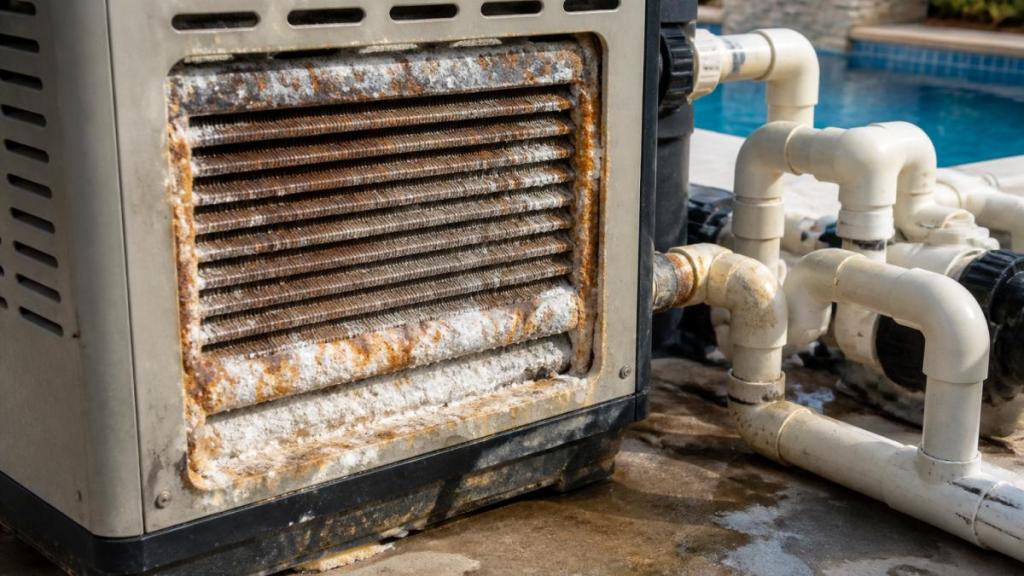
Salt air is a second, separate threat. Even a heater with a titanium exchanger can corrode outside when ocean air coats its shell, wiring, and connections in salt. The fix is a routine, not a product: rinse the unit, keep the area ventilated, and inspect for the white, crusty film that holds moisture against metal and starts rust.
- Rinse the outer cabinet monthly
- Check electrical connections for green or white buildup
- Keep plants and fencing from trapping damp air
- Touch up any scratched paint or coating right away
Coastal homes face both water-side and air-side corrosion, so they need both defenses working at once.
Pool Heater Maintenance Schedule: A Step-by-Step Plan
What You’ll Need
- Garden hose with a gentle spray nozzle
- Pool water test kit
- Soft brush
- Silicone-based protective spray
Step 1: Test and balance the water [Time: 10 minutes]
Check pH, alkalinity, and salt. Adjust before anything else.
Step 3: Inspect metal parts [Time: 10 minutes]
Check the heat exchanger housing, fittings, and wiring for rust or white film.
Step 5: Log it [Time: 2 minutes]
Note the date and any changes. Patterns show up fast in a written record.
Expected Result: Clean metal, stable chemistry, and no new corrosion spots.
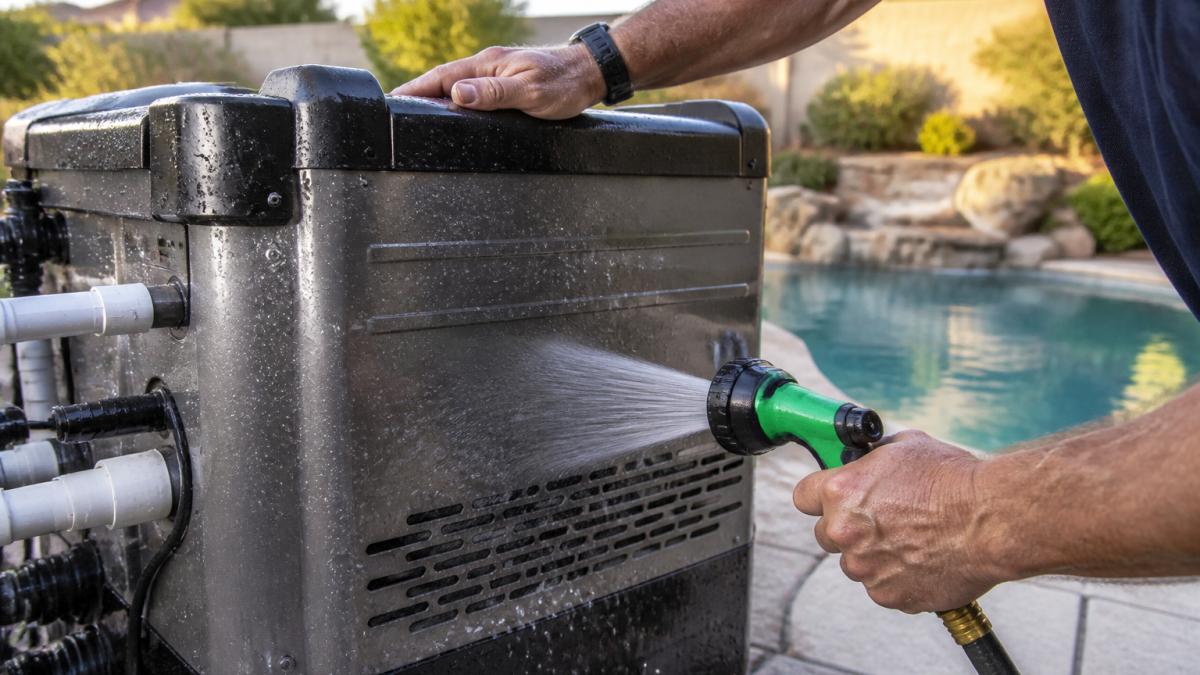
Safe Freshwater Rinsing Instructions
Rinsing sounds easy, but the wrong method causes damage:
- Shut off power to the heater at the breaker first.
- Let the unit cool completely.
- Use low pressure. A hard spray can force water into electrical parts.
- Rinse top to bottom so salt runs off, not into crevices.
- Never spray directly into the vent openings or control panel.
- Dry the cabinet with a soft cloth when you finish.
Do this monthly, and after any storm that carries salt spray inland.
Installation, Ventilation, and Plumbing Details That Prevent Corrosion
Good installation prevents corrosion no amount of cleaning can undo. Three details matter most: placement, airflow, and plumbing order.
Keep the heater in the open, not boxed in by walls or shrubs. Trapped moisture and exhaust speed up rust.
On the plumbing side, install a check valve between the heater and the salt chlorinator.
Proper electrical bonding and grounding also matter. The National Electrical Code requirements cover bonding and grounding for pool equipment, and a licensed electrician should handle this work.
Warning Signs of Heater Damage and What They Mean for Pool Heater Lifespan
Catching corrosion early can add years to a pool heater‘s life; one that is ignored often fails within a season or two. The harder question is not whether the heater is damaged but which corrosion process is doing it, because the fix differs for each.
Three Corrosion Types That Look Alike
Most heater failures trace back to one of three mechanisms. They produce similar symptoms, but the root cause and response differ.
1. Saltwater (chloride) corrosion. Chloride ions attack the passive oxide layer on stainless steel and copper alloys.
2. Low-pH (acidic) damage. Water below roughly 7.2 dissolves metal uniformly rather than pitting it, causing generalized thinning and a bluish-green stain on the exchanger or in the water, sometimes with a metallic taste.
**3. The fix is electrical, proper bonding and grounding per the National Electrical Code requirements, not a new heater.
A Quick Diagnostic Table
| What You See | Likely Cause | First Response |
|---|---|---|
| Deep pinholes, white/green crust | Chloride (salt) corrosion | Test salt level and LSI; verify exchanger material |
| Uniform thinning, blue-green stain | Low pH | Test pH immediately; correct alkalinity and pH |
| Corrosion at a joint between metals | Galvanic corrosion | Have a licensed electrician check bonding and grounding |
| Scale on exchanger, corrosion underneath | High pH / high calcium | Lower pH and calcium; descale per manufacturer |
| Rust streaks under cabinet, no water leak | External salt-air corrosion | Rinse cabinet; inspect coating and fasteners |
Warning Signs to Watch For
- White or green crust on fittings or the cabinet
- Rust streaks under the heater
- Pinhole leaks or water pooling near the unit
- Rattling or reduced heat output
- Rising salt use to hold chlorine levels
- Bluish-green staining in the pool or on the exchanger
- A metallic taste in the water near the return
If you see any of these, test your water first, pH, alkalinity, calcium, salt, and LSI, then call a technician. A corroded heat exchanger can leak water into the burner or electrical area, a safety issue, not just a repair bill.
When to Call a Qualified Pool Technician
Some problems are DIY; others are not. Call a licensed technician if you see:
- Water actively leaking from the heater cabinet
- A gas smell or any sign of burner damage
- Corrosion at an electrical connection or bonding point
- A heat exchanger that has already been replaced once
- Warranty-relevant damage, most manufacturers require professional diagnosis before honoring a claim
A technician can pressure-test the exchanger, verify bonding continuity, and confirm whether damage is water-side, air-side, or electrical. That diagnosis determines whether you repair, replace the exchanger, or replace the heater, the step most owners skip before spending money.
The single most important habit is testing pH and salt level on a set schedule. Most heater damage we see traces back to chemistry that drifted out of range for weeks without anyone noticing, and the second most common cause is a bonding or check-valve issue that a five-minute inspection would have caught.
Conclusion
Salt pools are worth it, but they demand a heater that can take the salt and an owner who stays ahead of corrosion.
If you would rather not think about any of it, that is where we come in. Dixie Pool Solar Heating & Misting installs Heliocol panels backed by an industry-best 12-year warranty and a 2-year labor warranty, with little to no maintenance after setup.
Get a free quote from Dixie Pool Solar Heating & Misting and protect your pool equipment while you cut your heating costs.
Frequently Asked Questions
Can saltwater corrode a pool heater?
Yes. Saltwater pools expose heaters to constant chloride, and over time that exposure eats into metal components, especially the heat exchanger. Corrosion speeds up when water chemistry drifts, when the salt level runs too high, or when a heater sits downstream of the salt chlorinator without a check valve. Choosing a heater with a cupro-nickel or titanium exchanger and keeping water balanced slows the damage considerably.
How often should you inspect a pool heater for corrosion?
Inspect the heater monthly during swim season and after any heavy chemical addition. Check the heat exchanger, plumbing connections, and cabinet for rust, scale, or white crust. Test water chemistry weekly and adjust pH, alkalinity, and salt level as needed. If you live in a coastal area, rinse the exterior with fresh water every week or two to remove salt air residue before it bonds to metal.
What is the average lifespan of a pool heater?
Most pool heaters last 8 to 12 years, but a saltwater pool can shorten that to 5 to 8 years if corrosion goes unchecked. Heaters with cupro-nickel or titanium exchangers tend to last longer in salt systems. Consistent pool heater maintenance, balanced water chemistry, and freshwater rinsing all extend the pool heater lifespan and delay the cost of replacement.
Does a salt chlorine generator damage pool equipment?
A salt chlorinator itself does not damage equipment, but the salt it uses can corrode metal parts when water chemistry is off or when salt levels run high. Install a check valve between the chlorinator and the heater to stop backflow, keep salt at the manufacturer’s recommended level, and rinse metal components with fresh water. These steps protect pool equipment without giving up the convenience of a salt system.


Leave a Reply