Last Updated: November 13, 2026
Quick Summary
Titanium is the most corrosion resistant pool heater exchanger material, making it the best choice for salt systems and coastal homes. Cupro-nickel is the practical middle ground for saltwater-rated gas heaters, while standard copper is the least forgiving in salt or aggressive water. A corrosion resistant pool heater still depends on balanced water chemistry to reach its lifespan.
- Titanium conducts heat less efficiently than copper, so designs compensate with more surface area.
- Most gas heater manufacturers specify a pH range of roughly 7.2 to 7.8 for metal longevity.
- Salt systems typically run 2,700 to 3,400 ppm, and cupro-nickel is not rated for unlimited salt levels.
- The National Electrical Code, Article 680, requires bonding of pool equipment including the heater.
- Dixie installs Heliocol panels with a 12-year warranty on all panels and a 2-year warranty on other labor.
Table of Contents
- Why Pool Heater Heat Exchanger Materials Decide How Long Your Heater Lasts
- Pool Heater Heat Exchanger Materials Compared: Copper, Cupro-Nickel, Stainless Steel, and Titanium
- Saltwater Pool Heater Corrosion: What Salt Systems Do to Metal
- Choosing the Best Pool Heater for Saltwater Pools
- Water Chemistry Thresholds That Protect Your Heat Exchanger
- Pool Heater Lifespan: What Each Material Realistically Delivers
- Coastal Exposure and Galvanic Corrosion: Protecting the Heater Body and Connections
- Get a Free Quote on a Corrosion-Resistant Solar Heating System
- Frequently Asked Questions
Why Pool Heater Heat Exchanger Materials Decide How Long Your Heater Lasts
The best corrosion resistant pool heater materials determine whether your heater survives five seasons or twenty. At Dixie Pool Solar Heating & Misting, heat exchangers fail early for one reason: the wrong metal met the wrong water.
A corrosion resistant pool heater lives or dies by its heat exchanger, the thin metal wall separating hot combustion gas or refrigerant from your pool water.
Below, we’ll compare copper, cupro-nickel, 316L stainless steel, and titanium side by side, then show you how water chemistry and coastal air decide which one lasts.
What the Heat Exchanger Actually Does
The heat exchanger moves heat from a hot source into your pool water. In a gas heater, burning fuel heats metal tubes; water flows through and carries the heat away.
The metal must conduct heat well and resist the water touching it, opposing demands, which is why no single material wins everywhere.
How Water Chemistry Attacks Metal
Pool water is never neutral toward metal. Chlorine oxidizes it. Low pH eats it. High salt content drives electrochemical reactions at the surface. Dissolved minerals scale it, and scale traps moisture against the metal, which accelerates pitting.
The Centers for Disease Control and Prevention pool water guidance treats pH and free chlorine as the two numbers that matter most for water that is both safe and stable. For your heater, they also decide how fast the exchanger corrodes.
Pool Heater Heat Exchanger Materials Compared: Copper, Cupro-Nickel, Stainless Steel, and Titanium
Short answer: titanium resists corrosion best, cupro-nickel is the practical middle ground, 316L stainless steel suits specific designs, and standard copper is the least forgiving in salt or aggressive water.
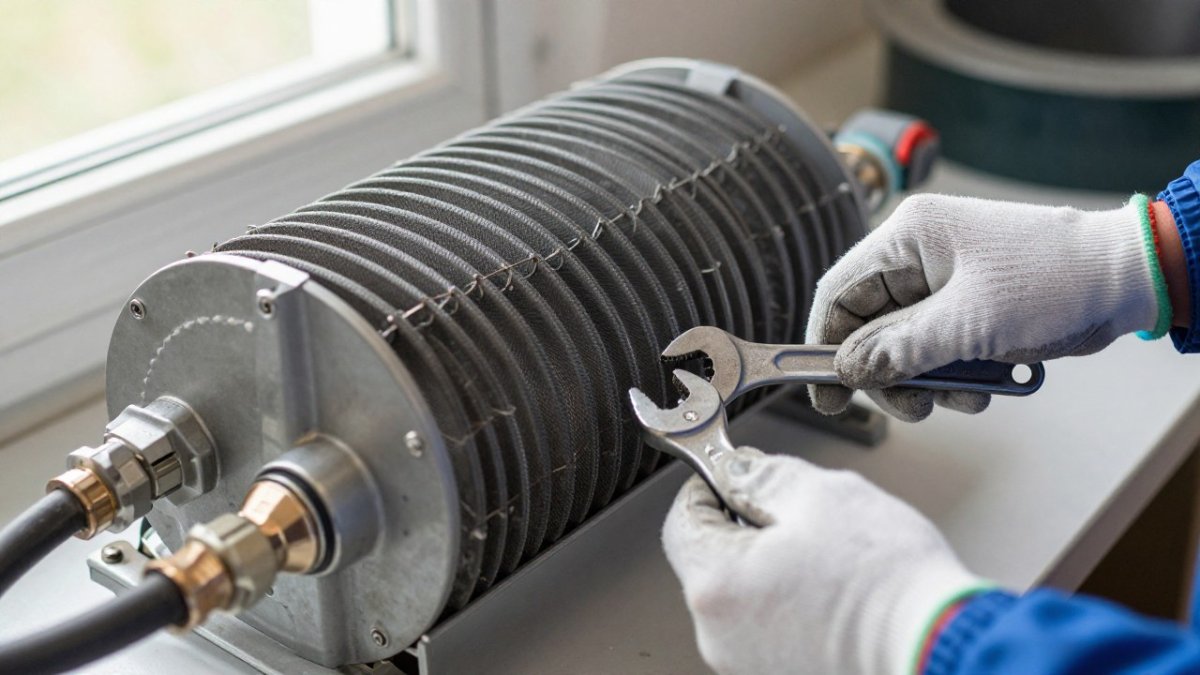
Standard Copper
Copper conducts heat better than any other common exchanger metal, which is why it dominated gas heater design for decades. In clean, balanced, low-salt water it performs well and costs the least.
Its weakness is chemistry. Copper corrodes quickly in saltwater and in water with low pH or high chlorine. A copper exchanger rated for “pool use” does not handle a salt system.
Cupro-Nickel (Copper-Nickel Alloy)
Cupro-nickel blends copper with nickel, usually 90/10 or 70/30. The nickel adds real corrosion resistance while keeping most of copper’s heat transfer, a genuine upgrade, not a compromise.
Many manufacturers use cupro-nickel as their saltwater-rated option. It handles moderate salt and typical chlorine-treated water well, but at very high salt concentration or in poorly balanced water it still corrodes faster than titanium.
316L Stainless Steel
316L stainless steel is a low-carbon, molybdenum-bearing grade built for chloride exposure. It shows up in heat pump coils and some commercial exchangers where strength and formability matter.
The catch is pitting and crevice corrosion. Stainless relies on a passive oxide layer, and chlorides can break it down in stagnant or low-flow spots.
Titanium
Its limits are cost and heat transfer. Titanium conducts heat less efficiently than copper, so designs compensate with more surface area. It also costs more upfront. For salt pools and coastal homes, that premium usually pays back.
| Material | Corrosion Resistance | Heat Transfer | Best For | Watch Out For |
|---|---|---|---|---|
| Standard copper | Low in salt water | Excellent | Balanced, low-salt pools | Fast failure in salt systems |
| Cupro-nickel | Good | Good | Saltwater-rated gas heaters | Corrodes at high salt levels |
| 316L stainless steel | Moderate to good | Moderate | Heat pump coils | Pitting in stagnant water |
| Titanium | Excellent | Moderate | Salt pools, coastal homes | Higher upfront cost |
Best for: salt systems and coastal installs, titanium. Skip if: budget is tight and your water is balanced and low-salt, where cupro-nickel does the job.
Saltwater Pool Heater Corrosion: What Salt Systems Do to Metal
Saltwater pool heater corrosion is the leading cause of premature heater failure in salt pools. A salt system generates chlorine from dissolved salt, and that combination is far harsher on metal than most homeowners expect.
Salt itself is not the whole story. If your heater is already showing the signs, our guide on how to prevent salt corrosion on pool heaters walks through the practical fixes.
Choosing the Best Pool Heater for Saltwater Pools
The best pool heater for saltwater pools pairs a titanium or cupro-nickel exchanger with a design rated for your salt level. Match the exchanger to the water first, then match the heater type to your climate and budget.
Solar thermal systems sidestep the problem entirely. For homeowners comparing options, our roundup of the best solar pool heater for saltwater systems covers what to look for.
Water Chemistry Thresholds That Protect Your Heat Exchanger
Most premature heat exchanger failures trace back to water chemistry, not manufacturing defects. “Keep it balanced” is not actionable, so below are the parameters that matter most for metal longevity and what to do when a reading drifts.
The five numbers that decide how fast metal corrodes
- pH. Most gas heater manufacturers specify a range of roughly 7.2 to 7.8, and many heat pump makers narrow it to 7.4 to 7.6. Low pH is the single most destructive condition for copper and cupro-nickel because it strips the protective oxide layer and accelerates pitting. High pH is less aggressive to metal but drives scale, which traps moisture and chlorides against the surface.
- Free chlorine. Keep it in the normal residual range for a stabilized outdoor pool, typically 1 to 3 ppm, and never let it spike above shock level while the heater is running. High free chlorine combined with low pH is the classic recipe for copper exchanger failure.
- Total alkalinity. Roughly 80 to 120 ppm buffers pH so it does not swing. Low alkalinity lets pH crash after rain or heavy bather load; high alkalinity makes pH hard to bring down.
Also track stabilizer (cyanuric acid) and, in salt systems, the output setting on the cell. A cell running at high output in a small pool can push local chlorine and pH conditions well beyond what a weekly test at the skimmer shows.
How to test and what to do when a number drifts
Test pH and free chlorine at least twice a week and after heavy rain, large swimmer load, or shock treatment. Test alkalinity, calcium hardness, salt, and stabilizer weekly to monthly.
Corrective actions, in order of urgency:
- pH below range: add a pH increaser (sodium carbonate) per label dosing, retest after circulation, and find the cause, low alkalinity, rain dilution, or an overactive salt cell.
- pH above range: add a pH decreaser (sodium bisulfate or muriatic acid per label), and check that aeration or a waterfall is not driving pH up.
- Free chlorine too high: stop the salt cell or feeder, let it decay with sunlight, and do not run the heater until it is back in range.
Watch out: shocking a pool and immediately running the heater pushes high-chlorine, high-pH water through the exchanger at the worst moment, bypass the heater or wait until chlorine drops back to normal residual before resuming heat.
Why this matters more than the metal label
A titanium exchanger in chronically low-pH water still pits, and a cupro-nickel exchanger in well-managed water can last many seasons. Material choice sets the ceiling; chemistry decides whether you reach it. If you are unsure how heating itself shifts your chemistry, our article on solar pool heating and water chemistry explains what changes and why.
Pool Heater Lifespan: What Each Material Realistically Delivers
Material choice sets the ceiling on pool heater lifespan. A well-maintained titanium exchanger can outlast the heater body. Cupro-nickel holds up well in salt water with good chemistry.
Water management matters as much as metal. For a fuller breakdown of how long each material lasts and when replacement makes sense, see our solar pool heater lifespan and replacement guide.
Coastal Exposure and Galvanic Corrosion: Protecting the Heater Body and Connections
Most buying advice stops at the heat exchanger. That is a mistake in a coastal install, because the exchanger is only one of several metal systems in and around a heater, and the ones outside the water path often fail first.
What salt air actually attacks
Airborne chloride deposits on every surface and holds moisture against it. The components that fail earliest in coastal installations tend to be:
- The heater cabinet and base pan, especially at seams, fasteners, and the bottom where splash and runoff collect.
- Electrical connections, terminal blocks, and control-board pins, where chloride films create resistance and intermittent faults.
- Gas piping, unions, and valves, particularly where two different metals meet.
A titanium exchanger does nothing for any of these. This is the distinction competitors blur: corrosion resistance is a property of the full assembly and its installation, not of the exchanger alone.
Galvanic corrosion, explained without the hand-waving
When two dissimilar metals are in electrical contact and both are wetted by an electrolyte, pool water, splash, or salt-laden condensation, the less noble metal becomes the anode and corrodes preferentially. The greater the nobility difference and the more conductive the electrolyte, the faster the reaction. Salt raises conductivity, which is why galvanic problems show up far more often in salt pools and coastal settings.
Common dissimilar-metal junctions around a heater include stainless fittings threaded into copper pipe, aluminum cabinet parts fastened with steel screws, and heater connections tied to pumps or filters made of different alloys. The reaction is driven by stray currents and by the natural potential difference between the metals.
Installation practices that reduce the risk
- Bonding. The National Electrical Code, Article 680, requires bonding of pool equipment, including the heater, pump, and associated metal parts, to a common bonding grid. Bonding equalizes potential between metal parts so stray currents do not drive galvanic attack. It is not the same as grounding, and one does not substitute for the other.
- Dielectric unions. Use dielectric unions or insulating flanges at connections between dissimilar metals to break the electrical path.
- Sacrificial anodes. Where the design allows, a sacrificial anode protects the less noble metal in the assembly by corroding first. Check and replace it on schedule.
Watch out: bonding a heater to a grid that is itself compromised, or omitting the bonding conductor because the unit “seems to run fine,” leaves stray currents free to eat the least noble metal in the assembly, often a fitting or cabinet part that is far cheaper to protect than to replace.
What this means for material choice
In a coastal or salt-system install, budget for the whole assembly, not just the exchanger. A titanium or cupro-nickel exchanger paired with a poorly protected cabinet, unbonded piping, and steel fasteners will still fail early. The reverse, a modest exchanger in a well-bonded, well-drained, regularly rinsed installation, often outlasts a premium exchanger in a neglected one.
Get a Free Quote on a Corrosion-Resistant Solar Heating System
At Dixie Pool Solar Heating & Misting, we install Heliocol panels built to last 20+ years, backed by an industry-best 12-year warranty on all panels and a 2-year warranty on other labor. We’ll help you choose the right pool heater for your climate before you commit.
Get started with Dixie Pool Solar Heating & Misting and extend your swim season from March through November.
Frequently Asked Questions
What pool heater material is most resistant to corrosion?
It resists chlorine, salt, and the low pH conditions that attack copper and stainless steel. Cupro-nickel is the next strongest option and costs less than titanium. Standard copper sits at the bottom of the list and is the usual culprit behind premature heater failure in saltwater pools. If your pool runs a salt system or sits near the coast, titanium is the safest long-term choice.
Can saltwater damage a pool heater?
Yes. A salt chlorine generator turns dissolved salt into chlorine, and that chlorinated, slightly salty water passes straight through the heat exchanger. Copper tubing corrodes faster under those conditions, and saltwater pool heater corrosion is one of the most common reasons heaters fail early. Titanium or cupro-nickel exchangers handle salt far better. Keeping salt concentration and pH in range also slows the damage.
How long does a pool heater typically last?
Pool heater lifespan depends heavily on the heat exchanger material and water chemistry. Copper exchangers in poorly maintained or saltwater pools can fail in a few years, while titanium units often run well past a decade. Solar heating systems are a different case entirely: quality panels like Heliocol are built to last 20+ years with little maintenance. Regular water testing and balanced chemistry are the single biggest factor in stretching any heater’s service life.
How can I prevent corrosion in a pool heater?
Test your water weekly and keep pH, alkalinity, and salt levels within the ranges your heater manufacturer specifies. Avoid letting pH drop below 7.2, since acidic water eats metal. Rinse the heater area after heavy chemical treatments, and make sure the heater is properly bonded to prevent galvanic corrosion. If you are in a coastal area, check connections for salt air damage. Choosing a titanium or cupro-nickel exchanger from the start removes most of the risk.


Leave a Reply