Table of Contents
- Why Climate Determines Your Pool Heater Choice
- What Is the Most Efficient Pool Heating System?
- Pool Heater BTU Requirements by Climate Zone
- Solar Pool Heating vs Gas Heater: Which Fits Your Climate?
- Micro-Climate Factors That Affect Pool Heater Performance
- Hybrid Heating Systems and Solar Cover Integration
- Installation, Maintenance, and Long-Term Costs
- Conclusion
- Frequently Asked Questions
Last Updated: September 19, 2026
Why Climate Determines Your Pool Heater Choice
Climate is the single biggest factor in how to choose the right pool heater for my climate. A system that works in a mild coastal area may struggle in a high-desert yard with cold nights and steady wind. At Dixie Pool Solar Heating & Misting, we see this play out every season: two pools of the same size, same pump, same filter, but wildly different heating results because of where they sit.
Pool heater performance is not just about the heater. It is about the gap between the water temperature you want and the air around it.
- Warm, sunny climates: less energy needed to hold a set temperature
- Cold or windy climates: more heat loss, so the heater works harder
- Dry, high-altitude areas: big day-to-night swings change demand fast
The [U.S. Department of Energy guide to pool heating(/2026/09/18/7-ways-reduce-pool-heating-costs-2026/) | energy.gov] notes that heating a pool can be the largest energy cost for many homeowners, which is why matching the system to the climate matters so much.
That gap between “what you want” and “what your climate gives you” is the throughline for this whole guide. Everything below, from BTU math to covers to hybrid setups, comes back to it.
What Is the Most Efficient Pool Heating System?
The most efficient pool heating system for most homes is a solar thermal system paired with a thermal cover, because it uses free sunlight instead of paying for gas or electricity. According to ENERGY STAR guidance on pool pumps and heaters, cutting heat loss is often the cheapest efficiency gain available.
Solar thermal panels warm water as it circulates through them. There is no flame, no compressor, and no monthly fuel bill. The trade-off: output depends on sun and air temperature, so a cover becomes part of the system, not an add-on.
Heat pumps are the next most efficient option in mild climates.
| System | Best For | Run Cost | Heat-Up Speed |
|---|---|---|---|
| Solar thermal | Sunny, dry climates | Little to none | Slow, steady |
| Heat pump | Mild air temps | Moderate | Moderate |
| Gas heater | Cold snaps, spas | High | Fast |
| Electric resistance | Rarely the best pick | Highest | Fast |
Pool Heater BTU Requirements by Climate Zone
BTU requirements set the floor for any pool heater decision. Undersize the heater and it runs nonstop without reaching your target. Oversize it and you pay for capacity you never use. The goal is to size for your actual temperature rise and your actual heat loss, not a national average.
How to Calculate BTUs for Your Pool
Use this formula: pool surface area (sq ft) × temperature rise (°F) × 12.
BTU Sizing for Different Climate Zones
Temperature rise is the gap between your target water temp and the average air temp during your swim season. That gap drives the math more than pool size alone.
- Warm zones: target 82°F with average air near 80°F means a small rise (2-5°F). A smaller heater or solar-only setup often works.
- Moderate zones: target 82°F with average air near 70°F means a 10-15°F rise. Standard sizing applies.
- Cold zones: target 82°F with average air near 55°F means a 25-30°F rise. Size up, and plan on a cover to cut overnight loss.
- High-desert zones: big day-to-night swings (30°F or more) mean you size for night loss, not daytime gain. A cover is not optional here.
Adjusting for Wind, Shade, and Evaporation
The formula above assumes a sheltered pool. Real yards add loss.
- Wind: a steady 5-10 mph breeze can increase surface heat loss noticeably. A windbreak or cover offsets it.
- Shade: less direct sun means solar collectors and the pool surface both underperform. Add collector area or lean on a backup heater.
- Evaporation: an uncovered pool can lose a significant share of its heat overnight. A solar blanket cuts that loss and lowers the BTU requirement for any system.
Size for your worst realistic week, not your best. A heater that barely keeps up in July will fall behind in October.
Run the formula with your real temperature rise, then add margin for wind, shade, and evaporation. A cover often reduces the required BTU output more than upgrading the heater does.
Solar Pool Heating vs Gas Heater: Which Fits Your Climate?
Solar pool heating vs gas heater comes down to how you use the pool. Solar wins on running cost and shines in sunny climates. Gas wins on speed and works in cold snaps.
Operating Costs and Efficiency Comparison
- Solar: no fuel cost, depends on sun and cover use
- Gas: predictable output, ongoing fuel spend
- Heat pump: efficient in mild air, less so in cold
- Electric resistance: simplest, most expensive to run
A solar blanket or thermal cover cuts evaporation and heat loss, which lowers demand for any system. That is why cover integration shows up in nearly every efficient setup.
Micro-Climate Factors That Affect Pool Heater Performance
Micro-climate is the local set of conditions around your pool, not the regional forecast. Two yards a mile apart can heat differently.
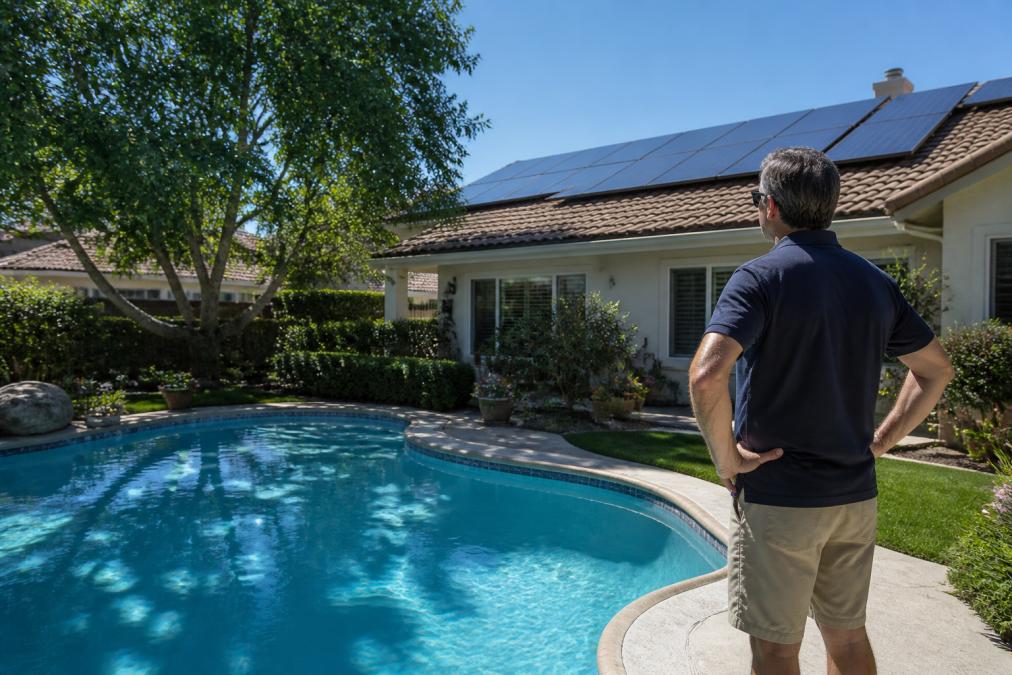
Watch for:
- Shade: trees and buildings block sun hours
- Wind: wind chill pulls heat off the surface fast
- Humidity: dry air speeds evaporation
- Orientation: south-facing roofs collect more sun
Hybrid Heating Systems and Solar Cover Integration
Hybrid systems combine two heat sources so you get low running costs most of the year and fast heat when you need it. This is the setup we recommend for homeowners who want both efficiency and a long season.
How a Hybrid System Actually Works
A typical hybrid pairs a heat pump or solar thermal array with a gas heater as backup. The control logic matters more than the hardware:
- Primary source runs first. The heat pump or solar array handles the bulk of heating when air temps and sun are favorable.
- Backup kicks in on demand. When the primary source cannot keep up, cold snaps, cloudy stretches, or a fast spa heat-up, the gas heater takes over.
- Setpoint and lockout controls prevent fighting. A controller with a lockout temperature stops the heat pump from running when air is too cold to be efficient, and stops the gas heater from firing when the primary source can handle the load.
How a Solar Cover Changes Your BTU Math
A solar blanket or thermal cover is the single highest-return add-on for any pool heater, and it changes the sizing math directly.
- Cuts evaporation. Evaporation is the largest source of heat loss for most uncovered pools. A cover reduces it substantially.
- Traps heat overnight. The cover holds warmth in the water instead of letting it escape to the night air.
- Lowers required BTU output. Because the pool loses less heat, the heater does not need to replace as much. In practice, a covered pool can often be served by a smaller heater than the same pool uncovered.
Matching the Hybrid to Your Climate
- Sunny, mild climates: solar thermal as primary, gas as backup for cold snaps. Cover is essential.
- Variable climates with cold nights: heat pump as primary, gas as backup. Cover cuts overnight loss.
- Cold climates with short seasons: gas as primary, heat pump as shoulder-season helper. Cover extends the season.
A hybrid system without a cover is leaving efficiency on the table. The cover reduces demand on both heat sources, which is where the savings come from.
Hybrid systems win when the control logic is right and a cover is in place. The cover lowers the BTU requirement; the hybrid lets you use the cheapest available heat source for the conditions.
Installation, Maintenance, and Long-Term Costs
Long-term cost is where solar pulls ahead. Heliocol panels are built to last 20+ years, and Dixie Pool Solar Heating & Misting backs them with an industry-best 12-year warranty on all panels installed, plus a 2-year warranty by Dixie Pool Solar on all other labor.
- Upfront: depends on pool size, roof space, and layout
- Ongoing: little to none for solar
- Lifespan: 20+ years on panels
- Warranty: 12 years on panels, 2 years on labor
Conclusion
Picking a heater that fights your climate means paying more every season for less comfort. Match the system to your sun, wind, shade, and how you actually use the pool, and the math gets simple.
Frequently Asked Questions
How many BTU do I need to heat a 10,000-gallon pool?
For a 10,000-gallon pool, you generally need 50,000 to 100,000 BTUs, depending on your climate and desired temperature rise. A common rule is 5,000 BTUs per hour for every 1,000 gallons, but colder climates or pools with high heat loss need more. To size accurately, multiply your pool volume in gallons by 8.34 (pounds per gallon), then multiply by your desired temperature rise in degrees Fahrenheit. This gives the BTUs needed per hour to heat the water.
Does climate impact the efficiency of solar pool heaters?
Yes, climate has a major impact. Solar pool heaters rely on ambient air temperature and sunlight to transfer heat to the water. In warmer, sunnier climates, they perform at their best and can extend your swim season by months. In cooler or cloudier regions, solar heaters still work but may need more panels or a backup system. Humidity levels, wind chill, and shade also affect how well solar heating performs in your specific location.
What is the most efficient pool heating system for my climate?
The most efficient pool heating system depends on your climate. In sunny regions with mild winters, solar pool heating offers the lowest operating cost and uses free solar thermal energy. In colder climates with limited sun, a heat pump or gas heater may be more practical. Heat pumps work well in moderate climates, while gas heaters provide fast heating for occasional use. For many homeowners, a hybrid approach combining solar with a backup heater delivers the best balance of cost and performance.
How do I calculate the heating requirements for my specific region?
Start by identifying your climate zone and average seasonal temperatures. Then calculate your pool volume in gallons and your desired temperature rise. Use the formula: pool gallons x 8.34 x temperature rise = BTUs needed per hour. Factor in local conditions like wind, shade, and humidity, which increase heat loss. A professional pool heater installer can perform a site-specific assessment to recommend the right size and type for your region.
 Dixie Pool Solar Heating & Misting
Leave a comment