Table of Contents
- Assess Your Climate and Heating Strategy
- Decide: Shut Down or Keep Running Through Winter
- Step-by-Step Winterization Process
- Draining Solar Pool Panels for Winter
- Pool Heater Freeze Protection for Active Systems
- Thermal Pool Covers and Heat Retention
- Common Winterization Mistakes to Avoid
- Preparing for Spring Startup
- Frequently Asked Questions
Last Updated: September 20, 2026
Assess Your Climate and Heating Strategy
How to prepare pool heating for winter depends on your local climate and whether you’ll use the pool in winter. Before winterizing, determine your freeze risk zone.
Determine Your Freeze Risk Zone
The National Weather Service divides the country into freeze zones based on average freeze dates. Your zone determines your winterization strategy.
-
Mild Winter Zones (average winter lows above 40°F, fewer than 10 days below freezing): Southern California, coastal regions, parts of the Southeast. These areas can support active heating systems with minimal freeze protection. A thermal cover and basic drain protection are usually sufficient.
-
Moderate Winter Zones (average winter lows 20-40°F, 10-60 days below freezing): Mid-Atlantic, Upper South, parts of the Midwest. These zones require either complete shutdown or robust freeze protection. Active heating is possible but demands careful management.
-
Hard Freeze Zones (average winter lows below 20°F, more than 60 days below freezing): Northern Midwest, Northeast, Mountain West. Complete system drainage is the safest approach. Active heating is expensive and risky without professional installation.
Find your zone via the NOAA hardiness zone map or your local pool service.
Calculate the Cost-Benefit of Active Heating
A gas heater costs $40-$80/month in moderate winters; a heat pump costs $20-$40/month. If you’ll use the pool fewer than 10 times, shutdown is cheaper. If 20+ times, heating becomes economical with a thermal cover (which cuts costs 50-70%). In hard freeze zones, heating costs rise significantly, making shutdown usually cheaper unless you’re a serious winter swimmer.
Ask three questions: (1) How cold does it get? (2) How often will you use the pool? (3) What’s your energy budget? If fewer than 10 winter use days, shutdown is cheaper. Most homeowners in hard freeze zones choose shutdown; most in mild zones choose active heating.
Solar thermal systems use the sun’s heat directly. In moderate and mild zones, they often pay for themselves within 5-7 years through energy savings.
Decide: Shut Down or Keep Running Through Winter
This decision shapes everything that follows. You have two paths, and they require completely different winterization steps.
Path 1: Shut Down Completely, Drain the system, turn off power and gas, and store equipment. This protects pipes from freeze damage and eliminates operating costs.
Path 2: Keep Running Through Winter, Maintain water temperature and keep the system active. This works if you’ll use the pool on warmer winter days or if you’re using solar heating with minimal operating costs.
Most homeowners in cold climates choose shutdown. If using a gas heater or heat pump, running through winter costs money. If using solar thermal heating, winter operation might cost almost nothing while extending your season.
Step-by-Step Winterization Process
Balance Water Chemistry Before Shutdown
Test and balance pH, alkalinity, and chlorine before draining. Unbalanced water damages equipment during storage. If shutting down, maintain slightly elevated chlorine (1-2 ppm above normal) to prevent algae. For active systems, maintain normal chemistry to prevent corrosion.
Turn Off Power and Gas Supply
Flip the breaker to shut down power to the pump and heater. For gas heaters, locate the supply valve near the heater and turn it off (close the tank valve for propane; shut off at the meter for natural gas). Wait five minutes to ensure gas clears from the lines.
Drain Pool Heater Equipment and Lines
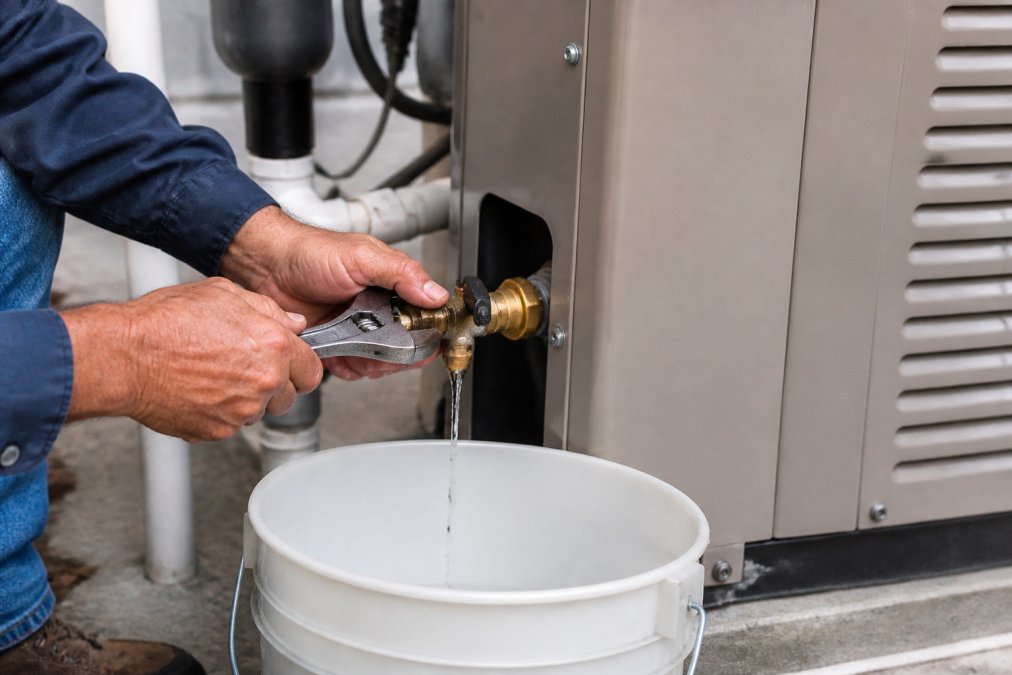
Locate the drain cocks on your heater (typically one inlet, one outlet). Open both slowly and place a bucket underneath. Leave them open 15-30 minutes until fully drained. Remove the pressure switch and store indoors. For plumbing lines, use compressed air (under 50 PSI) to remove remaining water. If keeping the system running, set the heater to maintain 50-60°F instead.
Draining Solar Pool Panels for Winter
Drain solar panels completely before the first hard freeze. Close isolation valves and open the drain valve at the lowest point; gravity empties panels in 20-30 minutes. For systems without isolation valves, use a submersible pump. Leave the drain valve open to prevent air pockets from trapping water. Check your manual for backwash options.
Pool Heater Freeze Protection for Active Systems
If you’re keeping your system running through winter, freeze protection becomes your priority. Water that freezes inside pipes and valves can cause thousands of dollars in damage.
Insert winter plugs (rubber or plastic devices) into all return lines, skimmer openings, and other ports to prevent water from sitting in exposed pipes where it can freeze.
Set Your Heater Temperature
If you’re running a gas heater or heat pump through winter, set it to maintain at least 50°F. This prevents the water in the heater itself from freezing, even on the coldest nights.
For solar thermal systems, the system naturally maintains temperature during sunny days. On cloudy or cold nights, a backup heater (if installed) can maintain minimum temperature.
Use a Thermal Pool Cover
A thermal pool cover reduces heat loss dramatically. It acts as a blanket, trapping warmth from the sun and reducing evaporation. This is especially valuable for solar heating systems, which rely on the sun to work effectively.
A thermal blanket can reduce heating costs by 50-70% during winter. It also prevents debris from entering the pool, reducing maintenance.
Thermal Pool Covers and Heat Retention
Thermal covers are one of the most cost-effective tools for winter pool heating. They work by reducing heat loss through evaporation and radiation, the two mechanisms responsible for 70-80% of pool heat loss. A quality thermal cover typically pays for itself within one or two seasons through energy savings. For solar thermal systems, the savings are even greater because the cover amplifies the sun’s heating effect.
Types of Thermal Covers and Their Performance
Solar thermal covers (often called solar blankets) have small air bubbles that trap heat and allow sunlight through. They’re lightweight and easy to remove for daily use. A solar blanket reduces heat loss by approximately 50-60% and costs $150-$400 depending on pool size. They’re ideal for active heating systems because they maximize solar gain while minimizing evaporation.
Opaque thermal covers block sunlight but provide better insulation, reducing heat loss by 60-75%. These work well if you’re not actively heating or if you’re using a backup heater. They cost $200-$500 and last 3-5 years with proper care. The trade-off: you lose daytime solar heating, so they’re best paired with a gas heater or heat pump if you’re maintaining water temperature.
Automatic pool covers offer convenience and better safety. They roll over the pool mechanically, reducing manual labor. They provide excellent heat retention (65-80% reduction in heat loss) but cost $3,000-$8,000 upfront. They’re most cost-effective for pools used frequently year-round or for owners willing to pay for convenience.
Calculate Your Cover ROI
A 15,000-gallon pool loses approximately 1-2°F per day without a cover in winter. To maintain 75°F in a moderate winter zone (average outdoor temp 35°F), a gas heater runs 6-8 hours daily, consuming 30,000-40,000 BTU per day. At $0.012 per BTU (typical natural gas rate), that’s $360-$480 per month.
A solar thermal cover reduces this to 2-3 hours daily, or $120-$160 per month, a savings of $240-$320 monthly, or $720-$960 per season (90 days).
A $250 solar blanket pays for itself in 10-14 weeks. A $400 opaque cover pays for itself in 5-6 months. An $8,000 automatic cover pays for itself in 8-11 seasons, only cost-effective if you plan to stay in your home long-term or use the pool year-round.
Cover Maintenance and Lifespan
Solar blankets last 2-3 years with proper care (rinse with fresh water, store indoors in summer). Opaque covers last 3-5 years. Automatic covers last 10-15 years if serviced annually. Factor replacement cost into your ROI calculation.
For active winter heating, a solar thermal cover paired with a solar heating system extends your season significantly. The cover traps heat generated by the panels, multiplying the system’s effectiveness. In a mild winter zone, a solar cover + solar heater can maintain 70°F water temperature with zero fuel cost on sunny days.
The Evaporation Factor
Evaporation accounts for 50-70% of heat loss in uncovered pools. A cover eliminates this entirely.
Common Winterization Mistakes to Avoid
Most winterization failures come from rushing the process or skipping steps. Here are the mistakes that cost homeowners the most.
Leaving Water in the System
Not Protecting Exposed Pipes
Forgetting the Pressure Switch
Skipping Water Chemistry Balance
Neglecting the Thermal Cover
Preparing for Spring Startup
Winterization is only half the job. Spring startup requires careful steps to ensure everything works correctly after months of dormancy.
Frequently Asked Questions
Do I need to drain my solar pool heating panels before the first freeze?
Yes, draining your solar pool heating panels before freezing temperatures arrive is critical. Water left in the panels and plumbing lines can freeze and expand, causing cracks and permanent damage. Most systems require complete drainage of the collector panels, header tanks, and all exposed plumbing lines. The exact process depends on your system design, check your equipment manual or consult a professional to ensure proper drainage of all freeze-prone areas.
What are the risks of leaving water in pool heating lines during freezing temperatures?
Water expands when it freezes, creating pressure that can crack panels, burst pipes, and damage internal components. Freeze damage is often irreversible and requires expensive repairs or full system replacement. Even small amounts of water trapped in return nozzles, drain cocks, or backwash lines can cause problems. Proper winterization, including draining all equipment and installing winter plugs, prevents this costly damage and extends your system’s lifespan.
Should I cover my pool heater or solar panels during winter?
A thermal pool cover over your pool helps retain heat if you’re running your system through winter, reducing heat loss and energy costs. For the heater itself, check your manufacturer’s guidelines, some units benefit from protective covers, while others should remain uncovered for ventilation. Solar panels should be drained and can be left exposed or covered depending on your climate and system design. Professional guidance ensures you protect your equipment without creating ventilation or moisture problems.
How do I know if my pool is worth heating through winter versus shutting down?
Consider your regional climate, outdoor temperature patterns, and how often you actually use the pool. In colder climates with extended freezes, shutdown is often simpler and safer. In milder regions, keeping a solar thermal system running through winter can extend your swimming season significantly, from March through November in many cases, while solar systems use free thermal energy from the sun rather than gas or electricity.
 Dixie Pool Solar Heating & Misting
Leave a comment