Table of Contents
- 1. Use a Solar Cover or Thermal Blanket to Cut Evaporation and Heat Loss
- 2. Optimize Your Pool Heat Pump vs Solar Heating Cost for Your Climate
- 3. Install a Solar Pool Heater and Claim Your Solar Pool Heater Tax Credit 2026
- 4. Run Your Variable Speed Pump During Off-Peak Hours
- 5. Master Thermostat Settings and Smart Controls for Energy Efficiency
- 6. Stay on Top of Filter Maintenance and Water Circulation
- 7. Shield Your Pool from Wind and Add an Insulating Barrier
- Frequently Asked Questions
Last Updated: September 18, 2026
1. Use a Solar Cover or Thermal Blanket to Cut Evaporation and Heat Loss
The cheapest way to cut pool heating costs is stopping heat from leaving the water in the first place. A solar cover or thermal blanket traps warmth at the surface and blocks most evaporation, which is where an uncovered pool loses the bulk of its heat.
Evaporation drives the biggest share of heat loss in most backyard pools.
- Use it every night, even in summer. Nighttime is when heat loss peaks.
- Reel it up during the day if you want solar gain from direct sun.
- Replace it once it starts cracking or sinking. A worn cover loses its insulating value.
How to Choose the Right Cover Thickness and Fit
Thicker covers insulate better but cost more and weigh more to handle. A snug fit matters more than thickness, because gaps let warm air escape around the edges.
A few practical tips:
- Measure your pool’s widest and longest points before ordering.
- Trim to fit, leaving minimal gaps along the walls.
- Choose a reel system if the cover is heavy. It makes daily use realistic.
A cover only pays off if you actually use it. A reel that mounts at the pool edge takes ten seconds to deploy, and that convenience is what keeps the habit going.
2. Optimize Your Pool Heat Pump vs Solar Heating Cost for Your Climate
A heat pump and a solar heater cut pool heating costs in very different ways, and your climate decides which one wins. In sunny regions with long swim seasons, solar thermal usually runs cheaper over time because the sun does the work.
| Factor | Heat Pump | Solar Thermal |
|---|---|---|
| Upfront cost | Lower | Higher |
| Operating cost | Ongoing electric use | Near zero |
| Best climate | Cooler, cloudy | Sunny, long season |
| Lifespan | Shorter | 20+ years |
3. Install a Solar Pool Heater and Claim Your Solar Pool Heater Tax Credit 2026
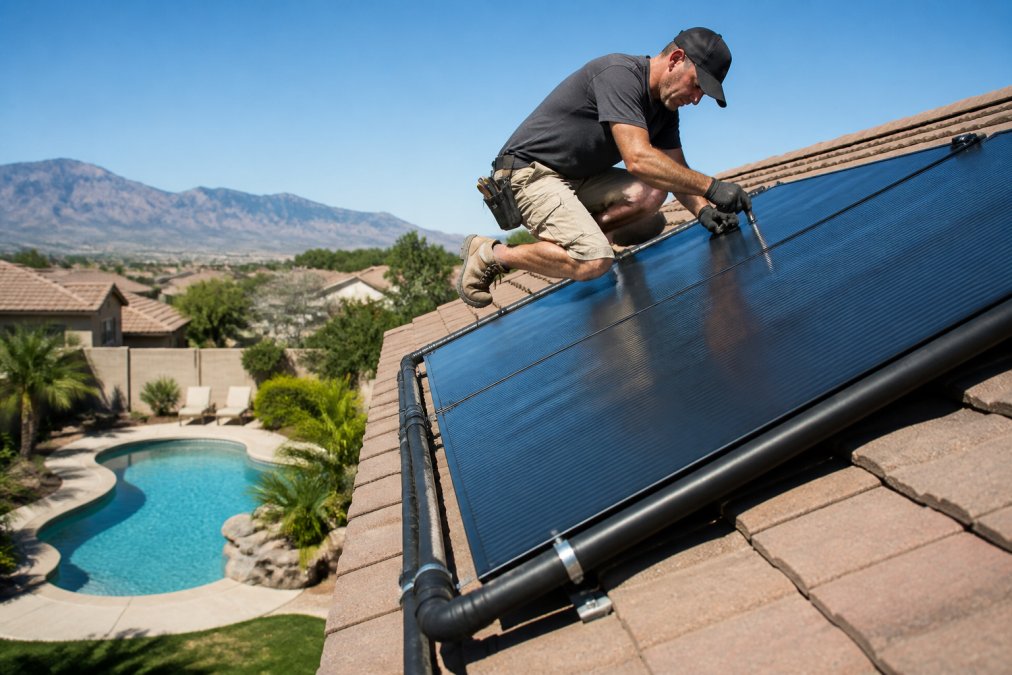
A solar pool heater pays you back twice: it slashes operating costs and may qualify for a solar pool heater tax credit 2026. Many homeowners find the incentives shorten the payback period by years.
What the 2026 Tax Credit Covers and How to Qualify
To improve your odds:
- Keep every invoice and installation record.
- Confirm the system meets efficiency and certification requirements.
- Ask your installer which credits and rebates apply in your area.
Do not assume you qualify. Credits have specific rules, and a system that misses a certification requirement can disqualify the whole claim. Verify before you sign.
This is where a specialist helps. Dixie Pool Solar Heating & Misting integrates Heliocol panels built to last 20+ years, backed by an industry-best 12-year panel warranty and a 2-year warranty by Dixie Pool Solar on all other labor.
4. Run Your Variable Speed Pump During Off-Peak Hours
A variable speed pump (VSP) is usually the single highest-ROI upgrade on this list, because pump energy scales roughly with the cube of speed. Drop from full speed to half speed and power draw falls to about one-eighth, not one-half. That is the affinity law working in your favor, and it is why a VSP can move the same daily water volume for a fraction of the energy a single-speed pump burns.
The practical setup most pool owners land on:
- Low speed for daily filtration. Many VSPs run efficiently in the 1,200-1,800 RPM range, drawing a small fraction of their rated wattage. Exact numbers vary by pump model and plumbing, so check your pump’s energy label or owner’s manual.
- High speed only when needed. Spa jets, water features, vacuuming, and backwashing need flow. Everything else does not.
- Longer runtime, lower speed. Running 8-12 hours at low speed typically moves the same water as 4-6 hours at high speed while using far less power.
Match Runtime to Turnover, Not to the Clock
A common rule of thumb is one full turnover of your pool volume per day, some owners run two in summer. To estimate turnover, divide your pool volume in gallons by the pump’s flow rate at your chosen speed. A 20,000-gallon pool at 40 gallons per minute turns over in about 500 minutes, or roughly 8.3 hours. That is your target runtime, not a fixed 6 or 8 hours.
Stack Off-Peak Rates on Top of Low-Speed Running
Many utilities offer time-of-use (TOU) rates with cheaper windows overnight or mid-day. Check your utility’s published rate schedule and program the pump to run during the cheapest window that still fits your turnover target. If your utility offers a pool pump or appliance rebate for VSPs, factor that into the payback math.
Quick ROI Math for a VSP Upgrade
You can estimate payback without a calculator app:
- Note the wattage of your current single-speed pump (often printed on the motor nameplate).
- Estimate the wattage of the VSP at your planned low speed (from the manufacturer’s energy chart).
- Multiply the wattage difference by your daily runtime hours, then by your electric rate per kWh, then by 365.
- Divide the installed cost of the VSP by that annual savings figure.
Most owners who run a single-speed pump several hours a day find the VSP pays back within a few seasons, and many utilities publish rebate programs that shorten it further. Verify current rebate availability with your utility before you buy.
Program the pump to ramp up briefly during the day for skimming and chemical mixing, then drop back to low speed. You get the cleaning benefit without paying high-speed watts all day.
U.S. Department of Energy pool pump guidance
5. Master Thermostat Settings and Smart Controls for Energy Efficiency
Every degree you lower the set point reduces the gap between water temperature and air temperature, and that gap is what drives heat loss and heater runtime. The savings are not linear, but the direction is reliable: a few degrees lower, held consistently, shows up on the bill.
Set Points That Actually Save
- 78°F is the commonly recommended comfort floor for recreational swimming. Many owners run 80-82°F out of habit and never test whether 78°F feels fine.
- Lower it further when the pool will sit unused for several days. A pool nobody swims in does not need to be swim-ready.
- Do not chase big setbacks with a heat pump. Heat pumps heat slowly. A 10-degree setback that you try to recover in two hours forces the unit to run at full output for hours, which can erase the savings. Smaller, longer setbacks work better with heat pumps than with gas heaters.
What Smart Controls Actually Automate
“Smart controls” is a broad label. The features that move the needle:
- Scheduled set points. Different targets for weekday mornings, weekend afternoons, and vacation mode.
- Swim-time alignment. Heat only in the window before you actually swim, not around the clock.
- Real-time energy monitoring. Many controllers and IoT sensors report pump and heater wattage, so you can see which schedule actually costs less instead of guessing.
- Weather-aware logic. Some systems pull local forecasts and pre-heat before a cold front or skip heating when a warm day will do it for free.
- Mobile alerts. A filter pressure or flow warning that reaches your phone prevents a small clog from becoming a week of inefficient runtime.
Pair Setbacks With a Cover
Thermostat setbacks and a solar cover compound. The cover slows heat loss overnight, so the heater has less ground to make up in the morning. Run the setback and the cover together and you get more benefit from each than either delivers alone.
Set the lowest temperature you genuinely find comfortable, schedule heating around real swim times, and let smart controls handle the rest. The free wins come first; automation locks them in.
U.S. Department of Energy swimming pool heating guidance
6. Stay on Top of Filter Maintenance and Water Circulation
Clean filters and steady water circulation keep your heater working less. A clogged filter restricts flow, forcing the pump and heater to work harder for the same result.
Your routine should include:
- Rinse or backwash filters on a set schedule.
- Check the pump flow rate monthly.
- Clear debris from skimmers and baskets.
- Watch for pressure changes that signal a clog.
7. Shield Your Pool from Wind and Add an Insulating Barrier
Wind strips heat from the water surface faster than almost anything else. Wind shielding and an insulating barrier together cut heat loss and lower your operating costs.
Layer that with an insulating barrier:
- Use a thermal blanket as your first line of defense.
- Add a cover for longer stretches away.
- Consider landscaping that blocks wind without shading the pool.
Frequently Asked Questions
What is the least expensive way to heat a pool?
Solar pool heating is the least expensive long-term option because the sun provides free energy after installation. You avoid monthly gas or electric bills and only pay for the initial system and minimal maintenance. With a solar cover and proper circulation, you can extend your season without ongoing fuel costs. Many homeowners see the system pay for itself within a few years through reduced pool heating costs.
How much can a pool cover reduce heating costs?
A pool cover can cut heating costs by 50 to 70 percent. It reduces evaporation, which is the largest source of heat loss, and acts as a thermal blanket to retain warmth overnight. Using a cover consistently also lowers water replacement and chemical needs. For maximum savings, combine a cover with a solar heater and run your pump during the warmest part of the day.
Is solar pool heating more cost-effective than gas or electric heat pumps?
Solar pool heating has the lowest operating cost because it uses free solar energy. Gas heaters are cheap to install but expensive to run, while heat pumps cost more upfront and still use electricity. For pool heat pump vs solar heating cost, solar wins over time with no fuel bills. Solar also qualifies for the solar pool heater tax credit 2026, improving your return on investment.
What are the federal tax credits available for solar pool heating systems?
State incentives like the Utah State 25% or $2,000 State Tax Credit may apply, so verify current rules before filing.
 Dixie Pool Solar Heating & Misting
Leave a comment