
Quick Summary
Pool heater energy use depends mainly on pool volume, the number of degrees the water must rise, and how much heat escapes through evaporation, wind and cool nights. Heater type and maintenance condition also change how efficiently that heat is delivered. Covering the pool and holding a steady, moderate temperature are the most effective ways to cut it.
- Larger pools hold more water, so they take more energy to heat.
- Each extra degree of target temperature adds to energy use.
- Evaporation is usually the largest heat loss for an uncovered pool.
- Covering the pool whenever you are not swimming reduces heat loss.
- Clean filters and scale-free heat exchangers help the heater run efficiently.
Table of Contents
- How Much Energy a Pool Heater Really Uses
- Pool Size, Volume and Depth as Energy Drivers
- Target Temperature, Temperature Rise and Heating Time
- Climate, Sun Exposure and Heat Loss From the Water Surface
- Heater Type, Efficiency and Equipment Condition
- Pool Heater Running Cost: Calculating Your Operating Costs
- How Pool Covers and Controls Cut Energy Use
- Estimating Heat Pump kWh Use Before You Buy
- Frequently Asked Questions
How Much Energy a Pool Heater Really Uses
Most homeowners think about pool heating in dollars, not kilowatt-hours or therms, yet understanding your pool heater energy use is what lets you predict bills accurately. That makes sense. But the energy a heater uses depends on a handful of factors, and knowing them helps you predict your bills before they arrive. For Southern Utah pool owners, the biggest variables are how big the pool is, how warm you want the water, and how much heat escapes into the air.
A pool heater does not run at full power all the time. Learn about Utah tax credits for residential pool heating that could offset the cost of running a system. It runs until the water reaches your target temperature, then it cycles on and off to replace the heat the water loses. So the real question is how much heat your pool loses and how much energy it takes to replace that heat.
Here is what drives the answer:
- Pool size and volume: More water takes more energy to heat.
- Target temperature: Each extra degree costs more energy.
- Heat loss: Wind, evaporation and cool nights pull heat out of the water.
- Heater type and condition: Efficiency varies a lot between equipment.
- Usage pattern: Heating a pool daily costs more than heating it a few times a week.
Watch out:
Pool Size, Volume and Depth as Energy Drivers
Pool size is the starting point for any energy estimate. The heater has to warm every gallon of water in the pool, so volume matters more than surface area alone. A deeper pool holds more water than a shallow one of the same footprint.
Here is a quick way to think about it:
- Small pools (under 10,000 gallons): Heat up quickly and cost less to keep warm.
- Medium pools (10,000 to 20,000 gallons): Need steady heating and benefit from a cover.
- Large pools (over 20,000 gallons): Take the most energy to heat and need careful sizing.
Depth changes the picture too. A deep end holds water that stays cooler and resists temperature changes. Shallow pools warm faster in the sun but also lose heat faster at the surface.
Target Temperature, Temperature Rise and Heating Time
Target temperature is one of the largest levers you control. Raising the setpoint by just a few degrees can noticeably increase energy use, especially on cool days.
Temperature rise is the number of degrees the heater must add to bring the water from its starting temperature to the target. A pool that starts at 60°F and must reach 82°F needs a 22-degree rise. A pool that already sits at 70°F needs only 12 degrees. The bigger the rise, the more energy the job takes.
Heating time follows from these two numbers and the heater’s output. A larger rise in a bigger pool takes longer and runs the equipment longer. That usually means more energy, even if the heater is efficient.
Common approaches include:
- Set a moderate target and hold it steady rather than chasing a high temperature.
- Heat in the warmest part of the day when the air helps.
- Avoid large daily swings in setpoint, which force repeated large temperature rises.
Climate, Sun Exposure and Heat Loss From the Water Surface
Climate affects pool heating more than most homeowners expect. Find out how to extend your swimming season in Utah with heating solutions and covers. In Southern Utah, daytime sun can warm the water, but cool nights, low spring humidity and wind can pull heat right back out.
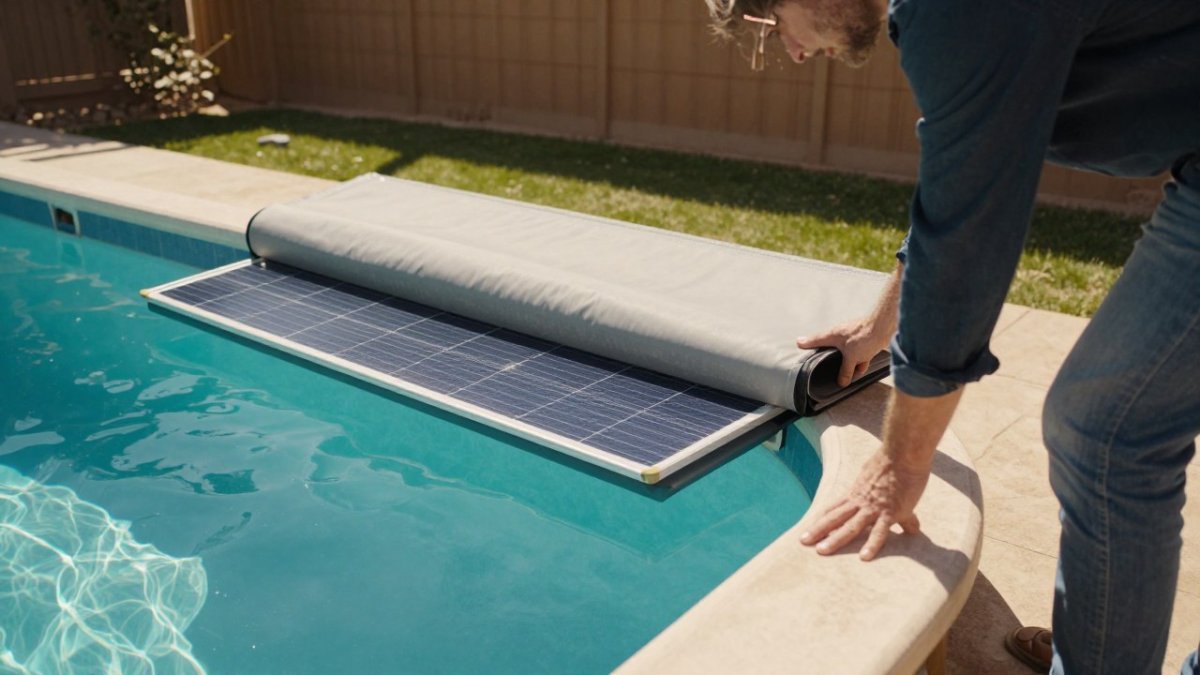
Heat leaves a pool through four distinct paths, and each responds to different conditions. Understanding them separately is what lets you predict which days will cost the most.
Evaporation is usually the single largest loss for an uncovered pool. Every pound of water that turns to vapor carries roughly 1,000 BTU of heat away with it.
Convection is heat moving from the warm water into cooler air. The loss scales with the temperature difference between water and air. A pool held at 82°F on a 50°F night loses heat fast; the same pool on a 70°F night loses far less.
Radiation is the pool giving off infrared energy to the sky, especially on clear nights. Cloud cover acts as a blanket and slows radiative loss; a clear, cool night is the worst combination. A solar cover or a liquid solar blanket reduces radiative loss along with evaporation.
Ground loss is heat conducted into the soil around and beneath the pool. It is small for an in-ground pool after the first season because the surrounding earth warms up, but it matters for above-ground pools and for pools with uninsulated walls. Ground loss is steady and largely outside your control once the pool is built.
Here is how the main factors compare:
| Factor | Effect on energy use | Impact level |
|---|---|---|
| Wind across the surface | Speeds evaporation and convective loss | High |
| Cool nights | Increases convective and radiative loss | High |
| Low humidity | Accelerates evaporation | High |
| Clear skies at night | Increases radiative loss | Medium |
| Full sun exposure | Adds free heat during the day | High |
| Shade from trees or walls | Reduces free heat gain | Medium |
| Uninsulated walls or above-ground pool | Adds ground loss | Low to medium |
Watch out: Judging heat loss by air temperature alone misleads you, a still, humid 60°F night can cost less heat than a windy, dry 68°F night.
Heater Type, Efficiency and Equipment Condition
Not all pool heaters use energy the same way. Gas heaters burn fuel and typically work fast. Electric heat pumps move heat from the outside air into the water. Solar thermal systems use the sun’s heat directly.
Efficiency ratings help compare equipment, but they only tell part of the story. A well-maintained heater running at its rated efficiency will use less energy than an old unit with clogged filters, scaled heat exchangers or a faulty thermostat.
Equipment condition matters in several ways:
- Clean filters and strainers keep water flowing and reduce strain on the heater.
- Scale buildup in the heat exchanger slows heat transfer and wastes energy.
- Worn components such as pumps and valves can increase runtime.
Check your heater’s manual for maintenance intervals.
Pool Heater Running Cost: Calculating Your Operating Costs
Estimating running cost is simpler than most people think once you separate the physics from the billing. The method below works for any heater type and lets you plug in your own pool, climate and utility rate.
Step 1, Find the heat your pool needs. Use the standard formula: gallons × 8.33 lb per gallon × temperature rise in °F = BTU required. A 15,000-gallon pool raised 15°F needs 15,000 × 8.33 × 15 ≈ 1,874,000 BTU.
Step 2, Convert heat to energy input. For a gas heater rated at 80% efficiency, divide the BTU required by 0.80: 1,874,000 ÷ 0.80 ≈ 2,342,500 BTU of fuel. One therm of natural gas contains about 100,000 BTU, so that is roughly 23.4 therms.
Step 3, Apply your utility rate. Multiply the fuel quantity by your price. At $1.20 per therm, the gas example costs about $28. At $0.14 per kWh, the heat pump example costs about $15.40. At $2.50 per gallon of propane, the propane example costs about $51.50. These are illustrative rates, substitute your own bill.
Step 4, Account for standing losses. The calculation above heats the water once. In practice the heater must replace ongoing losses every day, so multiply by the number of days you hold temperature. A covered pool might lose the equivalent of a 2-4°F rise per day; an uncovered pool in wind can lose far more.
Step 5, Build a seasonal estimate. Multiply daily cost by heating-season days. Track one month of actual runtime and your utility bill to calibrate the model.
A worked comparison for the same 15,000-gallon pool, 15°F rise, held for 90 days with a modest 3°F daily loss:
| Heater type | Efficiency input | Fuel per season | Cost at illustrative rate |
|---|---|---|---|
| Natural gas | 80% | ~280 therms | ~$336 at $1.20/therm |
| Heat pump | COP 5 | ~1,320 kWh | ~$185 at $0.14/kWh |
| Propane | 80% | ~247 gallons | ~$618 at $2.50/gal |
Watch out: Comparing a heat pump’s COP to a gas heater’s efficiency directly is apples-to-oranges, COP is a ratio of heat moved to electricity used, while gas efficiency is heat delivered to fuel burned. Convert both to cost per million BTU delivered before you compare.
How Pool Covers and Controls Cut Energy Use
A solar cover can trap heat during the day and reduce evaporation at night. See how solar pool panels save energy compared with gas heating.
Controls matter too. A programmable timer or smart controller can run the heater during warmer hours and hold a steady setpoint. Avoid letting the heater chase a high temperature overnight. Instead, aim for a consistent, moderate target.
Practical steps that reduce energy use:
- Cover the pool whenever you are not swimming.
- Lower the setpoint by a few degrees and keep it steady.
- Schedule heating for the warmest part of the day.
- Keep filters clean so the pump and heater run efficiently.
- Use windbreaks such as fencing or plantings to reduce surface wind.
Estimating Heat Pump kWh Use Before You Buy
If you are considering a heat pump, estimating kilowatt-hour use before you buy can prevent surprises. Our guide to whether solar pool heating is worth it compares costs and return on investment. Start with your pool’s volume, your target temperature rise, and the expected number of heating days. Then compare those numbers against the heat pump’s rated output and coefficient of performance, which describes how much heat it delivers per unit of electricity.
A simple way to check:
- Calculate the heat needed: Volume times temperature rise times a fixed factor gives the total heat in British thermal units. Pool supply sources and heat pump brochures often list this formula.
- Divide by the heat pump’s efficiency to estimate electricity use.
- Compare results across several models using the same inputs.
Ask any seller to explain their assumptions, including climate, cover use and temperature rise.
Frequently Asked Questions
How much does a pool heater raise your electric bill?
The increase depends on pool volume, the temperature rise you ask for, how long the heater runs, and the heater type. An electric resistance heater uses far more kWh than a heat pump for the same temperature rise, so the bill impact can be several times larger. Multiply the heater’s kW rating by hours of operation to estimate kWh, then multiply by your utility’s rate per kWh in USD. Compare the result with your current bill to see the change.
Is it better to leave the pool heater on all the time?
Usually not. Keeping a heater running continuously means paying to replace heat lost to evaporation, wind and cooler nights, even when no one swims. A setpoint schedule that heats the water before typical swim times and lowers the setpoint overnight generally uses less energy. Pool covers make scheduled heating more effective because they slow heat loss between sessions.
Does a pool cover reduce pool heating costs?
Yes. A cover blocks most evaporation, which is one of the largest sources of heat loss from an uncovered pool. Less evaporation means the heater needs to run less to hold the same temperature. The savings vary with climate, wind exposure and how often the cover is on, so track your heater runtime with and without the cover to measure the difference in your own pool.
How can I calculate a pool heat pump’s energy use in kWh?
Start with the heat pump’s rated power input in kW from the nameplate or manufacturer data, then multiply by the hours it runs per day to get daily kWh. Heat pumps deliver more heat than the electricity they consume, so the coefficient of performance affects how much heat you get per kWh, but the power draw is what appears on your meter. Multiply daily kWh by 30 for a monthly estimate and by your electricity rate in USD for cost.


Leave a Reply