Last Updated: November 16, 2026
Quick Summary
A pool chiller is the only option that actively lowers water temperature on demand, while a shade sail is a passive barrier that reduces heat gain without touching the water itself. If your pool regularly climbs past a comfortable swimming range in midsummer, shade alone will not fix it.
- A chiller draws water through a heat exchanger and returns cooler water, holding a set temperature even in full sun.
- A shade sail blocks direct solar radiation over part of the pool but cannot cool water below ambient air temperature.
- Chiller operating cost depends on power draw, daily runtime, and your local electricity rate.
- A shade sail costs far less upfront than a chiller and has no electricity draw at all.
- Running your pump at night and adding a fountain or aerator are free moves that pull heat from the water.
Table of Contents
- Pool Chiller vs Shade Sails: The Short Answer
- How Each Option Affects Pool Water Temperature
- Pool Chiller Cost: Upfront Price and Operating Expenses
- What a Pool Shade Sail Can and Cannot Do
- How to Cool Down a Hot Pool: Combining Strategies
- Climate, Pool Size, and Site Suitability
- Get a Free Quote on a Cooling Solution for Your Pool
- Frequently Asked Questions
Pool Chiller vs Shade Sails: The Short Answer
Weighing a pool chiller vs shade sails for temperature control comes down to one question: do you want to remove heat that is already in the water, or stop the sun from adding it? A chiller actively cools water through a refrigeration cycle and can pull temperatures down even in full sun. A shade sail blocks direct solar radiation over part of the pool surface and slows the heating rate, but it cannot cool water below ambient air temperature. This guide breaks down how each option works, what it costs to run, and when combining them makes the most sense.
Here is the short answer. A pool chiller is the only option that actively lowers water temperature on demand. A shade sail is a passive barrier that reduces heat gain and makes the pool feel cooler without touching the water itself. If your pool regularly climbs past a comfortable swimming range in midsummer, shade alone will not fix it. If your water only gets uncomfortably warm during the hottest two or three weeks, a sail may be enough.
The two are not really competitors. They solve different halves of the same problem, which is why the smartest setups often use both.
How Each Option Affects Pool Water Temperature
A chiller and a shade sail change water temperature through completely different mechanisms, and that difference explains almost everything about how they perform. Realistic expectations matter here: neither option delivers a fixed number of degrees, because both are fighting the same three heat inputs, direct solar radiation, ambient air temperature, and warm surfaces like decking and equipment.
A pool chiller works like an air conditioner for water. It draws pool water through a heat exchanger, dumps the heat into the surrounding air, and returns cooler water to the pool. Because it removes heat directly, a chiller can hold a set temperature regardless of how intense the sun is. The trade-off is that it uses electricity and runs a compressor, so operating cost scales with how hard it works.
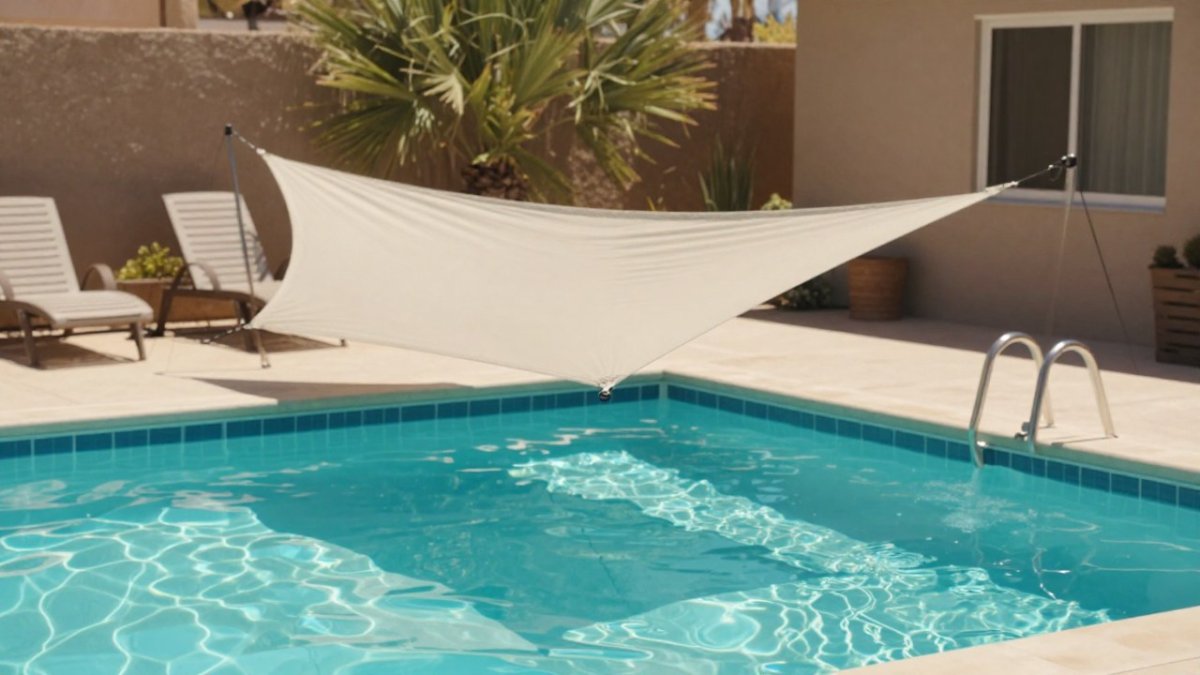
A pool shade sail is a tensioned fabric panel stretched over part of the pool. It blocks direct solar radiation from hitting the water, which cuts the rate of heat gain during the day. The water under the sail stays noticeably cooler to the touch, and the whole pool benefits somewhat as cooler water circulates.
In practice, this means a chiller gives you control, while a sail gives you relief. One is active and precise. The other is passive and partial. The clearest way to see the difference is to think in terms of heat balance: a chiller adds a negative heat term you can dial up or down, while a sail reduces the positive solar term but cannot go negative. On a still, humid night with no sun, the sail does nothing and the chiller still works.
Pool Chiller Cost: Upfront Price and Operating Expenses
Pool chiller cost breaks into two parts, and homeowners usually focus on the wrong one. The upfront purchase and installation is a one-time hit. The electricity bill is the number that keeps showing up every summer. The structure of the cost matters more than a single sticker price: what drives the upfront number up or down, and what makes the monthly number move.
Upfront cost. Chillers are sized by cooling capacity, and larger pools or hotter climates require bigger units, which cost more to buy and more to run. The upfront number is driven by four things: the unit’s rated capacity, the electrical work needed to supply it (a dedicated circuit and, for larger units, a higher-amperage feed), the equipment pad and plumbing changes, and any permitting or inspection your jurisdiction requires for the electrical work.
Operating cost. This is where chillers earn their reputation. A compressor-driven chiller runs on electricity, and in a hot climate it may cycle for hours each day to hold temperature. That ongoing expense is the real reason some homeowners look for alternatives. The monthly number depends on three variables: the unit’s power draw while running, how many hours per day it runs, and your local electricity rate.
Maintenance and ownership. A chiller adds a compressor and electrical service to your equipment list, which means periodic service and a finite equipment life. A shade sail flips this equation. The fabric and hardware cost far less upfront than a chiller, and there is no electricity draw at all. The catch is that a sail does less.
| Factor | Pool Chiller | Shade Sail |
|---|---|---|
| How it cools | Actively removes heat | Blocks direct sun |
| Upfront cost | Higher; driven by capacity, electrical work, and site prep | Lower; fabric and hardware |
| Operating cost | Electricity, ongoing; scales with runtime and rate | None |
| Cooling control | Precise, on demand | Passive, partial |
| Works at night | Yes | No |
| Maintenance | Compressor and electrical service | Fabric and hardware checks; eventual fabric replacement |
| Best for | Consistently hot water | Mild overheating, partial relief |
Watch out: comparing a chiller’s purchase price to a sail’s purchase price alone hides the real difference. The fair comparison is total cost over several seasons, upfront plus electricity plus maintenance for the chiller, versus upfront plus eventual fabric replacement for the sail, and that comparison only makes sense once you know how many weeks per year your pool is actually too hot.
What a Pool Shade Sail Can and Cannot Do
A shade sail is a smart, low-cost tool, but it has clear limits, and knowing them saves you from disappointment.
What it can do: cut direct solar radiation over part of the pool, keep the shaded area of water noticeably cooler, reduce glare, and give your backyard a defined, shaded lounging zone. Because there are no moving parts or power draw, a well-installed sail is close to maintenance-free beyond occasional fabric and anchor checks.
What it cannot do: lower water temperature below the surrounding air, cool the entire pool evenly, or help at night when the sun is gone. A sail covering one end of a large pool leaves the rest exposed. If your goal is a specific, comfortable temperature across the whole pool, a sail alone will fall short. For a deeper look at choosing the right structure, see our guide on choosing the right pool shade structure.
How to Cool Down a Hot Pool: Combining Strategies
Knowing how to cool down a hot pool is easier when you stop treating cooling as a single purchase. The most effective approach layers passive and active methods so each covers the other’s weakness.
Start with the free moves. Run your pump and filter at night to encourage evaporation, which pulls heat from the water. Add a fountain or aerator to increase surface exposure. These cost little and take the edge off.
Then add shade. A sail or similar structure reduces daytime heat gain, so your water starts the evening cooler and your active cooling has less work to do.
Finally, bring in active cooling where passive methods run out. A chiller gives you a set point you can trust on the hottest days. Used together, shade can lower the load on the chiller, which may mean less runtime than a chiller working alone. For more no-chiller tactics, read our breakdown of ways to lower pool temperature without a chiller.
Climate, Pool Size, and Site Suitability
Where you live and how your pool is built decide which option earns its place. This is the part most buyers skip, and it is where money gets wasted.
In a hot, sunny climate with long stretches of intense summer sun, water heats faster than passive shading can offset. That points toward active cooling, or a combination approach, especially for larger pools with lots of exposed surface. Smaller pools with partial existing shade may do fine with a sail.
Site layout matters just as much. A sail needs open space, solid anchor points, and correct orientation to block the sun when it counts. A chiller needs power, ventilation, and a sensible equipment location. Neither works well if the site does not suit it.
If you are unsure whether your water is genuinely running too hot or just feels warm, our guide on whether your pool water is too hot to swim in helps you confirm the problem before you spend. And if you are weighing active cooling against other systems, our overview of the best pool cooling systems for summer puts the full range side by side.
Get a Free Quote on a Cooling Solution for Your Pool
The right answer depends on your water, your site, and how much control you want. A shade sail is a sensible, low-cost first step. A chiller is the tool that actually holds a temperature. Many homeowners land on a mix of both, and that is usually where the best comfort per dollar sits.
At Dixie Pool Solar Heating & Misting, we help homeowners extend their swimming season from March through November. If you want a system built around your pool and your site, explore our seasonal pool temperature control guide and then request a quote.
Hot water does not have to end your swimming season early. Dixie Pool Solar Heating & Misting designs temperature control around your pool, your site, and how you actually use it. Our Heliocol panels carry an industry-best 12-year warranty, our labor is backed for 2 years, and our systems are built to run with little to no maintenance after installation. Get started with Dixie Pool Solar Heating & Misting and take back control of your pool temperature.
Frequently Asked Questions
Does a pool chiller actually lower water temperature?
Yes. A pool chiller runs pool water through a heat exchanger and fan system that releases heat into the air, then returns cooler water to the pool. How much it drops depends on the unit’s capacity, air temperature, humidity, and pool size. Chillers work best in dry heat, which is why they suit desert climates. They cool actively regardless of shade or time of day, unlike shade sails, which only reduce heat gain.
Is a pool chiller more effective than shade sails?
They solve different problems. A pool chiller actively removes heat from the water. A shade sail blocks solar radiation from reaching part of the pool, slowing heat gain but not cooling water that is already hot. For a pool that regularly overheats, a chiller is the more direct fix. For mild overheating or comfort shade, a sail may be enough.
How much does a pool chiller cost to install and run?
Pool chiller cost varies by size, brand, and installation complexity, so get a quote for your pool rather than relying on generic figures. Running costs come from electricity, since chillers use a compressor and fan. In practice, a chiller costs more upfront and to operate than a shade sail, which has no operating cost. Weigh that against how many weeks per year your pool is too hot to enjoy.
Can you combine a pool chiller with shade sails?
Yes, and the combination often works well. A shade sail over part of the pool reduces incoming solar radiation and gives swimmers a cooler spot to sit, while a chiller handles the water temperature itself. Used together, shade can reduce the heat the chiller has to remove during the day. Pair either option with a cover at night to limit heat gain and evaporation.


Leave a Reply