Last Updated: November 2, 2026
Quick Summary
Solar pool heating warms water without adding chemicals, but warmer water speeds up every reaction in the pool, so chlorine is consumed faster and pH drifts upward as aeration increases. Algae also finds warm, sunlit water friendlier, and mineral balance shifts, affecting scale and corrosion.
- Heat drives chemical reactions while sunlight breaks down free chlorine at the surface, so the fixes differ.
- Keep pH in the 7.4 to 7.6 range and check total alkalinity alongside it on heated pools.
- Algae risk rises once water stays above roughly 80°F and free chlorine falls below your CYA minimum.
- Run your pump long enough to turn over the full pool volume daily, and more in warm weather.
- Scale builds on collectors and piping when calcium hardness and pH run high, reducing heat transfer.
Table of Contents
- How Solar Pool Heating Changes Your Water Chemistry
- Heat vs. Sunlight: Separating Two Effects on Your Pool
- Heated Pool Chlorine Demand: Why Warm Water Burns Through Sanitizer
- Pool pH Changes With Temperature: What to Watch
- Algae Growth in Warm Water and How to Prevent It
- Pool Water Turning Green After Heating: Causes and Fixes
- Protecting Solar Collectors, Piping, and Pool Equipment
- Your Pool Chemistry Testing Schedule for a Heated Pool
- Frequently Asked Questions
How Solar Pool Heating Changes Your Water Chemistry
Solar pool heating warms your water without adding any chemicals, but warmer water changes how your existing chemicals behave. That is the impact of solar heating on pool water chemistry: heat speeds up every reaction in the pool, including the ones that consume chlorine and feed algae.
Here is what actually shifts once your pool runs warmer for more of the year:
- Chlorine is used up faster as water temperature climbs
- pH drifts as water warms and aeration increases
- Algae finds a friendlier environment in warm, sunlit water
- Mineral balance shifts, which affects scale and corrosion
Solar Heating vs. Solar Covers: Two Different Jobs
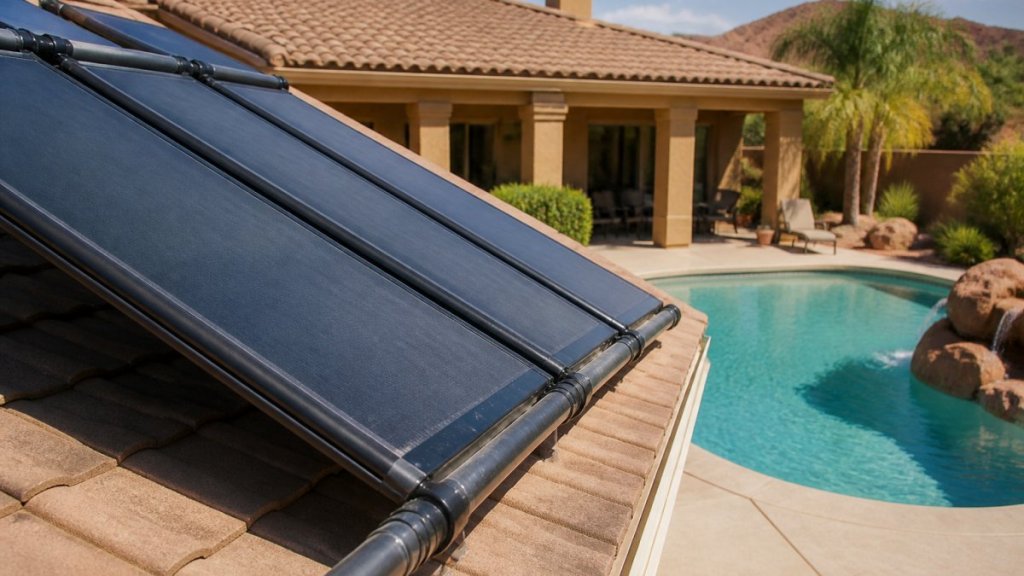
Solar pool heating is a system of collectors, usually roof-mounted panels, that circulates pool water and returns it warmer. A solar pool cover is a floating blanket that traps heat and cuts evaporation.
They are not the same product, and they change your chemistry in different ways.
- Heating raises water temperature, which speeds chemical reactions
- Covers reduce evaporation, which means less water loss and less chemical loss
- Covers also block sunlight, which slows algae growth and UV-driven chlorine loss
A heated pool with no cover loses more heat overnight and burns through more sanitizer. A covered pool holds heat and holds chemistry steadier. Used together, they cut chemical demand on both fronts.
Heat vs. Sunlight: Separating Two Effects on Your Pool
Two forces attack your chlorine, and they are not the same force.
Heat drives chemical reactions. Warmer water means chlorine reacts faster with contaminants, and it also degrades faster on its own. Sunlight, specifically ultraviolet rays, breaks down free chlorine directly at the water’s surface.
Why does the distinction matter? Because the fix is different:
- If heat is the problem, you adjust chemical levels and circulation
- If UV is the problem, you add stabilizer or shade the surface
- If both are working together, you need to address both
In practice, most warm pools face both at once. A heated pool in full sun loses chlorine to heat and UV simultaneously. That is why testing matters more on a heated pool than a cold one.
Heated Pool Chlorine Demand: Why Warm Water Burns Through Sanitizer
Heated pool chlorine demand rises because warm water accelerates the chemical processes that consume sanitizer. Chlorine does its job faster in warm water, which means it also gets used up faster.
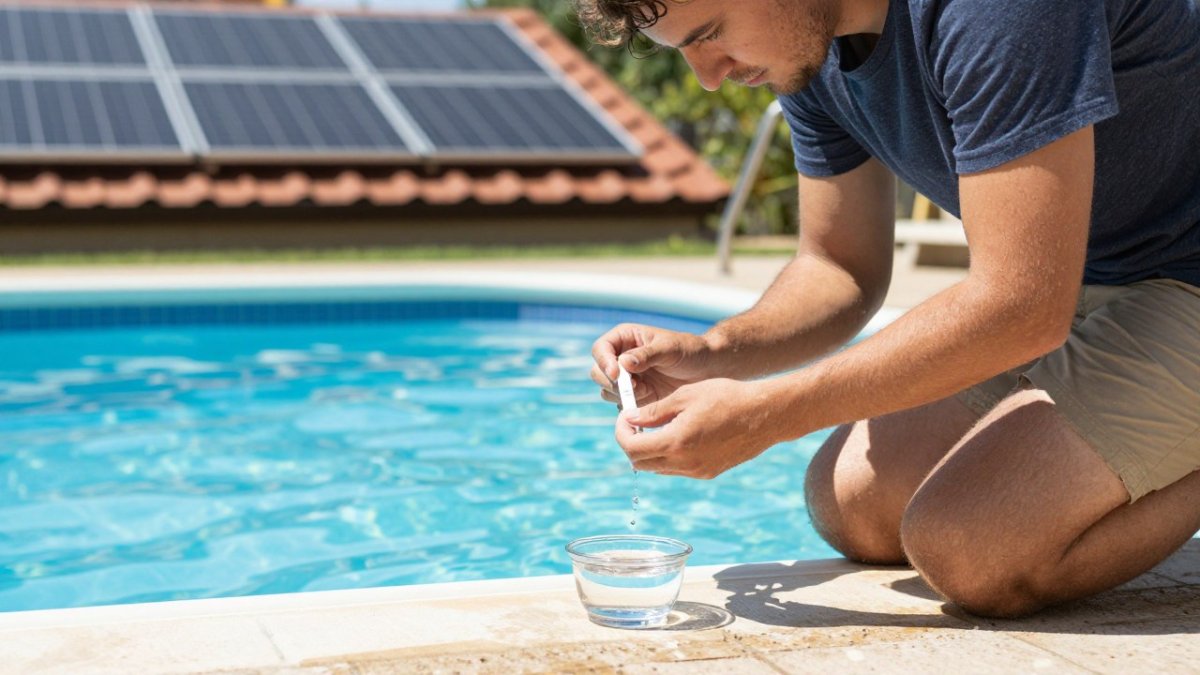
Warm water, strong sunlight, and heavy bather load can together draw down free chlorine. A pool that holds its level in cool weather can drop faster once the water warms up.
A common mistake is topping off chlorine without checking stabilizer. If cyanuric acid is too low, sunlight destroys the chlorine you add before it can work. If it is too high, chlorine gets locked up and stops sanitizing.
We recommend testing free chlorine and stabilizer together, not separately. For a closer look at how heat and sun wear on a system, see our guidance on maintaining pool chemistry in hot weather.
Pool pH Changes With Temperature: What to Watch
Pool pH changes with temperature because warmer water shifts the balance between dissolved gases and the carbonate buffer system. The direct temperature effect on pH is small, while indirect effects such as increased aeration, faster CO2 off-gassing, and higher biological activity can move readings.
Here is the mechanism in plain terms. Warmer water holds less dissolved carbon dioxide. As CO2 leaves the water, faster at higher temperatures and faster still when returns, waterfalls, or spa spillovers agitate the surface, the carbonate equilibrium shifts and pH rises.
Watch these signs:
- pH creeping above 7.8 without chemical additions
- Cloudy water despite normal chlorine readings
- Scale forming at the waterline, on tile, or inside the heater and collectors
- Chlorine feeling less effective even at normal levels
- pH that swings widely after rain or heavy bather load
High pH is a quiet problem. Chlorine loses killing power as pH climbs, at pH 8.0, hypochlorous acid (the active sanitizing form) is a small fraction of what it is at pH 7.4.
Keep pH in the 7.4 to 7.6 range and check total alkalinity alongside it. A common pattern in heated pools is rising pH paired with stable or slowly falling alkalinity, which points to aeration-driven CO2 loss rather than a dosing error. If alkalinity is below 80 ppm, raise it with sodium bicarbonate before chasing pH. If alkalinity is above 120 ppm and pH is high, lower both with muriatic acid, then aerate to bring pH back up without raising alkalinity.
Watch out: adding pH decreaser without checking alkalinity first can crash the buffer and send pH into a swing that is harder to correct than the original drift. Test alkalinity before every pH adjustment on a heated pool.
Temperature also affects how you read your test kit. Most residential kits are calibrated for water in the 70s Fahrenheit; samples taken from a solar return can read differently if the water is very warm.
Algae Growth in Warm Water and How to Prevent It
Warm water does not cause algae on its own, but it shortens the window between a chlorine dip and a visible bloom. The key variable is not temperature alone, it is the combination of water temperature, free chlorine level, cyanuric acid level, and circulation.
The chlorine/CYA relationship matters for algae control.
Algae prevention comes down to four levers: sanitizer steady, water moving, pH in range, and no dead spots.
Steps that work:
- Run your pump long enough to turn over the full pool volume daily, typically one full turnover, and more in warm weather or heavy use. A 20,000-gallon pool needs about 20,000 gallons pumped per day; check your pump’s flow rate at the filter gauge to confirm you are actually hitting it.
- Brush walls, steps, and the transition line weekly. Algae settles in low-flow spots, behind ladders, under returns, in corners, where warm water sits still.
- Shock when free chlorine drops below your target range for your CYA level, not below a fixed number.
- Keep stabilizer in a sensible range (30-50 ppm for most residential pools) so chlorine survives sunlight without being over-stabilized.
- Fix dead spots in circulation. Adjust return eyeballs, add a return if needed, and make sure the solar system’s bypass and flow settings are not starving the pool of turnover.
Watch out: running the solar system can change circulation patterns. If your system diverts a large share of flow through the collectors, the pool itself may turn over more slowly than you think.
Warm water plus poor circulation is the classic setup for a bloom. Early warning signs are a green tint on steps or walls, a chlorine demand that will not hold overnight, or water that looks dull rather than clear.
Temperature-specific guidance: below 70°F, algae growth is slow and a brief chlorine dip is usually forgiving. Between 70°F and 80°F, keep free chlorine at the low end of your target and test twice weekly.
Pool Water Turning Green After Heating: Causes and Fixes
Pool water turning green can point to a chlorine drop, a pH swing, or copper in the water. Warm water can make these problems develop faster.
Work through it in order:
- Test free chlorine first. A near-zero reading means algae is starting. Shock and brush.
- Check pH and alkalinity. High pH weakens chlorine and can cloud the water.
- Look for staining or clear green water. Clear green with no cloudiness can mean copper, often from equipment corrosion.
- Check your heating system. If green appears right after the system runs, inspect for leaks or degraded components. Our article on common problems with solar pool heating systems covers what to look for.
Protecting Solar Collectors, Piping, and Pool Equipment
Poor water chemistry does not just affect swimmers. It attacks the system that heats the pool. Corrosion and scale formation are the two main threats, and both get worse as temperature rises.
- Scale builds on collectors and in piping when calcium hardness and pH run high. Scale insulates the panel, so heat transfer drops.
- Corrosion eats at metal components when pH runs low or water is aggressive.
- Leaks develop where scale or corrosion has weakened joints and tubing.
A balanced pool protects the equipment. That means keeping pH, total alkalinity, calcium hardness, and stabilizer in range, not just chlorine.
Before you wrap a system for the season, it pays to know how to inspect solar pool panels for damage. And if your tubing is aging, check our guide on when to replace solar pool heating tubing before a small leak becomes a big repair.
Your Pool Chemistry Testing Schedule for a Heated Pool
A pool chemistry testing schedule for a heated pool should be tighter than for an unheated one. Warmer water moves faster, so your readings move faster too.
| What to Test | How Often | Target Range |
|---|---|---|
| Free chlorine | 2-3 times per week | 1-3 ppm, steady |
| pH | 2-3 times per week | 7.4-7.6 |
| Total alkalinity | Weekly | 80-120 ppm |
| Calcium hardness | Monthly | 200-400 ppm |
| Cyanuric acid | Monthly | 30-50 ppm |
Test more often during heat waves, heavy swimming, or after storms. Keep a simple log so you can spot trends before they become problems. A pool that holds steady readings week to week is a pool that will not surprise you.
Warmer water rewards a steady hand on chemistry. If your pool runs warm for more of the year, the testing and balancing routine matters more, not less. Dixie Pool Solar Heating & Misting offers Heliocol panels with a 12-year panel warranty and a 2-year labor warranty on other labor. For current pricing or a quote, visit our website.
Frequently Asked Questions
Does warmer pool water use up chlorine faster?
Yes. Chlorine reacts faster as water temperature rises, so a heated pool burns through sanitizer more quickly than an unheated one. That is why heated pool chlorine demand climbs as you extend the season into cooler months. Test free chlorine more often once the system is running, and expect to adjust your dosing routine rather than assume last season’s schedule still holds. Keeping cyanuric acid in the recommended range also slows chlorine loss from sunlight, which matters just as much as temperature.
Can solar pool heating affect pH or alkalinity?
The heating itself does not directly change pH, but warmer water shifts the balance. Carbon dioxide leaves warm water faster, which can push pH upward, and aeration through collectors adds to that effect. Total alkalinity acts as the buffer that keeps pH stable, so test both weekly. If pH drifts up repeatedly, adjust alkalinity first, then pH. Aim for pH between 7.4 and 7.6 and total alkalinity in the 80 to 120 ppm range for most pools.
How often should I test pool water when the pool is heated?
Test free chlorine and pH two to three times per week during the swim season, and total alkalinity weekly. Calcium hardness and cyanuric acid can be checked monthly. After any heavy rain, large water addition, or a stretch of unusually hot weather, test again before swimming. Keep a simple log of results so you can spot trends, such as chlorine dropping faster than usual, before they turn into cloudy water or algae.
Can solar-heated pool water turn green?
It can, but the heat is usually not the direct cause. Warm water speeds up algae growth, and if free chlorine falls below the level needed to sanitize, algae takes hold quickly. Poor circulation, low cyanuric acid, or a pH that keeps chlorine from working all contribute. If the water turns green after heating, shock the pool, brush the walls, run the filter continuously, and recheck pH and stabilizer levels before resuming normal dosing.


Leave a Reply