
Table of Contents
- Why Pool Chemistry Changes in Hot Weather
- How Often to Test Pool Water in Summer
- Managing Pool Chlorine Levels in Hot Weather
- Balancing Pool pH in Hot Weather
- Maintaining Total Alkalinity and Water Circulation
- Your Pool Water Testing Schedule
- Preventing Algae and Managing Water Loss
- Troubleshooting Out-of-Range Results
- Frequently Asked Questions
Last Updated: October 17, 2026
Why Pool Chemistry Changes in Hot Weather
Heat and sunlight fundamentally alter how your pool water behaves, making maintaining pool chemistry in hot weather essential to pool care. When temperatures rise, chemical reactions speed up. Chlorine breaks down faster. Algae grows more aggressively. Your pH shifts unpredictably. The hotter it gets, the more actively your pool chemistry works against you.
This is where maintaining pool chemistry in hot weather becomes critical. Maintaining pool chemistry in hot weather is critical. Summer isn’t just about enjoying warm water, it’s about keeping that water safe and clear when nature is working hardest to destabilize it.
UV rays from sunlight directly attack chlorine molecules. A sunny day can reduce your free chlorine levels by 20-30% faster than a cloudy one. High water temperatures accelerate chemical reactions. Bather load increases during hot months. More people mean more contaminants entering the water. All of these factors compound simultaneously.
The result? A pool that requires more attention, more testing, and more precise chemical management than it does during cooler months.
How Often to Test Pool Water in Summer
During hot weather, test your pool water every 2-3 days minimum. Many pool owners find that daily testing becomes necessary during heat waves or periods of heavy use.
Here’s why frequency matters more in summer:
- Chlorine demand increases dramatically when UV exposure peaks
- Temperature fluctuations can shift pH within hours
- Algae growth accelerates in warm conditions
- Evaporation concentrates chemicals, changing your alkalinity and stabilizer levels
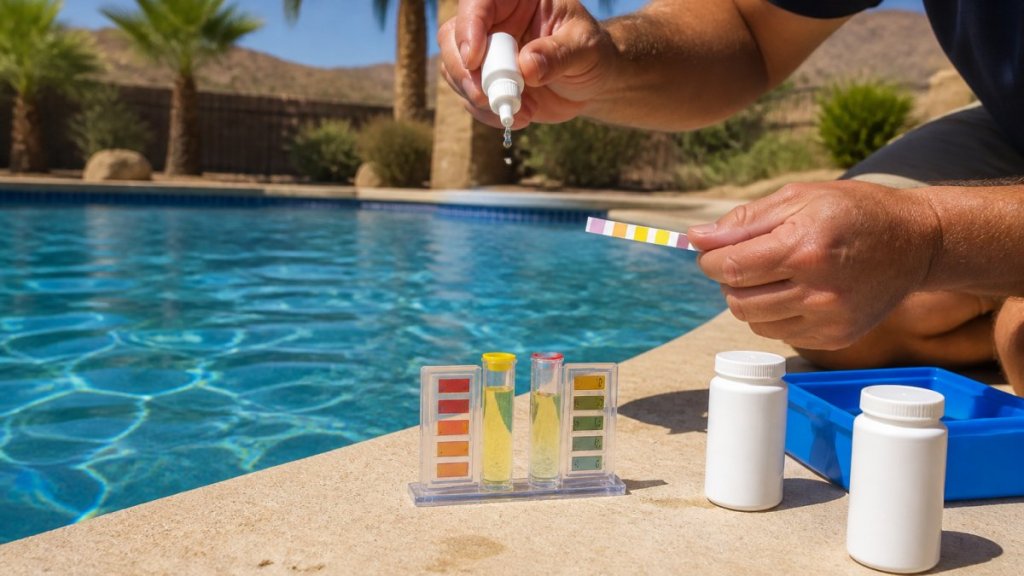
Your test kit should measure these core parameters:
- Free chlorine (the active disinfectant)
- Total chlorine
- pH level
- Total alkalinity
- Cyanuric acid (stabilizer)
Most pool owners test in the morning before anyone swims. This catches overnight changes and gives you time to adjust chemicals before the day’s use. If you notice unusual water clarity or smell strong chlorine, test immediately, don’t wait for your scheduled time.
Keep your test kit poolside during summer months. Quick access means you’re more likely to test consistently, and consistent testing catches problems before they become expensive.
Managing Pool Chlorine Levels in Hot Weather
Understanding Chlorine Demand During Heat and UV Exposure
Free chlorine is your pool’s primary defense against bacteria and algae. In hot weather, maintaining proper free chlorine levels becomes your single most important task.
Target range: 1.0-3.0 ppm (parts per million) for residential pools. During extreme heat or heavy use, keep levels at the higher end of this range.
Heat accelerates chlorine breakdown. Sunlight destroys chlorine molecules through UV exposure. Combined, these forces can deplete your free chlorine by 0.5-1.0 ppm per day during peak summer conditions. Without stabilizer protection, losses can be even steeper.
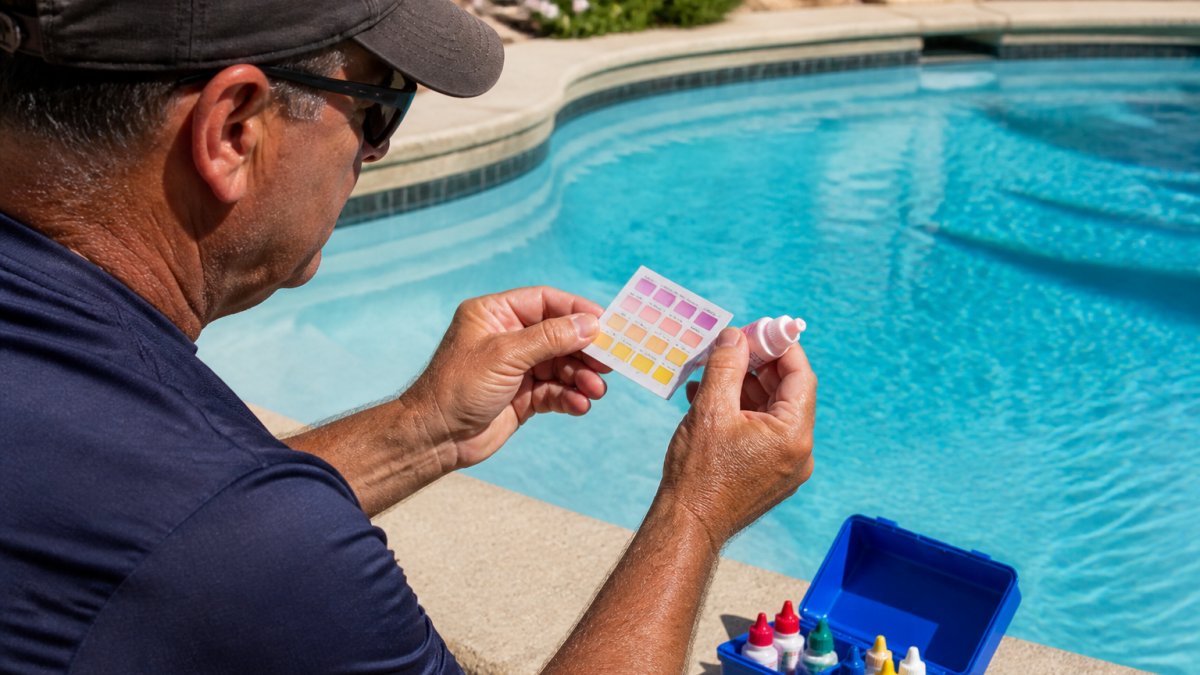
When free chlorine drops below 1.0 ppm, your pool becomes vulnerable to algae and bacteria. Green water or cloudy appearance signals that chlorine is depleted. At this point, you need to shock your pool, add a large dose of chlorine quickly to restore sanitizer levels.
Many pool owners undershoot during summer because they don’t realize how fast chlorine burns off. The fix is simple: add chlorine more frequently in smaller doses rather than waiting for levels to crash.
Stabilizing Chlorine With Cyanuric Acid
Cyanuric acid (also called stabilizer or conditioner) protects free chlorine from UV breakdown. Think of it as a sunscreen for your chlorine.
Without stabilizer, unstabilized chlorine loses 90% of its strength in direct sunlight within hours. With stabilizer, that same chlorine lasts days.
Target stabilizer level: 30-50 ppm for outdoor pools. Never exceed 100 ppm, high stabilizer levels reduce chlorine effectiveness and make it harder to adjust your water chemistry.
Add stabilizer once at the start of pool season. You rarely need to add more during summer unless you drain and refill significant portions of your pool. Stabilizer doesn’t break down or evaporate, it accumulates over time.
Do not confuse stabilizer with chlorine. Many pool owners add stabilizer when they should be adding free chlorine, or vice versa. Test your cyanuric acid level separately. If stabilizer is already at 50 ppm, adding more will not help your chlorine last longer, it will actually make your chlorine less effective.
Balancing Pool pH in Hot Weather
pH measures how acidic or basic your water is. Target range: 7.2-7.8 for residential pools.
Heat pushes pH upward. As water temperature rises, pH naturally climbs toward the basic (alkaline) side. High pH causes chlorine to work less effectively. It also makes water cloudy and can damage pool equipment over time.
Test pH every 2-3 days during summer. If pH creeps above 7.8, add pH decreaser (sodium bisulfate) to bring it back into range. Follow product instructions for dosing, typically 1.5 pounds per 10,000 gallons lowers pH by 0.2 points.
Wait 4-6 hours after adding pH decreaser before retesting. Chemicals need time to distribute through the water.
High pH also makes total alkalinity harder to manage. Alkalinity acts as a buffer that stabilizes pH. If alkalinity is too high, pH becomes stubborn and resists adjustment. This is why total alkalinity management matters in hot weather.
Maintaining Total Alkalinity and Water Circulation
Total alkalinity is the buffer that keeps pH from swinging every time you add chlorine or it rains. Target range: 80-120 ppm. When alkalinity is in range, pH moves slowly and predictably. When it is out of range, every other adjustment fights you.
Why alkalinity climbs in hot weather: evaporation removes water but leaves dissolved minerals behind. Each top-off adds fresh water with its own mineral content, and the net effect over a hot, dry week is a slow rise. High alkalinity (above 120 ppm) makes pH stubborn, you add decreaser, pH drops, then bounces back within a day. That is the signature of an alkalinity problem masquerading as a pH problem.
Lowering alkalinity takes patience and a specific technique. Follow product instructions for dosing and retest after the recommended interval.
If alkalinity is low (below 80 ppm), add alkalinity increaser (sodium bicarbonate) per label. Low alkalinity lets pH swing wildly, which is its own equipment and swimmer-comfort problem.
Circulation is the other half of stability. Your pump must turn over the full volume often enough to distribute chemicals and keep dead zones from forming. During summer, run the pump 8-12 hours daily; during heat waves or heavy bather load, 12-16 hours. Longer runtime does three things: it spreads sanitizer evenly, it pulls algae spores into the filter before they settle, and it keeps temperature more uniform so chemistry behaves predictably.
A practical check: if you can see debris sitting on the pool floor in a corner an hour after the pump starts, you have a dead zone. Adjust return jets toward that corner rather than simply adding more pump hours.
Fix alkalinity before pH. A pool with alkalinity in range holds pH for days; a pool with high alkalinity fights every pH adjustment you make. Circulation is the second lever, no amount of chlorine compensates for stagnant water.
Your Pool Water Testing Schedule
Create a routine and stick to it. Consistency beats perfection.
| Test Parameter | Frequency | Ideal Range | Action if Out of Range |
|---|---|---|---|
| Free Chlorine | Every 2-3 days (daily during heat waves) | 1.0-3.0 ppm | Add chlorine or shock if below 1.0 ppm |
| pH | Every 2-3 days | 7.2-7.8 | Add pH decreaser if high; pH increaser if low |
| Total Alkalinity | Weekly | 80-120 ppm | Add pH decreaser gradually if high |
| Cyanuric Acid | Weekly | 30-50 ppm | Add stabilizer only if below 30 ppm |
| Water Level | Every 3-5 days | Within 6 inches of skimmer | Top off with fresh water if low |
Test in the morning before anyone swims. Record results in a notebook or phone app. Tracking patterns helps you spot trends before they become problems.
If your pool consistently shows high chlorine demand, consider adding more stabilizer (up to the 50 ppm target). If pH keeps rising, your total alkalinity may be too high, address alkalinity first, then pH will be easier to control.
Preventing Algae and Managing Water Loss
Algae thrives in warm water with inadequate chlorine. Prevention is far easier than treatment.
Keep free chlorine at 2.0-3.0 ppm during peak summer months. This higher level (versus the minimum 1.0 ppm) provides a safety margin. If chlorine drops quickly due to UV or bather load, you have buffer before reaching dangerous lows.
Brush pool walls and steps weekly. Algae spores settle on surfaces. Brushing removes them before they establish. Pay special attention to shaded areas where circulation is weak.
Water loss accelerates in hot weather. Evaporation increases. Splashing removes water. Check your water level every 3-5 days. If it drops more than 1 inch per day, you may have a leak. If loss is normal evaporation, top off with fresh water.
Adding fresh water dilutes your chemicals slightly. Each top-off lowers chlorine, alkalinity, and stabilizer concentrations. This is why frequent testing matters, topping off changes your water chemistry.
In extreme heat, consider adding water during cooler evening hours. This reduces evaporation loss and gives chemicals time to distribute before the next day’s heat.
Troubleshooting Out-of-Range Results
When a test comes back out of range, work in a fixed order so you do not undo your own adjustments. The sequence that works: confirm the reading, fix alkalinity first, then pH, then sanitizer, then stabilizer, and retest between each step.
Step 1: Confirm the reading. Retest with fresh reagent or a second strip. A single bad reading is the most common cause of over-dosing. If two tests agree, proceed.
Step 2: Alkalinity before pH. If alkalinity is above 120 ppm, lower it in 10 ppm increments with pH decreaser, waiting 24 hours between doses. If alkalinity is below 80 ppm, raise it with sodium bicarbonate.
Step 3: pH. Target 7.2-7.8. High pH (above 7.8) reduces chlorine’s killing power, add pH decreaser per label, wait 4-6 hours with the pump running, then retest.
Step 4: Free chlorine. Target 1.0-3.0 ppm, holding the upper end (2.0-3.0 ppm) during heat waves.
Step 5: Combined chlorine and smell. A strong chlorine smell with adequate free chlorine means chloramines. Shock to break them down; the smell disappears as combined chlorine is oxidized. Retest after the shock has circulated overnight.
Step 6: Stabilizer. If cyanuric acid is below 30 ppm, add stabilizer to reach 30-50 ppm.
Step 7: Retest timing. After any adjustment, run the pump continuously and wait the label’s stated interval, usually 4-6 hours for pH and 24 hours for alkalinity, before retesting.
Safety and chemical handling. Store chlorine and acid separately, never mix them, and add chemicals to water, not water to chemicals. Wear gloves and eye protection, and keep all chemicals out of reach of children and pets.
Never combine troubleshooting steps into one big dose. Adjust one parameter, circulate, retest, then move to the next. Stacked corrections are the fastest route to a pool you cannot balance.
Frequently Asked Questions
How often should I test pool water in hot weather?
Test your pool water at least twice weekly during hot weather and heavy use. If temperatures exceed 85°F or you’re running your pool daily, test every other day. High heat increases chlorine demand and pH drift, so frequent testing catches imbalances before they affect water safety and clarity. Use a reliable test kit or strips to check free chlorine, pH, total alkalinity, and cyanuric acid levels.
Why does a pool use more chlorine when it is hot?
Heat and UV sunlight break down chlorine molecules faster, increasing chlorine demand. Swimming activity also consumes chlorine as it sanitizes contaminants from bathers. In hot weather, chlorine can deplete 15-25% faster than in cooler months. Adding stabilizer (cyanuric acid) slows UV breakdown, but you’ll still need to increase chlorine doses and test more frequently to maintain safe disinfectant levels.
How do I keep pool chlorine levels stable during a heatwave?
Maintain free chlorine between 2-4 ppm during a heatwave by testing every other day and adjusting doses as needed. Ensure cyanuric acid levels stay between 30-50 ppm to shield chlorine from UV breakdown. Run your pump for 8-12 hours daily to distribute chemicals evenly. Brush pool walls and tiles daily to prevent algae growth. If chlorine drops rapidly despite adjustments, check for leaks or excessive evaporation and top up water levels to maintain proper chemical concentration.
Does hot weather affect pool pH?
Yes, hot weather raises pH naturally as water temperature increases. Higher pH reduces chlorine effectiveness and can cause cloudiness and scale buildup. In hot weather, pH tends to climb toward 7.8-8.0 or higher. Test pH every 2-3 days and add pH decreaser (muriatic acid) as needed to keep pH between 7.2-7.6. Proper circulation and frequent testing are essential because pH changes accelerate in heat.


Leave a Reply