Table of Contents
- Pool Heating in Humid Climates: Why Standard Solutions Fall Short
- Most Efficient Pool Heating System for Humidity and Heat Loss
- Pool Heat Pump Efficiency in Humid Climates: Performance and Limits
- Solar Pool Heating Pros and Cons for Humid Regions
- Pool Heater Operating Costs: Annual Expenses by Type
- Sizing Your Pool Heater and Maximizing Performance in Humid Weather
- Which Pool Heating Solution Works Best for Your Climate
- Frequently Asked Questions
Last Updated: October 17, 2026
Pool Heating in Humid Climates: Why Standard Solutions Fall Short
Humidity fundamentally changes how pool heating works, and most owners don’t realize it until they’ve bought an underperforming system.
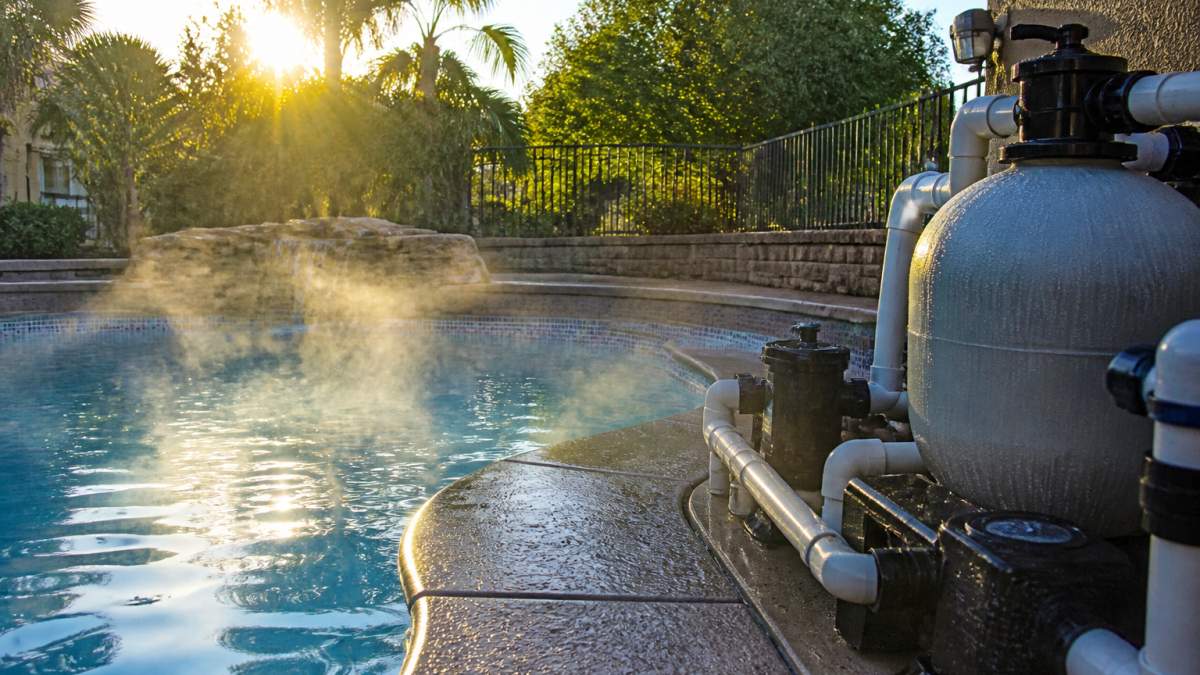
Humid climates create heat loss patterns standard solutions weren’t designed for: saturated air speeds evaporative heat loss, wind amplifies it, and shade reduces solar gain, so your system works harder, costs more, and delivers less consistent temperatures.
This guide covers what actually works for pool heating humid climates, from why conventional approaches fall short to the solutions that deliver.
Most Efficient Pool Heating System for Humidity and Heat Loss
The most efficient pool heating system for humid climates balances three demands: capturing heat, minimizing evaporative loss, and managing operating costs.
Heat pumps rank highest for efficiency in moderate humidity because they move existing heat rather than generate it, using less energy than electric resistance or gas.
Solar thermal heating (distinct from photovoltaic panels) captures the sun’s heat through collectors, producing zero operating costs after installation where sun exposure is adequate.
Solar’s efficiency depends on seasonal sun availability.
In humid climates, the real efficiency gain comes from reducing heat loss, not just adding heat. A solar pool cover or thermal blanket prevents evaporation and can cut your heating needs by 40% or more. Pair this with any heating system and you’ll see dramatic cost reductions.
Pool Heat Pump Efficiency in Humid Climates: Performance and Limits
Heat pumps deliver coefficient of performance (COP) ratings of 3 to 5 in moderate climates, moving 3 to 5 units of heat into your pool per unit of electricity.
Wind exposure also hurts: moving air reduces the temperature differential the system exploits, and coastal or lakefront humid properties often see performance-degrading wind.
For year-round swimming or March-through-November access, a heat pump alone rarely delivers the expected comfort or cost-effectiveness; pairing it with solar or gas backup creates a more resilient system.
Solar Pool Heating Pros and Cons for Humid Regions
Solar thermal heating offers compelling advantages where factors align.
Heliocol panels installed by Dixie Pool Solar Heating & Misting carry an industry-leading 12-year panel warranty plus a 2-year labor warranty, and withstand humidity, salt air, and UV without degradation.
Solar also requires roof or ground space with southern exposure and minimal shade; properties with limited sun or heavy tree coverage won’t generate enough heat to justify the investment.
A hybrid addresses both limitations: solar as the primary system with a heat pump or gas heater as backup.
Solar heating works best in humid climates when paired with backup heating and a pool cover. This combination extends your season affordably while managing the variability that humidity and seasonal weather create.
Pool Heater Operating Costs: Annual Expenses by Type
Operating cost is where humid-climate pool heating decisions are won or lost, and it depends on four inputs: pool size, utility rates, season length, and evaporative heat loss.
The cost formula, stated plainly
Every heater’s annual operating cost reduces to the same equation:
Annual cost = (BTUs delivered to the pool ÷ heater efficiency) × hours of operation × local fuel price
For a heat pump, “efficiency” is COP (coefficient of performance). For a gas heater, it is annual fuel utilization efficiency (AFUE), typically 82%-95% for modern units. For solar thermal, the fuel price is zero after installation, so the equation collapses to maintenance and pump electricity only.
Worked example with transparent assumptions
Use a 15,000-gallon outdoor pool, a 10°F temperature lift, a March-through-November season (about 270 days), and a target of 82°F. Assume the pool loses roughly 3°F-5°F per day with a nightly cover and 6°F-8°F without one, those loss rates drive the hours the heater must run.
- Heat pump (COP 4.0, electricity at $0.16/kWh): Delivering roughly 100,000 BTU per day of make-up heat at COP 4.0 draws about 7.3 kWh, or about $1.17 per day. Over 270 days that is roughly $315 per season, before shoulder-season COP penalties.
- Gas heater (AFUE 85%, natural gas at $1.20 per therm): The same 100,000 BTU per day requires about 1.18 therms, or about $1.42 per day, roughly $383 per season. Propane at $2.50-$3.00 per gallon roughly doubles that figure.
- Electric resistance (COP 1.0, $0.16/kWh): About 29 kWh per day, or $4.64 per day, roughly $1,250 per season, the most expensive option to run and rarely the right choice for a full season.
These are illustrative figures built on stated assumptions, not quotes. Your actual numbers move with your utility rates, pool size, cover use, and setpoint.
Why humidity changes the math
In humid air the vapor-pressure gradient between pool surface and air is smaller, which reduces evaporation per unit of wind, but wind and uncovered surface area still dominate losses. The practical result: a cover is worth more than a heater upgrade in many humid-climate pools, because it attacks the loss side of the equation.
Lifecycle cost, not just first season
A fair comparison adds purchase, installation, maintenance, and replacement over service life. Gas and heat-pump units commonly last 10-15 years; quality solar panels carry 10-12 year warranties and are engineered for 20+ years. Spread installed cost across those years and add the operating figures above, and solar and hybrid systems usually win on total cost of ownership in humid climates with adequate sun.
Before you compare heaters, get your last 12 months of electric and gas bills and your utility’s current rate schedule. A 5-cent difference in $/kWh can flip the heat-pump-versus-gas decision for a full-season pool.
| Heating Method | Primary Cost Driver | Illustrative Seasonal Operating Cost* | Typical Service Life |
|---|---|---|---|
| Gas Heater | Fuel consumption (therms/gallons) | ~$380 natural gas; ~$760+ propane | 10-15 years |
| Heat Pump | Electricity ÷ COP | ~$315 | 10-15 years |
| Electric Resistance | Electricity at COP 1.0 | ~$1,250 | 10-15 years |
| Solar Thermal | Installation only | ~$30-$80 (pump) | 20+ years |
| Hybrid (Solar + Backup) | Backup usage only | ~$100-$160 | 20+ years |
*Illustrative only, based on a 15,000-gallon pool, 82°F setpoint, 270-day season, $0.16/kWh electricity, $1.20/therm natural gas, and nightly cover use. Substitute your own rates.
Sizing Your Pool Heater and Maximizing Performance in Humid Weather
Sizing is where most guides hand-wave and where humid-climate pools most often go wrong. A repeatable method beats a rule of thumb.
Step 1: Calculate the heat-up load
The standard formula for bringing a pool up to temperature is:
BTU required = gallons × 8.33 lb/gal × temperature rise (°F) ÷ hours to heat
For a 15,000-gallon pool and a 10°F rise over 24 hours: 15,000 × 8.33 × 10 ÷ 24 ≈ 52,000 BTU/hour. Over 48 hours, halve it to about 26,000 BTU/hour. This is the heat-up load, the capacity needed to raise temperature on demand.
Step 2: Calculate the maintenance load
Once at temperature, the heater only replaces standing losses from evaporation, radiation, and convection, which scale with surface area, wind, and the water-to-air temperature gap. A common estimate is 100-150 BTU/hour per square foot of surface uncovered, dropping by roughly half with a properly fitted nightly cover.
A 400-square-foot pool surface therefore needs roughly 40,000-60,000 BTU/hour of maintenance capacity uncovered, or about 20,000-30,000 BTU/hour covered.
Step 3: Adjust for humid-climate realities
- Wind: Surface agitation accelerates evaporation. A windbreak that cuts sustained wind across the pool can reduce the maintenance load meaningfully; without one, size toward the high end of the maintenance range.
- Shade: A shaded pool loses passive solar gain and needs more active capacity. Full-sun pools can size closer to the low end.
- Cover use: A cover is the single largest sizing lever. Decide up front whether the pool will be covered nightly, because it changes the required capacity by roughly half.
Step 4: Estimate heat-up time for any candidate heater
Invert the formula: hours = gallons × 8.33 × rise ÷ heater output (BTU/hour). A 100,000 BTU/hour heat pump heats the 15,000-gallon pool 10°F in about 12.5 hours under ideal conditions; a 75,000 BTU/hour unit takes about 17 hours. Use the manufacturer’s rated output at your expected air temperature, not the marketing peak.
Step 5: Match the technology to the load
- Solar thermal: Size collector area to roughly 50%-100% of pool surface area for a seasonal pool in a sunny humid climate; more area for year-round use. Solar has no rated BTU output independent of sun, so it is sized by area and orientation, not by heater rating.
- Heat pump: Choose a unit whose rated output at your shoulder-season air temperature meets the maintenance load; use the heat-up load to decide whether you need a larger unit or simply accept a longer recovery.
- Gas: Gas heaters are sized by output and recover fast, which suits pools that are heated on demand rather than held at temperature.
- Hybrid: Size solar to carry the summer maintenance load and the backup to cover shoulder-season maintenance plus heat-up.
The most common humid-climate sizing error is sizing to the heat-up load alone and ignoring maintenance losses, or vice versa. Run both numbers and size to the larger. Undersizing forces the heater to run continuously and never quite reach setpoint; oversizing wastes upfront money and short-cycles.
Performance metrics worth comparing
When comparing units, ask for three numbers at the same conditions: rated BTU/hour output, COP at a stated air and water temperature, and rated flow rate. A heat pump that hits its COP only at 80°F air will disappoint in a 55°F shoulder month. Compare solar panels on certified collector efficiency and warranty terms, and gas units on AFUE and recovery rate.
Which Pool Heating Solution Works Best for Your Climate
Your ideal solution depends on three factors: available sunlight, seasonal temperature range, and budget.
With 6+ hours of unobstructed southern sun daily and a focus on lowest long-term costs, solar thermal is the best choice.
The decision hinges on your swimming timeline, sun exposure, and financial priorities.
Extending your pool season in a humid climate requires a heating solution matched to your specific conditions.
Frequently Asked Questions
What is the most efficient pool heating system for humid climates?
Solar thermal heating systems are the most efficient option for humid regions because they harness free solar energy with no operating costs. In humid climates, solar panels still perform well despite cloud cover and moisture in the air. Heat pumps rank second, they pull heat from ambient air and water, achieving coefficient of performance (COP) ratings of 3-5 in warm, humid conditions. Gas heaters are the least efficient; they consume fuel continuously and lose heat through exhaust. For humid-climate pool owners, solar systems offer the lowest long-term operating costs, while heat pumps provide a solid middle ground if solar isn’t viable due to roof space or shading.
Do pool heat pumps work well in humid climates?
Yes, heat pumps perform reasonably well in humid climates because they extract heat from warm air and water rather than generating it. Humidity itself doesn’t reduce heat pump efficiency significantly, what matters is air temperature. In regions with warm, humid summers, heat pumps achieve strong COP ratings (3-5), meaning they produce 3-5 units of heat for every 1 unit of electricity consumed. However, humidity increases evaporation from your pool surface, which counteracts heating gains. Combining a heat pump with a pool cover or misting system reduces evaporation loss and improves net heating performance in humid environments.
How much can I save annually with solar pool heating versus gas or electric heating?
Solar pool heating systems eliminate operating costs after installation because they use free thermal energy from the sun. In humid climates with adequate roof space, homeowners typically save $1,500-$2,000 per year compared to gas heating, depending on pool size, usage season, and local fuel prices. Heat pumps reduce annual costs by 50-70% versus gas but still require electricity payments. Gas heaters cost the most to operate, propane and natural gas prices fluctuate, but typical annual heating expenses for a residential pool range from $2,000-$4,000. Solar systems also qualify for federal tax credits and some state incentives, further reducing net investment.
Will solar pool heating work if my pool is shaded part of the day or gets cloudy weather?
Solar pool heating works in partly shaded conditions and cloudy weather, though performance is reduced. Modern solar thermal panels (like Heliocol systems) continue to absorb and transfer heat even on overcast days because they capture diffuse solar radiation, not just direct sunlight. In humid climates with frequent cloud cover, solar heating takes longer to reach target water temperature but still operates year-round. Sizing your system appropriately, using more panel area, compensates for partial shading and cloud cover. If your pool receives at least 4-6 hours of direct sunlight daily, solar heating remains viable and cost-effective. For heavily shaded pools, heat pumps or hybrid systems combining solar with a heat pump backup offer better performance.


Leave a Reply