Table of Contents
- Best Solar Thermal Panels for Pools: Our Top Picks for 2026
- How We Evaluated Solar Thermal Panels for Pools
- Heliocol Panels: Built for Long-Term Performance
- Durable Solar Panels for Salt Pools: What to Look For
- How Many Solar Panels to Heat a Pool: Sizing Guide
- Solar Pool Heater Efficiency Ratings Explained
- Installation, Maintenance, and Troubleshooting
- Which Solar Thermal Panel Should You Pick?
- Frequently Asked Questions
Last Updated: September 7, 2026
Best Solar Thermal Panels for Pools: Our Top Picks for 2026
Solar thermal panels are the most cost-effective way to heat a residential swimming pool. For Southern Utah homeowners, a properly sized array can extend the swimming season from March through November. At Dixie Pool Solar Heating & Misting, we provide sustainable solar thermal solutions, and this guide breaks down which systems actually deliver.
The best solar thermal panels for pools balance heat output, durability against UV and chemicals, and warranty coverage. The cheapest panels often fail within five to seven years, while industrial-grade panels like Heliocol routinely last two decades or more (energy.gov).
Quick Comparison of Leading Panels
| Panel Type | Material | Best For | Typical Lifespan | Warranty Strength |
|---|---|---|---|---|
| Heliocol (Glazed) | Polypropylene | Long-term residential use | 20+ years | 12-year industry best |
| Unglazed Black Panels | Polypropylene | Warm climates, budget focus | 8-12 years | 5-10 years |
| Copper/Glass Glazed | Copper tubing | High heat output | 20+ years | 10-12 years |
| Rolled EPDM Mats | Rubber | Extreme budgets | 5-8 years | 3-5 years |
Quick Picks:
- Best Overall: Heliocol glazed panels, industrial construction with a 12-year warranty
- Best for Salt Pools: UV-stabilized polypropylene with corrosion-proof fittings
- Best Value: Unglazed polypropylene for mild climates with high sun exposure
How We Evaluated Solar Thermal Panels for Pools
Our evaluation focuses on real-world performance rather than marketing claims. We assess thermal efficiency, how effectively a panel transfers solar gain into heat for your pool water. Glazed panels with copper tubing achieve the highest heat transfer rates, while unglazed polypropylene models work best where air temperature stays above 50°F.
We also weigh structural factors heavily. Panel weight matters for roof-mounted systems, and mounting hardware must withstand Southern Utah‘s wind loads. Flow rate compatibility with your existing pump is critical, since undersized plumbing creates pressure drops that shorten pump life.
The panels with the lowest upfront cost almost never deliver the lowest cost per year of service. A 12-year warranty on an industrial panel beats a 5-year warranty on a budget panel every time.
Heliocol Panels: Built for Long-Term Performance
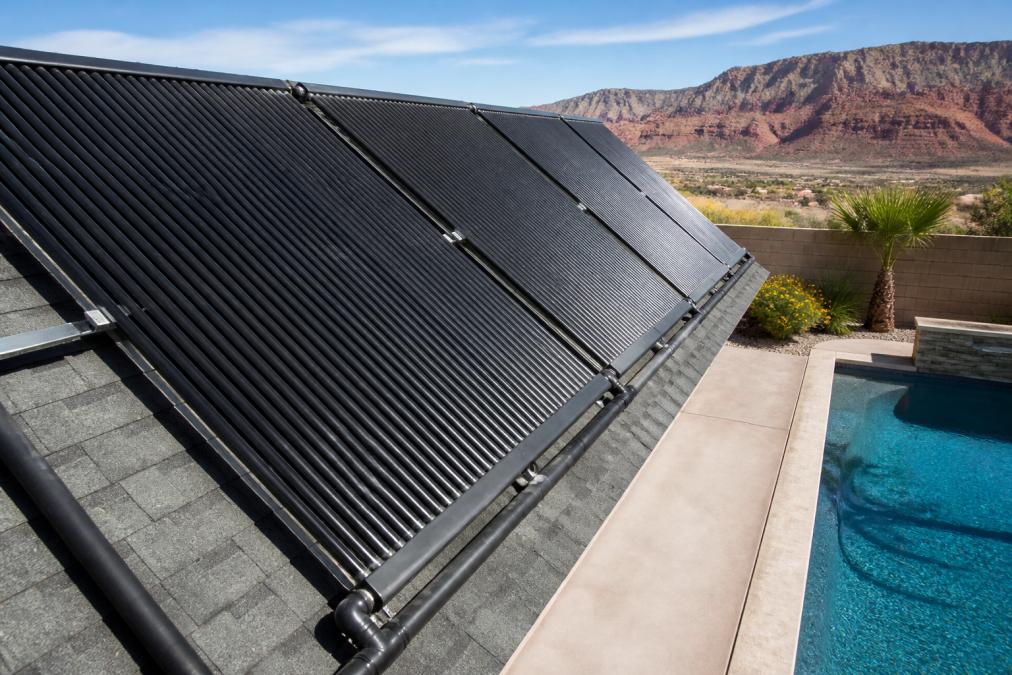
Our top pick for most residential pools is Heliocol, the system Dixie Pool Solar Heating & Misting recommends for Southern Utah homeowners. These panels use industrial-grade polypropylene that resists UV degradation and chemical exposure far better than consumer-grade alternatives. The glazed surface traps solar gain close to the collector, delivering more heat on marginal days.
The 12-year warranty on Heliocol panels is industry best. Heliocol’s industrial design also handles residential pump pressure without the bowing or warping that plagues thinner panels.
Ask your installer whether the mounting hardware and plumbing adapters carry the same warranty as the panels themselves. Labor coverage varies widely, and a 2-year workmanship warranty is the minimum you should accept.
Durable Solar Panels for Salt Pools: What to Look For
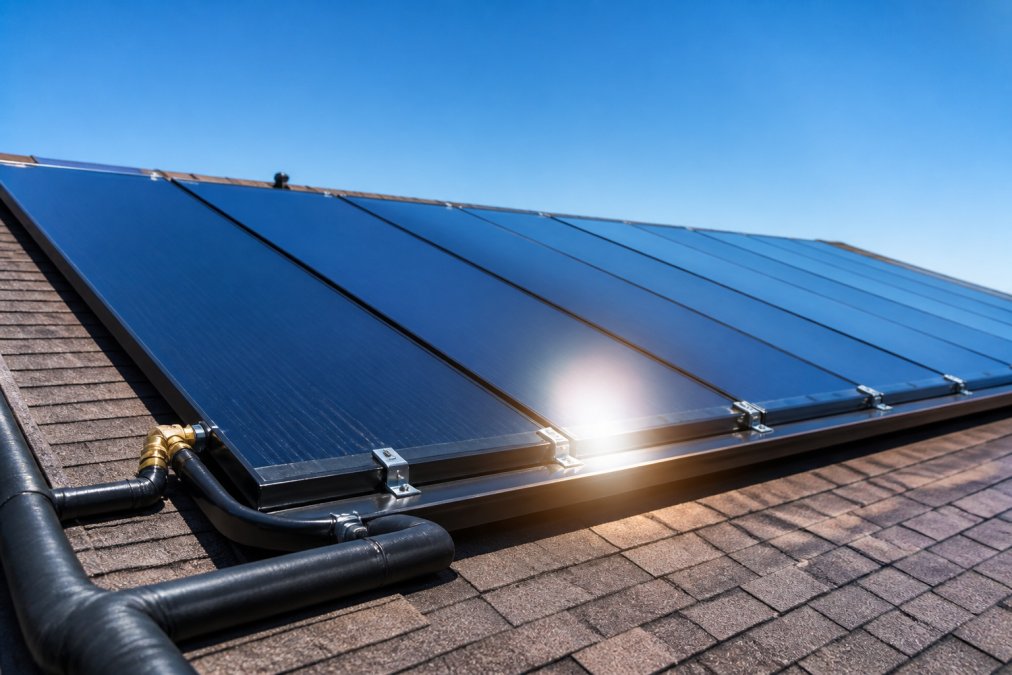
Salt water is the single biggest threat to pool heating equipment. The chlorine generated by salt systems attacks metal fittings and degrades rubber gaskets, so you need durable solar panels for salt pools with corrosion-proof components throughout. Look for polypropylene headers, EPDM seals, and stainless steel clamps rather than brass or zinc-plated hardware.
UV resistance matters just as much as chemical resistance. Panels exposed to Southern Utah’s high-desert sun need UV-stabilized polymers that won’t become brittle. Cheaper panels often fade and crack within three to four years, and replacing one panel means draining the entire array and re-plumbing the connections.
A common mistake is assuming all polypropylene panels handle salt equally well. The difference comes down to material density and the quality of UV inhibitors mixed into the plastic. Industrial panels like Heliocol use a denser polymer with higher inhibitor loading, which contributes to their 20-plus year lifespan rating even in harsh sun and salt.
How Many Solar Panels to Heat a Pool: Sizing Guide
The general rule is that your collector surface area should equal 50 to 100 percent of your pool’s surface area (energy.gov). A 400-square-foot pool therefore needs between 200 and 400 square feet of collectors, depending on climate, desired water temperature, and shade. High solar-gain regions allow sizing toward the lower end, but the more precise constraint is usually your pump’s flow capacity, not roof space.
Flow Rate Math: Matching Panels to Your Pump
Every manufacturer publishes a design flow rate, typically 4 to 6 GPM per 100 square feet of collector. A 300-square-foot array therefore demands 12 to 18 GPM. The question is whether your current pump can deliver that flow at the total head height of your roof-mounted array.
Here is the practical check most installers run:
- Find your pump’s performance curve. Most residential pumps (e.g., 1 HP or 1.5 HP) are rated at a specific GPM at a given feet of head. A typical 1 HP pump moves about 40 GPM at 10 feet of head, dropping to roughly 20 GPM at 30 feet of head, and a single-story roof with 50 feet of plumbing runs often lands in the 25-35 feet of head range.
- Subtract the pool’s baseline resistance. Your filter, heater, and skimmer lines already consume 10-20 feet of head. Add the solar array’s pressure drop, usually 2-5 feet of head.
- Compare the result to your pump’s curve. If total head pushes your pump below the required GPM, you have three options: run a dedicated solar pump, split the array into zones with a diverter valve, or reduce collector area.
A common failure pattern is a homeowner who buys a 400-square-foot array for a 20,000-gallon pool but has a 3/4 HP pump that simply cannot push 20+ GPM up to the roof. The system trickles water through the panels, heat transfer collapses, and the pool never warms. Always verify pump capacity before buying panels.
Roof Structural Integrity: The Load Check Nobody Does
Water-filled solar panels are heavy. A typical unglazed polypropylene panel weighs about 1.5 to 2 pounds per square foot when dry, but a full panel holds roughly 0.5 to 0.75 gallons of water per square foot, adding another 4 to 6 pounds per square foot. A 300-square-foot array therefore adds 1,500 to 2,400 pounds of live load, concentrated on the mounting feet.
Most residential roofs are engineered for a live load of 20 pounds per square foot, so a properly distributed array is usually fine (hud.gov). Problems arise when panels are concentrated on one roof plane or mounting feet land on unsupported sheathing. Before you commit to a roof mount, check three things:
- Rafter spacing and size: 2×6 rafters on 24-inch centers are marginal; 2×8 or larger on 16-inch centers are safer. Your installer should lag into the rafters, not just the decking.
- Roof age and condition: A roof with less than 5 years of life left should be replaced before you mount panels, since removing and reinstalling an array for a new roof costs $500 to $1,500 in labor.
- Mounting hardware rating: Look for stainless steel brackets rated for at least 100 pounds each, and verify the manufacturer’s wind-load rating for your region. Ground racks are a viable alternative if your roof is questionable.
A Sizing Formula That Accounts for Real Conditions
A practical formula for sizing solar panels is:
Collector Area (sq ft) = (Pool Surface Area × 0.75) × (Desired Temp Rise / 15°F) × (1 + Shade Factor)
The shade factor is 0.1 for full sun, 0.2 for light shade, and 0.3 for heavy afternoon shade. For a 400-square-foot pool wanting a 15°F rise in full sun, that works out to 300 square feet. For the same pool wanting a 20°F rise with light shade, it becomes 400 × 0.75 × 1.33 × 1.2 = 480 square feet, significantly larger than the simple 50% rule suggests.
The 50-100% rule is a starting point, not a final answer. The real constraints are your pump’s flow capacity at head, your roof’s structural limits, and your desired temperature rise. Run those numbers before you buy, and you will avoid the two most common reasons solar pool systems fail to deliver.
Solar Pool Heater Efficiency Ratings Explained
Solar pool heater efficiency ratings measure how much of the sun’s energy striking the collector actually transfers into your pool water. Unglazed panels typically achieve 70 to 80 percent efficiency in ideal conditions, while glazed panels with copper tubing can reach 80 to 90 percent. The tradeoff is cost: glazed panels cost more per square foot but deliver more heat per square foot, meaning you need less total collector area.
Thermal efficiency drops as the temperature difference between the collector and outside air grows, which is why solar pool heating works best in spring and fall. When air temperatures fall below 50°F, even the best panels struggle to add meaningful heat, making solar a season-extender rather than a year-round solution in most climates.
What matters more than peak efficiency is how a panel performs across a full season. A panel rated at 90 percent efficiency in a lab may lose more output to wind and cloud cover than a slightly less efficient panel with better heat retention. Look for ratings tested at real-world flow rates rather than laboratory maximums.
Installation, Maintenance, and Troubleshooting
Professional installation matters far more with solar pool heating than with most other home systems. The array must handle wind loads, balance flow across all panels, and integrate with your pump and filter using diverter and vacuum relief valves. A poorly installed system leaks, underperforms, and can damage your pump. But even a well-installed system will eventually need attention, and knowing how to diagnose the most common failure modes will save you a service call.
Leak Diagnosis: Finding the Source Fast
Leaks almost always occur at the connections, not in the panels themselves. The most common failure points are:
- Plumbing adapters at the roof penetrations: These PVC-to-polypropylene transitions use a threaded fitting with an O-ring. UV exposure degrades the O-ring, and the joint starts weeping. Replace the O-ring and re-torque the fitting, a 15-minute job.
- Panel header connections: Panels connect with unions or barbed fittings. If water drips between panels, the union O-ring has failed. Drain the array, replace the O-ring, and re-tighten.
- Cracked panel tubes: Rarer, usually caused by freezing or a pressure spike from a stuck diverter valve. A cracked tube requires panel replacement, but you can isolate the damaged panel with ball valves to keep the rest of the array running while you source a replacement.
Before you call an installer, check whether the leak is active only when the pump is running. If it drips when the pump is off, you have a vacuum leak that is drawing air into the system, a different fix than a pressure-side leak.
Air Locks and Flow Issues: The Pump’s Silent Killer
Air locks are the most common DIY complaint. They happen when air gets trapped in the highest point of the array, usually because the vacuum relief valve (VRV) is stuck closed or installed at the wrong elevation. The VRV sits at the top of the array and opens to let air in when the pump shuts off, preventing the panels from collapsing under vacuum.
If your system has no flow but the pump is running, check the VRV first. Tap it gently, if stuck, water will not flow. Clean or replace it. A second cause is an undersized return line: if the return pipe is smaller than the supply, back-pressure stalls flow. Ensure both lines are the same diameter, typically 1.5 or 2 inches.
Diverter Valve Problems: The Silent Flow Killer
Diverter valves direct water either to the solar array or back to the pool. A stuck valve, often from debris or mineral buildup, can send all water to the panels even when the controller says bypass, or vice versa. Symptoms include the pool not heating despite full sun, or the pump straining with high pressure.
Most diverter valves have a manual override lever. If stuck, exercise the lever back and forth to break the seal. If that fails, disassemble the valve, clean the ball and seat, and apply silicone lubricant to the O-rings, a 20-minute job requiring no special tools.
Winterization: The One Task You Cannot Skip
Panels must be drained completely before freezing temperatures arrive, since trapped water expands and cracks the collector tubes. The standard procedure is:
- Close the supply valve from the pump.
- Open the vacuum relief valve to let air into the system.
- Open the drain valve at the lowest point of the array.
- Leave the valves open for the winter so any residual moisture can evaporate.
In mild climates, some homeowners leave the system charged but run the pump on freezing nights. This is risky, a power outage during a freeze will destroy the panels. Draining is always safer.
Maintenance Schedule That Prevents Most Failures
A simple seasonal checklist keeps your system running for decades:
- Monthly (swimming season): Visually inspect panels for debris, check for wet spots on the roof, and verify the controller shows flow.
- Quarterly: Exercise the diverter valve and VRV, and check the filter pressure gauge, a rise of 10 PSI above normal indicates a clogged filter that reduces flow to the solar array.
- Annually: Inspect all O-rings and gaskets, replace any that show cracking, and verify mounting hardware is tight.
Most solar pool heating failures are not panel failures, they are connection failures, air locks, and stuck valves. Learning to diagnose these three issues yourself will save you hundreds of dollars in service calls and keep your system running at peak efficiency for its full lifespan.
Which Solar Thermal Panel Should You Pick?
For Southern Utah homeowners, Heliocol glazed panels are a sustainable choice. The industrial polypropylene construction handles salt pools and intense UV exposure, and the 12-year warranty is industry best. With a 20-plus year expected lifespan, the annual cost of ownership can be significantly reduced compared to gas heaters or budget solar alternatives.
The decision comes down to how long you plan to stay in your home. For long-term homeowners, the math often favors paying more upfront for panels that will still be heating your pool two decades from now. Factor in the Utah state tax credit and gas rebates, and the payback period shortens considerably.
Frequently Asked Questions
What is the best solar heating system for pools?
The best system depends on your pool size, roof orientation, and local climate. Unglazed polypropylene panels are the most common and cost-effective choice for seasonal pools in sunny areas. Glazed panels with copper tubing offer higher efficiency for year-round use but cost more. Look for panels with UV-resistant materials and a strong warranty. For most residential pools, a properly sized unglazed system from a reputable brand like Heliocol provides the best balance of performance, durability, and value.
How many solar panels are needed to heat a swimming pool?
A common rule is to install panel area equal to 50-100% of your pool’s surface area. In Southern Utah’s high-sun climate, aiming for 70-80% is often sufficient to extend your season from March through November. A 20×40-foot pool (800 square feet) would need roughly 560-640 square feet of panels. Local installers can calculate exact requirements based on your pool’s exposure, shade patterns, and desired water temperature.
Are solar thermal panels worth it for residential pools?
For most pool owners, yes. Solar thermal systems typically pay for themselves within 2-5 years through reduced gas or electric bills. A family can save $1,500-$2,000 annually on heating costs. Panels last 20+ years with little maintenance, and tax credits can reduce upfront costs by up to $2,000. Unlike heat pumps, solar panels have no operating costs once installed. They also add property value and reduce your carbon footprint.
How do solar pool heater efficiency ratings compare to heat pumps?
Solar thermal panels have efficiency ratings typically between 70-85%, meaning they convert that percentage of available sunlight into heat. Heat pumps have efficiency ratings (COP) of 5-6, meaning they produce 5-6 units of heat per unit of electricity. However, solar uses free sunlight while heat pumps consume electricity constantly. In sunny climates, solar can offer a cost-effective alternative.
Will solar panels work with my existing pool pump?
Most solar thermal panels are designed to work with standard pool pumps. Panels require a minimum flow rate to operate efficiently. A 1 HP pump typically handles up to 600 square feet of panels. Professional installers check your pump’s flow rate and may recommend a diverter valve kit to direct water through the panels only when heating is needed. Proper integration protects both your pump and the solar system.
Choosing the right solar thermal panels for pools means looking past the sticker price and calculating the true cost per year of service. Dixie Pool Solar Heating & Misting installs industry-leading Heliocol panels backed by a 12-year warranty and 2-year labor coverage, with professional integration into your existing pool system. Get a free quote today and extend your swimming season from March through November without adding a cent to your utility bill.


Leave a Reply