Table of Contents
- Why Southern Utah Pool Owners Are Skipping Gas Heaters
- The Best Way to Heat a Swimming Pool Without Gas: Solar Thermal
- How to Heat a Swimming Pool Without Gas: A Step-by-Step Plan
- Solar Pool Heating Cost vs Gas: The Real Numbers
- Extending Swimming Season in the High Desert: What to Expect
- How to Get a Solar Pool Heating Quote in Utah
- Common Mistakes to Avoid When Switching to Non-Gas Heating
- Final Verdict: Is Non-Gas Pool Heating Right for You?
- Frequently Asked Questions
Last Updated: September 8, 2026
Why Southern Utah Pool Owners Are Skipping Gas Heaters
Rising utility rates and a high-desert climate that demands heat for nearly half the year have pushed many Southern Utah pool owners to reconsider how they warm their water. The question of how to heat a swimming pool without gas in Southern Utah is no longer a niche concern; it is becoming the default conversation for anyone building, buying, or retrofitting a residential pool from St. George to Cedar City. Gas heaters deliver fast results, but they come with continuous fuel costs that climb every winter.
At Dixie Pool Solar Heating & Misting, we help homeowners achieve the same comfort without the monthly gas bill. The technology is mature, reliable, and well-suited to the 300-plus days of sunshine the area receives. Below, we break down the most effective non-gas strategies, what they cost to run, and how to match a system to your pool and usage habits.
The Best Way to Heat a Swimming Pool Without Gas: Solar Thermal
Solar thermal pool heating is the most effective non-gas method for Southern Utah because it directly captures the sun’s heat and transfers it to your pool water. Unlike photovoltaic panels that generate electricity, solar thermal collectors warm water directly, making the process far more efficient for this single purpose.
How Solar Pool Heating Works
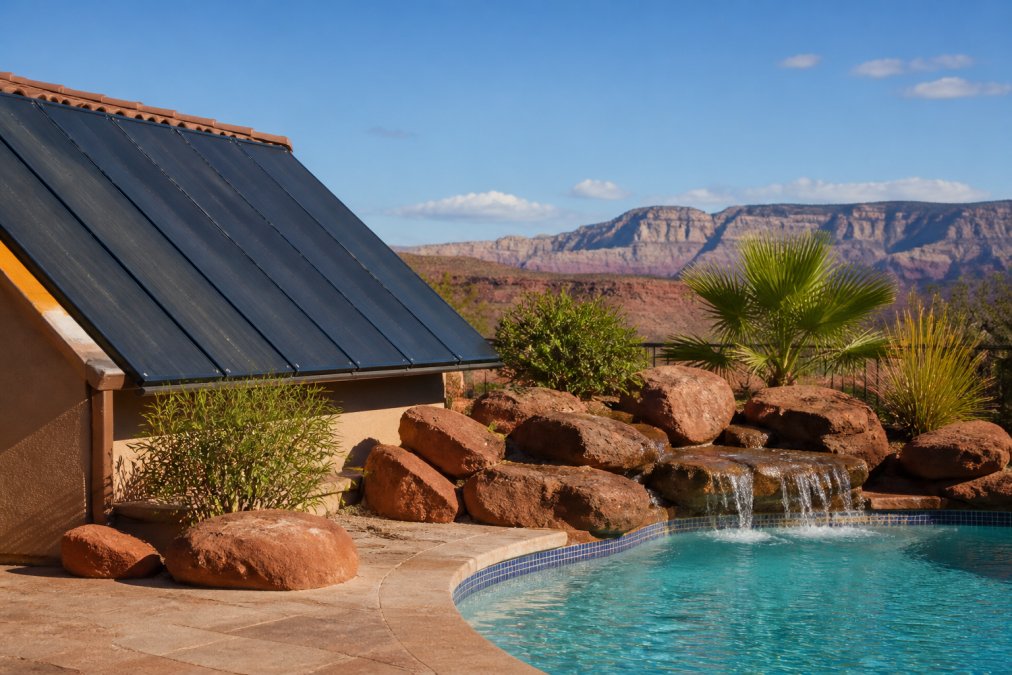
Solar thermal pool heating circulates pool water through rooftop collectors, where the sun warms it before it returns to the pool. The system relies on three main components: the solar collectors, a pool pump to move water, and a controller that diverts water to the collectors when they are warmer than the pool.
In Southern Utah’s climate, where ambient air temperature and solar radiation are both high for much of the year, the thermal gain is substantial. The pool pump already runs for filtration, so the only added operating cost is the small amount of electricity needed to run the controller and divert water.
How to Heat a Swimming Pool Without Gas: A Step-by-Step Plan
Switching to a non-gas system requires a plan that accounts for your pool’s size, orientation, and how you actually use it. The following steps outline the process from assessment to installation.
Step 1: Assess Your Pool and Sun Exposure
Start by measuring your pool’s surface area in square feet and noting where the sun hits your roof between 10 a.m. and 4 p.m. Solar collectors need unobstructed access to the sun during these peak hours to deliver meaningful heat. If your roof faces south or west with minimal shade, you have a strong candidate site.
Step 2: Calculate the Right System Size
A general rule is that your collector area should be roughly 50 to 100 percent of your pool’s surface area, depending on your target temperature and season length. A 500-square-foot pool typically needs between 250 and 500 square feet of collectors to maintain comfortable temperatures from March through November.
Step 3: Choose Between Solar Thermal and Electric Heat Pumps
This is the central decision in any plan for how to heat a swimming pool without gas in Southern Utah. Solar thermal systems have near-zero operating costs because they use free sunlight, while electric heat pumps consume electricity but work even on cloudy days.
| Heating Method | Operating Cost | Best For | Key Limitation |
|---|---|---|---|
| Solar Thermal | Near zero after install | Long season, sunny climates | Needs roof space and sun |
| Electric Heat Pump | Moderate (electricity) | Consistent heat, cloudy days | Higher utility bills |
| Gas Heater | High (fuel) | Fast heat-up | Ongoing fuel costs |
Step 4: Plan the Installation and Retrofitting
Retrofitting an existing pool is straightforward because solar thermal systems tie into your current pool plumbing. The installation involves mounting collectors on your roof, running supply and return lines, and connecting a controller that senses temperature differences. Most professional installations are completed in one to two days.
Step 5: Manage Your Pool for Maximum Heat Retention
Once your system is installed, heat retention becomes your primary job. A pool blanket is the single most effective tool for reducing heat loss, as evaporation is the largest source of heat loss in an open pool. Covering the pool overnight means your solar system spends less energy reheating water that already reached the target temperature.
Solar Pool Heating Cost vs Gas: The Real Numbers
The most common objection we hear is that solar thermal costs too much upfront. The comparison that matters is lifetime cost, not the initial installation price. A gas heater requires a continuous purchase of fuel every time you swim, and those costs accumulate year after year.
The Upfront Investment
Pricing for a professionally installed solar thermal system depends on the pool’s size, specific components, and installation requirements. This price typically includes the collectors, mounting hardware, controller, plumbing connections, and labor.
A new gas heater, by comparison, may have a lower initial cost. That lower sticker price is why many homeowners initially choose gas, but it ignores the fuel bill that arrives every month you heat the pool.
The Operating Cost Reality
A typical residential pool gas heater consumes a significant amount of fuel. Running it for several hours a day during the shoulder season can lead to substantial monthly costs. Over a heating season, the fuel cost alone can be considerable.
Solar thermal systems, by contrast, have near-zero operating costs. The pool pump already runs for filtration, and the only added expense is the small amount of electricity to run the controller. Over time, this difference can add up to significant savings in avoided gas purchases.
Payback Period in Southern Utah
If a solar system saves a homeowner a significant amount per year in avoided gas, it can pay for itself over time. The Utah state tax credit: 25 percent of the system cost, up to $2,000, can further reduce the effective upfront cost and shorten the payback period (tax.utah.gov).
Most solar thermal collectors carry a 20-year lifespan, and many, including the Heliocol panels we install, are warrantied for 12 years. That means the system operates free of fuel costs for a decade or more after it pays for itself.
The Comparison That Actually Matters
A gas heater is a recurring expense disguised as a lower upfront cost. Over 15 years, a gas-heated pool in Southern Utah can incur substantial fuel costs. A solar thermal system can offer significant savings over the same period, as the sun does not send a monthly bill.
When comparing costs, ask your installer for a 10-year and 15-year total cost projection that includes fuel, maintenance, and expected rate increases. The upfront price is only the beginning of the story.
What About Electric Heat Pumps?
A typical heat pump draws a certain amount of electricity per hour of operation. Running it for several hours per day can add to monthly utility bills, potentially cheaper than gas but still a recurring cost that solar avoids entirely after installation.
For homeowners who need consistent heat on cloudy days or want to extend the season into cooler months, a heat pump can make sense as a supplement. But as a primary strategy, it trades one utility bill for another.
Extending Swimming Season in the High Desert: What to Expect
Southern Utah’s high-desert climate presents a specific challenge: warm days give way to cool nights, and the swimming season is defined by how well your pool retains heat after sunset. Extending the season requires managing both heat gain during the day and heat loss at night.
With a properly sized solar thermal system, many pool owners extend their usable season from roughly April through October, and some stretch it from March through November with a pool blanket. The key variable is overnight temperature drop. In the high desert, nights can be 30 degrees cooler than the daytime high, so a pool that reaches 88 degrees by late afternoon may drop to 78 degrees by morning without a cover (weather.gov).
A pool blanket reduces this overnight loss substantially, meaning your solar system starts each day from a warmer baseline. This combination of solar thermal gain during the day and evaporation control at night is what makes a long season possible.
How to Get a Solar Pool Heating Quote in Utah
Getting a solar pool heating quote in Utah begins with a site assessment to evaluate your roof orientation, available sun, and pool size. Most reputable installers offer this as a free consultation.
When you request a quote, be prepared to share your pool’s dimensions, your typical swimming season, and any shading concerns. A professional installer will calculate the collector area needed, review your existing pool pump’s flow rate, and confirm that your roof structure can support the added weight of the collectors and water. At Dixie Pool Solar Heating & Misting, we provide this assessment as part of our free quote process, using Heliocol panels that carry a 12-year warranty.
Common Mistakes to Avoid When Switching to Non-Gas Heating
The most frequent mistake we see is undersizing the system. Homeowners often try to save money by installing fewer collectors than recommended, then find their pool never reaches a comfortable temperature in the spring or fall. The system runs constantly but cannot keep up with heat loss.
Another common error is neglecting the pool blanket. A solar thermal system paired with an uncovered pool will struggle to maintain temperature on cool nights, and the owner may blame the solar equipment when the real issue is evaporation. The blanket is a core component of an efficient non-gas heating strategy.
Skipping the pool blanket is the fastest way to undermine a solar heating system. Without it, overnight evaporation can erase much of the day’s thermal gain, forcing the system to work harder and slowing the payback period.
The Mistake Most Homeowners Make: Ignoring Local Incentives
Beyond sizing and blankets, the most expensive mistake we see in Southern Utah is homeowners who install a system without first researching available rebates and tax credits. The Utah state tax credit for residential solar energy systems, including solar pool heating, offers 25 percent of the system cost, up to $2,000. Many homeowners never claim it because they do not ask their installer about the paperwork.
The credit applies to the installed cost of the system, including labor and materials, and is claimed on your Utah state income tax return. You will need to complete the appropriate state tax form and attach documentation from your installer showing the system’s cost and specifications. Confirm this before signing a contract.
The Timing Mistake: Installing Without Checking Utility Programs
Some Utah municipalities and electric cooperatives periodically offer rebates or incentives for energy-efficient electric equipment, including pool pumps and heat pumps. These programs change frequently. Before committing to any non-gas heating system, check with your local utility provider to see whether current rebates apply to pool equipment.
The Integration Mistake: Forgetting About Smart Controls
A less obvious but increasingly common mistake is installing a solar thermal system without integrating smart controls or automation. In Southern Utah, where electricity rates can vary by time of day, pairing your pool pump and heating controller with a smart scheduling system lets you run the pump during off-peak hours or during peak solar production. This is particularly relevant if you pair solar thermal with an electric heat pump as a supplement.
Modern controllers from manufacturers like Heliocol offer scheduling features that let you set the system to heat only during specific windows. Taking time to configure these settings can reduce your electricity consumption noticeably over a season.
The Inspection Mistake: Skipping the Roof Assessment
Finally, do not skip a professional roof assessment before committing to solar collectors. Southern Utah’s red rock soil and high UV index mean roofs age differently than in other climates. A roofing contractor or your solar installer should verify that your roof structure can support the added weight of collectors and water, typically 2 to 3 pounds per square foot when filled (energy.gov).
Final Verdict: Is Non-Gas Pool Heating Right for You?
If you swim regularly from spring through fall and want to eliminate recurring fuel costs, non-gas pool heating is the right choice. Solar thermal offers the lowest long-term operating cost of any method, and in Southern Utah’s sunny climate, it delivers consistent results for the majority of the swimming season. Electric heat pumps remain a viable alternative for those who need heat on cloudy days, but they carry ongoing electricity costs.
The team at Dixie Pool Solar Heating & Misting specializes in solar thermal installations using Heliocol panels designed to last more than 20 years, backed by a 12-year warranty on all panels and a 2-year warranty on labor. With little to no maintenance required after installation, the system is designed to be a permanent, low-cost solution. If you are ready to stop paying for gas and start heating your pool with the sun, request a free quote.
Frequently Asked Questions
What is the most inexpensive way to heat a pool?
Solar thermal heating is the most inexpensive way to heat a pool over the long term. While the upfront installation cost exists, the system uses free sunlight and has almost no operating costs. In Southern Utah’s sunny climate, a properly sized solar system can offer significant energy savings, making it a cost-effective alternative to gas or electric heat pumps.
Can solar pool panels work effectively in the high desert climate?
Yes. The high desert climate is ideal for solar pool heating because of abundant sunshine and high solar gain, even in cooler months. The main challenge is managing heat loss from cool nights and wind. Pairing solar panels with a pool blanket or thermal cover reduces evaporation and retains heat, allowing you to extend your swimming season from March through November.
How much does it cost to heat a swimming pool with natural gas?
Natural gas pool heating costs vary with utility rates, but pool owners can incur significant annual expenses on gas alone. These costs fluctuate with market prices and are incurred every season. In contrast, solar thermal systems have no operating costs after installation, making them a stable, predictable investment that avoids the ongoing expense of gas.
How do I know what size solar pool heating system I need?
A general rule is to install solar collector area equal to 50% to 100% of your pool’s surface area. For example, a 20-by-40-foot pool needs 400 to 800 square feet of panels. Your installer should calculate the exact sizing based on your pool’s exposure, desired water temperature, and local climate to ensure you get reliable heat during the shoulder seasons.


Leave a Reply