Table of Contents
- Why Utah Winters Demand a Different Pool Cover Strategy
- Types of Winter Pool Covers: Mesh vs. Solid Pool Cover
- Safety Covers vs. Tarp-Style Covers: Which Protects Better?
- How to Measure a Pool for a Winter Cover
- Pool Cover Snow Load: What Utah Snow Means for Your Cover
- Anchors, Cables, and Water Bags: Installation and Attachment
- Pool Closing Checklist: Winterization for Utah Conditions
- Cost, Durability, and Choosing the Right Pool Cover
- Frequently Asked Questions
Last Updated: October 15, 2026
Why Utah Winters Demand a Different Pool Cover Strategy
Choosing the right pool cover for Utah winters starts with one fact: your cover has to survive snow, not just leaves. In Southern Utah, winters swing between warm sunny days and hard freezes, and a cover that works in a mild climate can fail here.
The right winter pool cover keeps debris out, blocks sunlight, and holds up under snow load. Get it wrong and you pay twice: at purchase and again at opening.
Types of Winter Pool Covers: Mesh vs. Solid Pool Cover
The mesh versus solid pool cover decision comes down to drainage. A mesh cover is woven fabric with tiny holes that drain water while blocking leaves and large debris. A solid cover is impermeable, stops everything including sunlight, but needs a pump to remove standing water.
Most pool owners in snowy regions pick one of these two, or a safety cover built from either material.
Mesh Covers: Drainage and Light Transmission
Mesh covers let rain and melted snow drain straight through, so you never bail water off the top, their biggest advantage in a wet winter.
The trade-off is light: mesh lets sunlight in, which can feed algae in a warm spring. Pair it with a proper chemical closing to offset this.
- Best for: snowy areas where meltwater is constant
- Watch for: algae growth if the pool was not closed clean
- Lifespan: often shorter than solid covers because UV wears the weave
Solid Covers: Blocking Light and Debris
Solid covers block all sunlight, stopping algae before it starts, and keep out fine dirt that mesh lets through.
The catch is water. Rain and snowmelt pool on top, and you must pump it off. A cover pump is not optional with a solid cover. Skip it and the weight can pull the cover into the pool.
- Best for: pools that sit under heavy tree cover
- Watch for: standing water if you skip the pump
- Lifespan: generally long, since the material is thicker
Safety Covers vs. Tarp-Style Covers: Which Protects Better?
A pool safety cover is anchored to the deck and rated to hold weight, making it the safer choice around children or pets.
If you have young kids or pets, this is not a close call. Choose a safety cover.
Safety covers cost more upfront but last longer and look cleaner, stretching tight instead of sagging. Tarp-style covers are cheaper and easier to self-install, but shift, tear, and need replacing sooner.
A tarp-style cover held down by water bags is not a safety barrier. It will not support the weight of a child or pet who falls onto it. If safety is a concern, use an anchored safety cover instead.
How to Measure a Pool for a Winter Cover
Measuring a pool for a winter cover means recording the longest and widest points plus the shape.
Follow these steps:
- Stretch a tape across the longest length of the pool, wall to wall
- Measure the widest width at the broadest point
- Note the shape: rectangle, oval, kidney, or freeform
- Measure the perimeter for a safety cover, which anchors around the edge
- Check the water level, since a cover sits relative to it
For a freeform or kidney pool, measure several points and sketch the outline so the cover follows the curve.
Edge overlap matters too: a cover should extend past the pool edge so it can be secured. Too small and it pulls loose in wind or under snow.
Measure at the water line, not the coping, for a tarp-style cover. For a safety cover, measure the deck edge where the anchors go. Mixing the two is the most common sizing mistake we see.
Pool Cover Snow Load: What Utah Snow Means for Your Cover
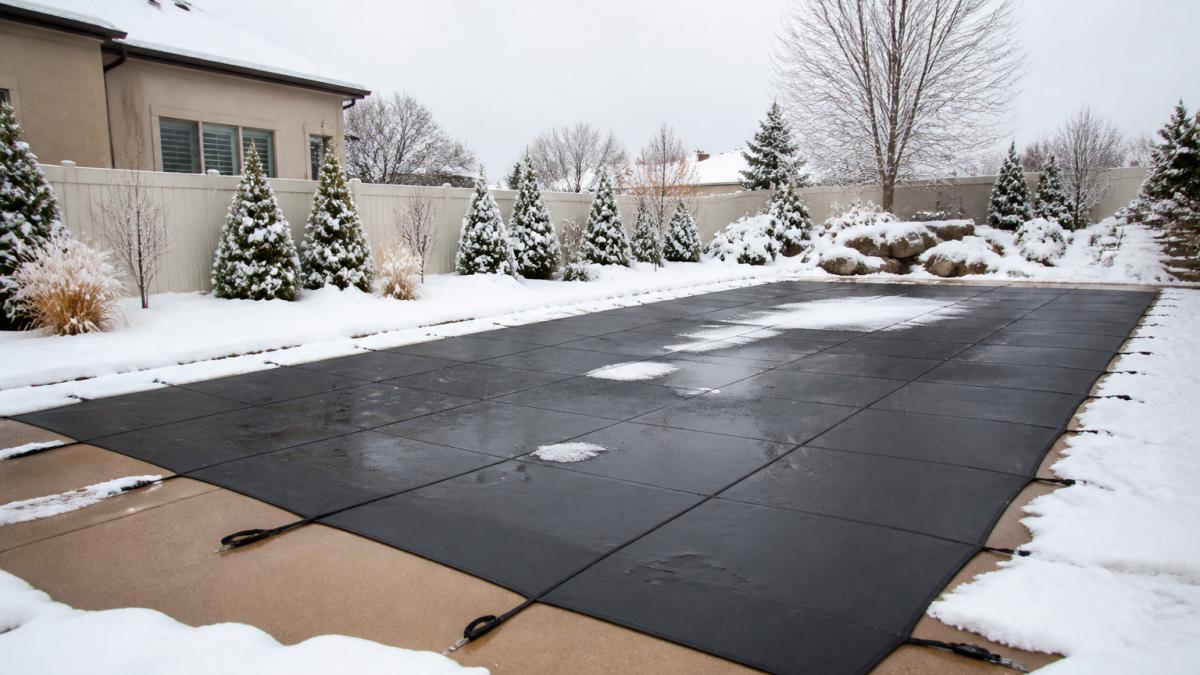
Pool cover snow load is the weight of accumulated snow pressing down on the cover, and it is the number one reason covers fail in this region. What matters is not depth in inches but weight per square foot, which swings wildly with moisture content.
Why Wet Snow Is the Real Threat
A common rule of thumb is that dry, powdery snow weighs roughly 5 to 10 pounds per cubic foot, wet settled snow about 20, and saturated slush or ice can exceed 40. A foot of wet snow on a 20-by-40-foot cover can add several tons of load in a single storm, the scenario that tears seams, bends anchors, and drops covers into the pool.
How Elevation, Wind, and Freeze-Thaw Change the Equation
- Elevation. Higher yards see more, drier snow; lower valleys see less but wetter, heavier snow. The failure mode differs even when depth looks similar.
- Wind. Wind-driven snow piles unevenly, so one corner can carry far more load, sagging usually starts at a single low point.
- Freeze-thaw cycles. Repeated melt and refreeze turns snow into dense ice, the heaviest load per inch and the hardest to remove safely.
Safe Snow Removal: What to Do and What Never to Do
- Remove snow in layers, early. Clear a few inches after each storm rather than waiting for a foot; the longer snow sits, the denser it gets.
- Use the right tool. A soft-bristle or plastic snow rake pulls snow off from the deck edge. Never use a metal shovel or ice chopper.
- Never walk on the cover. Even a safety cover rated to hold weight is not a walking surface.
Why Anchored Covers Handle Load Better
A safety cover anchored to the deck and tensioned across the pool distributes load to the anchors and deck rather than letting fabric sag into the water. A loose tarp sags first, collects more snow in the sag, and fails faster, a feedback loop a properly tensioned cover avoids.
A cover pump is not optional on a solid cover in a snowy climate. If the pump fails or freezes during a storm, meltwater and slush can accumulate faster than you can remove them, and the weight can pull the cover and its anchors out of the deck.
After every storm, walk the perimeter and check for sagging, pulled anchors, or standing water. Five minutes of inspection after each event prevents the spring surprise of a torn cover and a green pool.
Anchors, Cables, and Water Bags: Installation and Attachment
Attachment hardware decides whether your cover stays put. The three options, anchors, cables, and water bags, each suit a different cover type.
- Anchors are brass or plastic fittings set into the deck. They hold a safety cover tight and are the strongest option.
- Cables run through a channel in the cover edge and cinch it around the pool. Common on above-ground pools.
- Water bags sit on the cover edge to weigh it down. Cheap, but they freeze, crack, and need replacing.
For an in-ground pool, a safety cover with anchors is the best long-term choice; for above-ground, a cable-and-winch system is standard.
Installation is a weekend job with the right tools, but anchor placement has to be exact. A misplaced anchor means a loose cover and a leak point.
Pool Closing Checklist: Winterization for Utah Conditions
A pool closing checklist keeps you from skipping a step that ruins the cover’s work. Winterization and the cover go together: a clean, balanced pool under a good cover opens clear in spring.
Use this checklist each fall:
- Clean the pool: vacuum, skim, and brush the walls
- Balance the water: check pH, alkalinity, and sanitizer
- Add winter chemicals per label directions
The cover protects the water, but the closing protects the pool. A clean, balanced pool closed properly under a good cover is what gives you a clean opening in spring.
Cost, Durability, and Choosing the Right Pool Cover
Choosing the right pool cover comes down to three things: how much snow you get, whether safety matters, and your budget. Price varies by size, material, and type, so get a quote for your pool rather than guessing. Sticker price is only the first line item, total cost of ownership separates a good decision from an expensive one.
The Full Cost Picture
Most pool owners focus on purchase price and forget accessories, installation, and replacement. A realistic budget for a 16-by-32-foot in-ground pool looks roughly like this:
| Cover Type | Upfront Cost | Typical Lifespan | Accessories | Snow Handling | Best For |
|---|---|---|---|---|---|
| Tarp-style | Lowest | 1-3 seasons | Water bags, cable | Poor | Tight budgets, mild winters |
| Mesh safety | Mid | 10-15 years | Anchors, installation | Good | Snowy areas, drainage |
| Solid safety | Highest | 12-15+ years | Anchors, cover pump, installation | Best | Safety, algae control |
Beyond the cover itself, budget for:
- A cover pump if you choose solid. A quality submersible pump is a recurring cost; cheap pumps fail in cold weather.
- Installation. A safety cover requires anchors drilled into the deck at precise intervals, a professional job, and anchor placement errors are expensive to fix.
- Replacement hardware. Water bags crack, cables fray, and anchors occasionally pull, small but recurring costs.
The Math That Favors Spending More Upfront
A cheap tarp cover that lasts two seasons then fails costs you the cover, the water cleanup, and the replacement, three expenses in the time a quality safety cover lasts once. Over a ten-year horizon, the mid-tier mesh safety cover usually wins on cost per season, even before the safety benefit. The cheapest cover is only cheapest if it never fails, a bad bet in a snowy climate.
Matching the Cover to Your Pool Type
- In-ground pools are best served by an anchored safety cover, mesh or solid. The deck provides anchor points, and the tensioned fit handles snow load far better than a tarp.
- Above-ground pools typically use a cable-and-winch system cinched around the top rail. Safety covers exist but require a different anchoring approach, and the pool wall itself is a load limit.
- Freeform and kidney pools need a custom safety cover, which costs more than a standard rectangle but is the only option that fits the shape and anchors correctly.
Safety and Standards
U.S. Consumer Product Safety Commission pool safety guidance notes that barriers and covers play a role in preventing child drownings, which is worth weighing if you have young kids. A cover marketed as a safety cover should meet the applicable ASTM standard for pool covers, and the anchor system is part of that rating. If safety is a priority, confirm the cover carries the standard and that installation follows the manufacturer’s anchor pattern.
Where Solar Fits In
For pool owners in this region, solar heating pairs well with a good cover. A cover holds heat in and keeps debris out, and solar panels extend your season. Dixie Pool Solar Heating & Misting installs Heliocol panels backed by a 12-year warranty, with a 2-year labor warranty on the rest. Our customers often extend their season from March through November and cut heating costs, and many qualify for a state tax credit and a gas rebate.
The right cover is the one that survives your worst winter, not your average one. Compare covers on cost per season, not sticker price, and treat the anchoring system and pump as part of the cover, not optional extras.
Frequently Asked Questions
Do you have to put a winter cover on a pool?
A winter cover is not legally required in most areas, but it protects your pool from debris, algae growth, and freeze damage. Without a cover, leaves and dirt sink to the bottom, making spring cleanup harder. A cover also keeps children and pets from falling into the water during the off-season. For Utah winters, a cover helps prevent ice damage to the pool surface and equipment.
What is the difference between a mesh and a solid winter pool cover?
Mesh covers let water drain through small holes while blocking larger debris. Solid covers block everything, including sunlight, which helps prevent algae but requires a pump to remove standing water. Mesh covers are lighter and easier to handle. Solid covers offer better protection against algae but need more maintenance to manage water and snow load.
Can a pool cover support the weight of snow?
Most quality safety covers are engineered to support snow loads, but heavy accumulation can damage any cover. Utah winters can bring significant snowfall, so you should remove snow with a soft-bristle broom or roof rake before it exceeds a few inches. Never let snow pile up for weeks. Check your cover’s manufacturer rating for snow load capacity and follow their guidelines.
When should you install and remove a winter pool cover?
Install your winter cover when water temperatures drop below 65°F, usually in late September or October in Utah. Remove it in spring after the last freeze, typically late March or April, before the water warms enough for algae to bloom. Installing too early traps heat and encourages algae. Removing too late can cause algae growth under the cover.
A cover that fails mid-winter means a torn mess, dirty water, and a rough spring opening. Pairing the right cover with solar heating keeps your pool protected and ready to enjoy longer. Dixie Pool Solar Heating & Misting offers Heliocol panels with a 12-year warranty, low-maintenance operation, and help with available tax credits and rebates. Get a free quote from Dixie Pool Solar Heating & Misting and extend your swim season from March through November.


Leave a Reply