Table of Contents
- Why Professional Solar Pool Heater Inspection Matters
- What’s Included in a Solar Pool Heater Inspection Checklist
- Solar Pool Heater Troubleshooting: When to Call a Professional
- Solar Pool Heater Maintenance: The Inspection Advantage
- Seasonal Maintenance and Inspection Timing
- The Real Return on Investment: Inspection Prevents Costly Repairs
- Frequently Asked Questions
Last Updated: October 14, 2026
Why Professional Solar Pool Heater Inspection Matters
A professional solar pool heater inspection evaluates your entire solar heating system for safe, efficient operation.
Your solar pool heater is a complex system of collectors, plumbing, pumps, valves, and controls.
Many pool owners skip inspections because they think solar systems don’t need maintenance.
Professional inspections catch these issues early, identifying what needs attention now versus what might fail next year, preventing emergency repairs that cost thousands.
What’s Included in a Solar Pool Heater Inspection Checklist
A complete solar pool heater inspection covers three areas: collectors, circulation system, and performance data.
Collector Panel Assessment
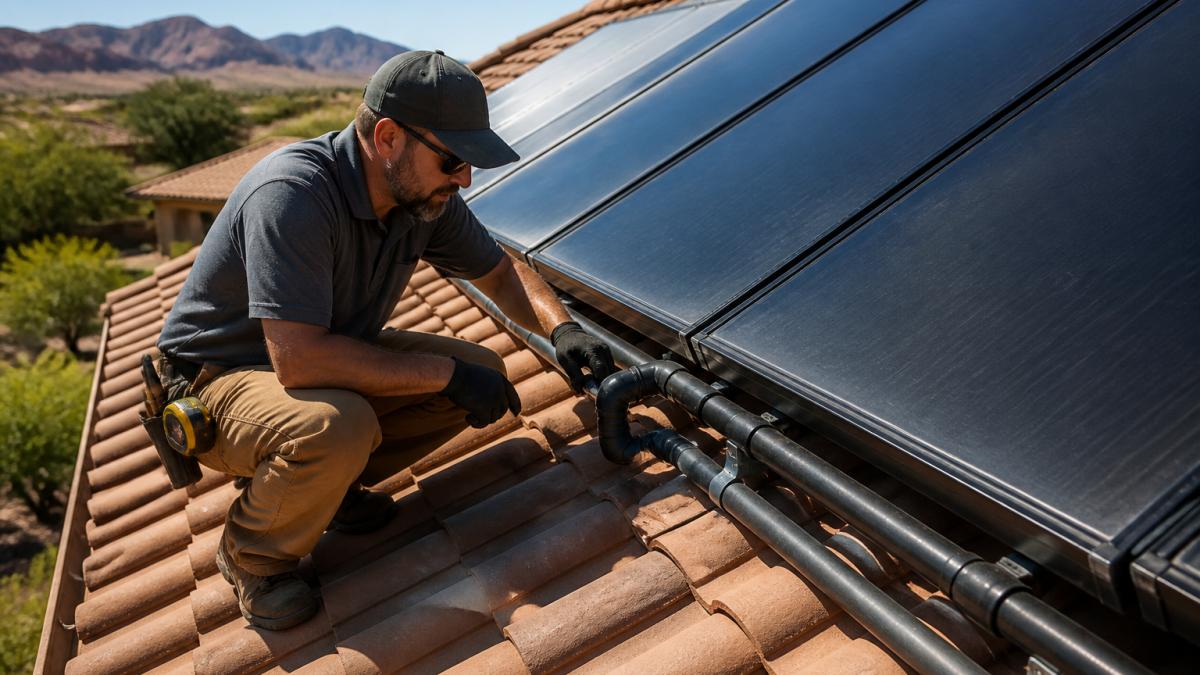
The solar collectors absorb the sun’s heat and transfer it to your pool water. An inspector checks for:
- Physical damage like cracks, corrosion, or loose connections
- Proper mounting and structural integrity
- Seal condition around edges and penetrations
Collectors last 20+ years, but damage happens: cracked panels leak, mounting brackets vibrate loose, and corroded fittings restrict flow.
The inspector also verifies collectors are connected in the right sequence; poor connections reduce heat transfer and strain the pump.
Circulation System and Plumbing Check
The circulation system moves water through the collectors and back to your pool. An inspection includes:
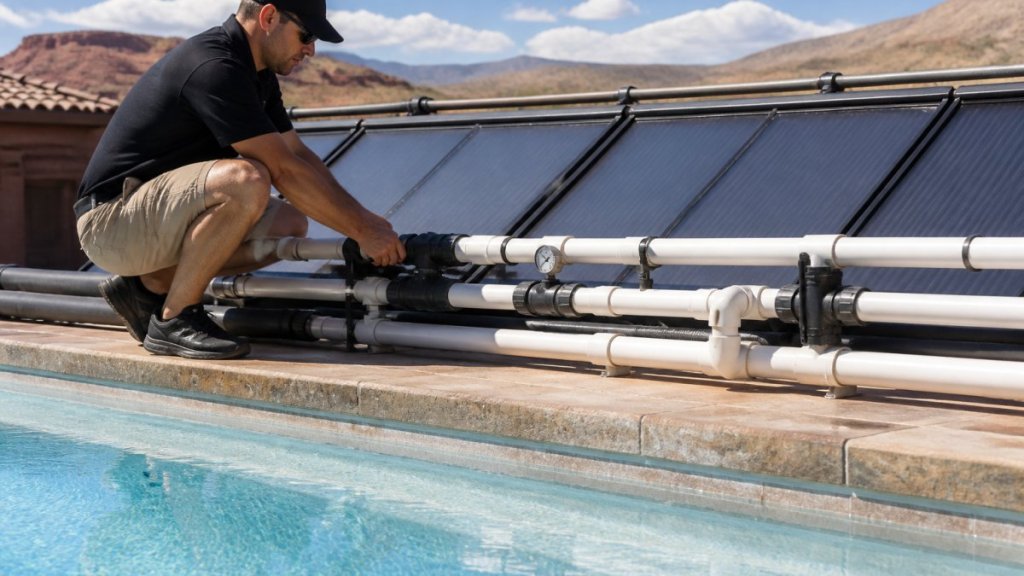
- Checking all pipe connections for leaks or corrosion
- Testing valve operation and proper positioning
- Inspecting pump condition and listening for unusual sounds
Plumbing problems are common culprits: a small leak wastes water and reduces heating, a stuck valve blocks water from the collectors, and a clogged filter strains the pump.
The inspector traces the entire water path from pool through collectors and back, documenting any restriction or leak.
Temperature and Flow Rate Verification
Performance testing shows whether your system actually heats your pool. The inspector measures:
- Water temperature entering and leaving the collectors
- Flow rate through the system (measured in gallons per minute)
- Pump pressure readings
These numbers reveal the real story: a system can look fine but underperform. Low flow means the pump is struggling or plumbing is restricted; a small temperature rise indicates a collector or circulation issue.
The inspector compares your readings to the system’s specifications to pinpoint the cause.
Solar Pool Heater Troubleshooting: When to Call a Professional
Most guides say to “call a pro when something looks wrong”, useless without a boundary. Here is what each symptom points to, which checks you can do yourself, and which require a technician.
What Each Warning Sign Usually Means
| Symptom | Likely Cause | DIY-Safe Check | Needs a Technician |
|---|---|---|---|
| Pool warms slowly or not at all on clear days | Low collector flow, air lock, failed sensor, or scaled collector tubes | Confirm the pump is running and the filter is clean | Flow rate measurement, sensor calibration, pressure differential test |
| Visible water at pipe joints or collector edges | Loose union, degraded O-ring, cracked header, or freeze damage | Visual look for drips during the pump cycle | Pressure test, header repair, collector reseal |
| Pump runs but flow feels weak at the returns | Clogged filter, stuck check valve, impeller debris, or closed bypass | Clean the filter, confirm all valves are open | Valve actuation test, impeller inspection, flow gauge reading |
| Air bubbles in the returns | Suction-side leak, low water level, or pump lid seal | Top off the pool, reseat the pump lid | Suction leak detection, line pressure test |
| Utility bill climbs with no usage change | Pump running longer to compensate for restricted flow | Compare run hours to prior months | Amp draw test, flow rate verification |
| System shuts off unexpectedly | Controller fault, high-limit trip, or sensor failure | Check the breaker and controller display | Controller diagnostics, sensor resistance test |
| Collectors look cloudy or discolored | Internal scaling, UV degradation, or freeze damage | Visual inspection from a safe vantage point | Collector efficiency test, panel replacement assessment |
The DIY Line: What You Can Safely Do
A few free checks belong in every owner’s routine:
- Visual sweep of collectors from the ground or a safe vantage point, look for cracks, missing mounting hardware, and staining that suggests a leak.
- Filter cleaning on the manufacturer’s schedule. A dirty filter is the single most common cause of low flow, and it is not a technician job.
- Valve position check before each heating cycle. Confirm the bypass and return valves are where the system diagram says they should be.
What Requires a Qualified Technician
These tasks involve pressure, electricity, or refrigerant-grade diagnostics and require training:
- Flow rate measurement in gallons per minute at the collector inlet and outlet.
- Pressure differential testing across the filter and collectors to isolate restrictions.
- Sensor and thermostat calibration, a sensor reading two or three degrees off can quietly cost you a full season of heating.
If you see water pooling near electrical components, smell burning at the controller, or notice the pump breaker tripping repeatedly, shut the system down at the breaker and call a technician. Those are not inspection items, they are safety items.
When to Schedule an Inspection
You don’t need to wait for a failure. The keyword is timing, and most owners get it wrong:
- Before the swimming season. In most climates, this means early spring, before you start asking the system to heat. Winter is when freeze damage and debris accumulation do their work.
- After severe weather. Hail, high wind, and hard freezes can crack collectors, loosen mounts, and split exposed plumbing without obvious symptoms.
- When performance changes. If your pool used to reach temperature by mid-afternoon and now takes until evening, that is a data point, not weather.
A professional brings a flow gauge, pressure differential kit, multimeter, and a reference for what your system should read, what turns a symptom into a diagnosis.
Solar Pool Heater Maintenance: The Inspection Advantage
Regular inspections prevent most problems and are the foundation of smart maintenance.
Think of inspections like preventive medicine. A doctor checks your health before you get sick. An inspection checks your system before it breaks down.
Between inspections, you need basic maintenance:
- Keep the filter clean according to manufacturer guidelines
- Clear leaves and debris from around collectors
- Check visible pipes for leaks during your weekly pool check
An inspector will recommend tasks based on your system’s condition: annual flushing for early corrosion, more frequent filter cleaning for low flow, or monthly valve exercise for a sticking valve.
These small tasks prevent big problems: a maintained system stays reliable for decades, while an ignored one degrades quickly.
Seasonal Maintenance and Inspection Timing
The best time for a professional inspection depends on your climate and pool use.
In cold-winter regions, inspect in early spring before heating season.
If you use your pool year-round, schedule a fall inspection to catch problems before winter stresses the system.
For maximum performance, many owners get two inspections annually, spring before heating season and fall as temperatures drop, catching seasonal issues and keeping performance consistent.
Your solar pool heater inspection checklist should include:
| Inspection Task | Timing | Frequency |
|---|---|---|
| Collector visual check | Spring and fall | 2x yearly |
| Plumbing leak inspection | Spring and fall | 2x yearly |
| Flow rate measurement | Spring | 1x yearly |
| Temperature performance test | Spring | 1x yearly |
| Pump and valve operation | Spring and fall | 2x yearly |
| Filter condition check | Monthly | As needed |
| System pressure reading | Spring and fall | 2x yearly |
Regular seasonal inspections catch problems early and keep your system heating efficiently year-round.
The Real Return on Investment: Inspection Prevents Costly Repairs
“It saves thousands” is a claim, not an argument. Here is how the math works, what drives inspection pricing, and how to read your report.
What Drives the Cost of an Inspection
Inspection pricing scales with the system. Understanding the variables helps you compare quotes fairly:
- Number of collectors. A two-panel system on a single-story roof takes a fraction of the time a twelve-panel array on a two-story roof does.
- Roof access and pitch. Steep pitches, tile roofs, and limited access points require fall protection and slower work.
- System age and complexity. Older systems with manual valves and analog controllers take longer to test than modern automated systems.
A routine inspection typically runs in the low hundreds of dollars; a full diagnostic on a large or aging system runs higher. Ask for a written scope before you book.
The Repair Math: Why Early Detection Pays
The ROI argument only holds if you can name what you’re avoiding. Consider these failure chains:
- A slow plumbing leak wastes water, drops system pressure, and forces the pump to run longer. Left alone, the pump motor overheats and fails. A pump replacement plus the labor to re-plumb the pad typically costs several times what the inspection and a fitting repair would have.
- A single cracked collector leaks and loses efficiency. If the crack is caught early, the header or panel can often be repaired. If water intrusion spreads to adjacent panels through shared manifolds, you are looking at replacing a section of the array instead of one panel.
- A drifting temperature sensor reads a few degrees low, so the controller runs the pump longer than needed. The system looks fine. The utility bill is not. Calibration is a minor line item; a season of unnecessary pump runtime is not.
The pattern is consistent: the cheapest repair is the one you find before it cascades. Inspections are not a maintenance expense, they are the mechanism that keeps small line items from becoming replacement line items.
How to Read Your Inspection Report
A good report is a prioritized list, not a pass/fail grade. Here’s how to interpret it:
- Immediate / safety items. Leaks near electrical components, exposed wiring, cracked collector headers, or a pump drawing excessive amps. Address these before the next heating cycle.
- Near-term items. A sensor reading out of tolerance, a valve that sticks, or flow slightly below spec. These will not fail tomorrow, but they will erode efficiency every day you run the system.
- Monitor items. Early corrosion on a fitting, minor discoloration on a panel edge, or a filter that is approaching the end of its service life. Note them and re-check at the next inspection.
If a report lacks baseline readings, ask for them, without numbers, you can’t tell whether the system is improving or degrading.
Verifying Performance After Service
Repairs aren’t finished when the technician packs up. Verify the fix:
- Run a full heating cycle on a clear day and note how long the pool takes to reach your set temperature.
- Compare the temperature rise across the collectors to the baseline in your report. It should match or exceed the pre-failure reading.
- Watch the flow at the returns. Steady, bubble-free flow confirms the plumbing repair held.
- Check the utility bill over the next billing cycle. A corrected flow or sensor issue usually shows up as a measurable drop in pump runtime.
- Re-inspect at the recommended interval, not when something breaks. The whole point of a baseline is to compare against it.
Protecting Resale Value
A documented inspection history is a tangible asset at sale. Buyers and their inspectors ask for maintenance records, and dated reports, baseline readings, and completed repairs read as a maintained system rather than an unknown liability, free to keep, expensive to reconstruct.
Keep every report in one folder, digital or physical, alongside your panel warranty paperwork. When you sell, hand the buyer the whole file. It answers their questions before they ask them.
Frequently Asked Questions
What does a solar pool heater inspection include?
A professional solar pool heater inspection examines collector panels for cracks or damage, checks plumbing connections for leaks, verifies water flow rate and temperature output, tests circulation system operation, and inspects mounting hardware and roof penetrations. Technicians also assess heat retention and evaluate whether your system meets design specifications for your pool size and climate.
How often should a solar pool heater be inspected?
Most systems benefit from annual inspection before the heating season begins (March in your area) and after heavy weather events. Seasonal maintenance checks help catch issues early, corrosion, loose fittings, or reduced flow, before they affect heating performance. If you notice temperature drops or uneven heating, schedule an inspection immediately rather than waiting for your annual service.
Can a professional inspection improve solar pool heater efficiency?
Yes. Inspections identify blockages in collectors, leaking connections that reduce flow rate, and sediment buildup that blocks heat transfer. Cleaning panels, adjusting circulation, and replacing worn seals can restore efficiency to near-original levels. With Heliocol panels designed for 20+ years of service, regular inspection ensures you maintain the energy savings that justify your initial investment.
What warning signs mean I need a solar pool heater inspection?
Schedule an inspection if your pool water temperature plateaus despite sunny conditions, you notice leaks around plumbing connections, collectors show visible cracks or discoloration, water flow seems weak, or heating takes longer than it used to. These signs often indicate circulation issues, collector damage, or air in the system, all fixable during a professional inspection before they worsen.


Leave a Reply