

Table of Contents
- How Solar Pool Heaters Work and Why Savings Matter
- Step 1: Calculate Your Pool’s Gallonage and Current Heating Costs
- Step 2: Determine Your Annual Energy Consumption and Baseline Expenses
- Step 3: Estimate Annual Savings From Solar Pool Heating
- Solar Pool Heater Tax Credit 2026 and Available Rebates
- Gas vs Solar Pool Heating Cost Comparison
- Using a Solar Pool Heater Payback Period Calculator
- Common Mistakes to Avoid When Calculating Savings
- Frequently Asked Questions
Last Updated: September 23, 2026
How Solar Pool Heaters Work and Why Savings Matter
Solar pool heaters circulate pool water through roof or ground-mounted collectors where the sun heats it before returning it to your pool. Unlike gas heaters and electric heat pumps, solar systems have no fuel costs and minimal maintenance, running reliably for 20+ years.
At Dixie Pool Solar Heating & Misting, we’ve helped Southern Utah homeowners extend their swimming season from March through November. The real appeal is the savings, solar heating cuts annual energy bills significantly while maintaining comfortable water temperatures.
Understanding whether solar works for your pool requires calculating potential savings based on pool size, current heating costs, and local sun exposure.
Step 1: Calculate Your Pool’s Gallonage and Current Heating Costs
To find your pool volume:
- Measure length, width, and average depth in feet
- For rectangular pools: length × width × average depth × 7.5 = gallons
- For round pools: diameter × diameter × average depth × 5.9 = gallons
- For oval pools: length × width × average depth × 6.7 = gallons
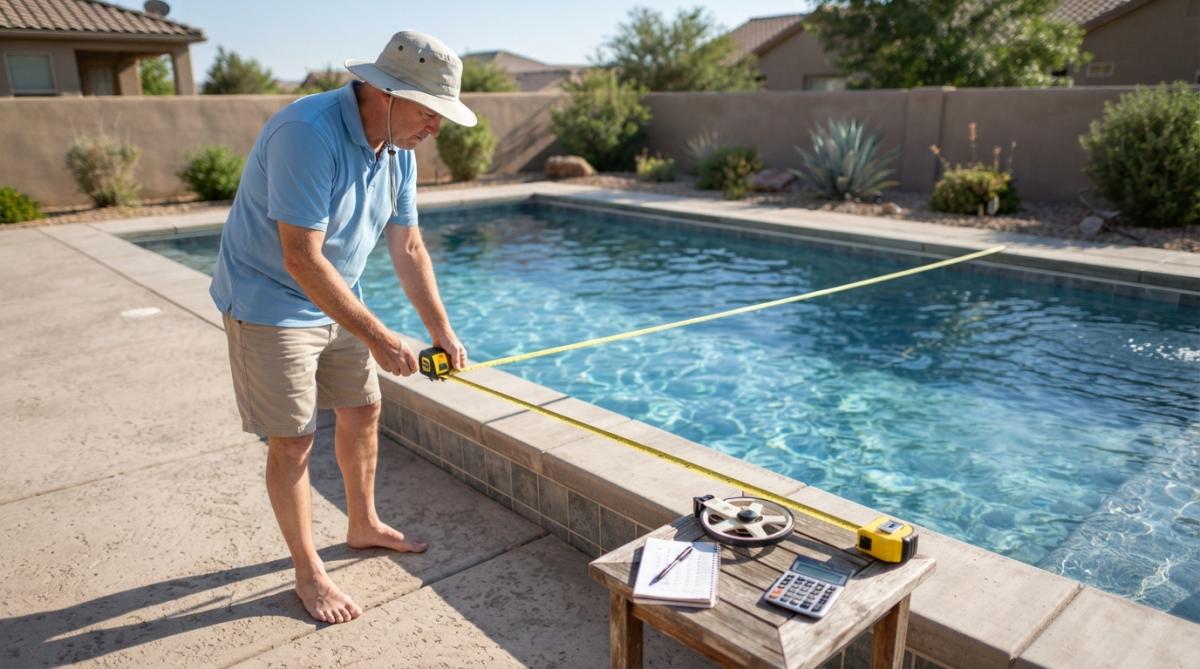
Find your current heating costs by reviewing utility bills from the past year. For gas heaters, multiply heating therms by your gas rate per therm; for electric heat pumps, multiply kilowatt-hours by your electricity rate. This gives your baseline annual heating expense.
Call your utility company if your bills don’t clearly show heating costs. They can often break down seasonal usage by appliance. This detail matters because it ensures your savings calculation is based on real numbers, not estimates.
Step 2: Determine Your Annual Energy Consumption and Baseline Expenses
Energy consumption depends on pool size, desired water temperature, outdoor temperature, and heating duration. The difference between pool temperature and air temperature determines energy loss, with costs rising during cooler months and shoulder seasons.
Review 12 months of utility bills and add the months when pool heating occurred to establish your annual baseline. This benchmark is essential for calculating payback period and return on investment.
Step 3: Estimate Annual Savings From Solar Pool Heating
Solar pool heater savings depend on system size, climate, and pool usage. A properly sized system should provide 70-100% of heating needs. Collector area should equal 50-100% of pool surface area; Southern Utah’s strong sun exposure allows the lower end of that range.
Climate factors affecting efficiency include direct sunlight (Southern Utah has strong sun exposure), ambient temperature, wind, shade, and pool cover usage. To estimate savings, apply your baseline annual heating cost to the percentage solar will provide, for example, 80% coverage of a $1,800 baseline equals $1,440 annual savings.
The most accurate way to estimate savings is to get a professional assessment. A solar contractor can evaluate your roof orientation, shading, pool size, and local climate to give you a realistic projection specific to your property.
Solar Pool Heater Tax Credit 2026 and Available Rebates
Federal and state incentives dramatically improve payback period and net cost but are often overlooked. The real financial picture emerges only when you integrate incentives into your total investment cost.
Federal Tax Credit (Residential Energy Efficient Property Credit)
The federal government allows homeowners to claim a tax credit for solar thermal systems through the Residential Energy Efficient Property Credit. This is not a deduction, it’s a dollar-for-dollar reduction in your tax liability. For solar pool heaters, the credit applies to the cost of equipment and installation. Verify current eligibility and credit percentages with the Internal Revenue Service before finalizing your purchase, as credit amounts and rules change periodically.
State-Level Incentives
State incentives vary significantly by location. Some states offer tax credits, rebates, or performance-based incentives. Check the Database of State Incentives for Renewables and Efficiency for your specific state’s current programs. Many states have updated their incentives in recent years to encourage residential solar adoption.
How Incentives Change Your Payback Calculation
Most homeowners calculate payback using full system cost, then subtract incentives. Instead, use net cost (system cost minus all incentives) as your starting point. Example: With annual savings, payback can be significantly improved by factoring in incentives. Over 20 years, this dramatically changes total return.
Stacking Incentives
Federal, state, and local rebates often stack, allowing you to capture all available credits. However, some programs have caps or restrictions. Always read the fine print and ask your installer which incentives apply to your situation.
Timing Matters
Incentive programs change annually and may have funding limits. Check current availability before getting quotes, as delays could mean missing rebate or tax credit windows.
When evaluating solar pool heater quotes, always ask the contractor to itemize which incentives they’ve included in their cost estimate and which you’ll need to claim separately on your tax return. This prevents surprises and ensures you’re comparing true net costs across different quotes.
Gas vs Solar Pool Heating Cost Comparison
Gas heating costs depend on rates and season length but consume fuel continuously. Electric heat pumps are more efficient but require significant electricity and take longer to heat pools. Solar heating has zero operating costs after installation, running on free solar energy with minimal maintenance. Over 10 years, solar typically pays for itself through energy savings alone.
| Heating Type | Operating Cost Per Year | Maintenance Cost | Setup Cost |
|---|---|---|---|
| Gas Heater | $1,200-$2,400 | $200-$400 | $2,000-$4,000 |
| Heat Pump | $800-$1,600 | $150-$300 | $3,000-$6,000 |
| Solar Heater | $0 | $50-$150 | Higher upfront |
Using a Solar Pool Heater Payback Period Calculator
Payback period is the time for energy savings to equal installation cost. Calculate it by dividing total installed cost (after incentives) by annual savings. Example: $3,600 net cost ÷ $1,500 annual savings = 2.4 years. Online calculators provide more accurate estimates by accounting for regional climate variations and seasonal usage patterns.
The Inflation Problem Most Calculators Ignore
Utility rates can rise over time. Standard payback calculators assume flat rates, making payback appear longer than it actually is. A system saving a certain amount in year one might save more in subsequent years, while operating costs remain zero.
Dynamic ROI: Accounting for Rising Energy Costs
Model payback with inflation-adjusted utility rates. Assuming a conservative annual increase, savings can accelerate. A system with a certain payback at static rates can break even faster when accounting for rising utility costs.
Tracking Real Savings With Smart Home Energy Monitoring
Calculators provide estimates, but your actual savings depend on real-world variables: how often you use your pool, whether you use a cover, cloud cover patterns, and seasonal temperature swings. The gap between estimated and actual savings is where many homeowners experience disappointment.
Bridge this gap by integrating smart home energy monitoring. If your pool heater is connected to a smart meter or home energy management system, you can track actual electricity or gas consumption before and after solar installation. This real data, not estimates, shows whether your system is performing as projected.
Many modern pool systems integrate with platforms like Enphase Energy or similar smart home ecosystems that display real-time energy production and consumption. Over the first year of operation, this data reveals your true payback trajectory and helps you adjust usage patterns if needed (for example, running your pool pump during peak solar hours rather than at night).
Payback Period Varies by Location and Usage
A system in a sunny region with high utility rates breaks even much faster than one in a cloudier area with lower rates.
When comparing payback estimates from different contractors, verify that they’re using the same assumptions about:
- Your actual pool size and usage patterns
- Local average daily solar insolation (sun hours)
- Your current utility rates and rate structure
- System efficiency losses (pipe losses, collector efficiency, etc.)
- Whether estimates include or exclude incentives
Avoid calculators that don’t require your actual address or utility rates. A generic calculator might overestimate sun exposure or use regional average rates that don’t match your bill. The most accurate payback estimate comes from a professional assessment that includes your roof orientation, shading analysis, and actual utility consumption data.
Long-Term Value Beyond Payback
Common Mistakes to Avoid When Calculating Savings
Many homeowners underestimate their actual savings or overestimate installation costs, leading to poor decisions.
Frequently Asked Questions
How do I calculate solar pool heater savings for my specific pool?
Start by determining your pool’s gallonage, current heating method and costs, and annual usage hours. Multiply your pool’s length, width, and average depth in feet, then divide by 7.5 to get gallons. Next, calculate your current monthly heating expenses by reviewing utility bills or gas statements. Then estimate what percentage of those costs solar heating can eliminate based on your climate zone and sun exposure. A solar pool heater payback period calculator can automate this process once you input these baseline figures.
What is the solar pool heater tax credit 2026 and how much can I claim?
Federal and state incentives vary by location. Utah offers a state tax credit of up to 25% of installation costs or $2,000, whichever is less. Additionally, some utility programs provide rebates like the Enbridge Gas $750 rebate for switching from gas heating. These credits and rebates directly reduce your net installation investment, improving your overall payback period. Verify current eligibility requirements with your state’s tax authority and utility provider, as incentive amounts and qualification rules change annually.
How much can I save annually by switching from gas to solar pool heating?
Annual savings depend on your pool size, current heating method, usage season, and local climate. Most homeowners with residential pools see annual savings between $1,500 and $2,000 when switching from gas to solar, though actual figures vary based on utility rates, sun exposure, and seasonal usage patterns. To calculate your specific savings, compare your current annual gas or electric heating costs against the minimal operating costs of solar heating, which requires no fuel or electricity to generate heat. Factor in your region’s solar irradiance data and your pool’s thermal efficiency.
What factors most affect my solar pool heater payback period?
The payback period is determined by dividing your total installation cost (minus tax credits and rebates) by your annual energy savings. Key factors include system sizing relative to pool surface area, collector orientation and roof pitch, shading from trees or structures, local utility rates, seasonal usage duration, and climate zone. Pools with higher gas bills, better sun exposure, and longer usage seasons achieve faster payback periods. A payback period calculator accounts for these variables to project when your system will pay for itself through reduced heating bills.


Leave a comment