Table of Contents
- Why Pool Water Evaporates and What’s Normal
- Measuring Your Pool Water Loss: Evaporation or Leak
- Using a Pool Cover to Prevent Evaporation
- Reducing Water Loss When the Pool Is Not in Use
- Liquid Pool Cover Products to Minimize Evaporation
- How Pool Heating and Water Temperature Affect Evaporation
- Preventing Pool Water Evaporation: Step-by-Step Action Plan
- Frequently Asked Questions
Last Updated: October 6, 2026
Why Pool Water Evaporates and What’s Normal
Pool water naturally evaporates, it’s not a leak or a sign something’s wrong, though you can take steps to prevent pool water evaporation.
Knowing what’s normal helps you spot real problems. Most pools lose water at a steady rate that shifts with weather, season, and sun exposure.
How sun exposure speeds evaporation
The sun is the biggest driver of pool water evaporation: heat turns water molecules into vapor, and the hotter the surface, the faster it happens.
A pool in full sun all day loses more water than one with afternoon shade, and the effect intensifies in peak summer.
How wind and heat increase water loss
Wind accelerates evaporation by carrying away water vapor that would otherwise settle back into the pool.
High temperatures speed up how fast water molecules escape, so evaporation peaks on hot, windy summer days and during heat waves.
Dry air pulls moisture away faster, so arid climates see higher evaporation year-round while coastal areas lose water more slowly.
Measuring Your Pool Water Loss: Evaporation or Leak
Not all water loss is evaporation, leaks happen too. Measuring your actual water loss tells you which problem you’re facing.
The bucket test method
Fill a bucket with pool water, set it on the deck beside the pool, mark the water level in both, and wait 24 hours.
If the bucket dropped the same amount as the pool, you’re losing water to evaporation only.
Repeat the test weekly across seasons and track the numbers to build a baseline for normal water loss.
When to suspect a leak
A leak shows itself through water loss that exceeds normal evaporation. If the bucket test shows the pool losing significantly more than the bucket, investigate further.
Look for wet spots on the deck, cracks in the pool shell, and water sounds near the equipment.
Leaks often occur at equipment connections, drain lines, or the pool shell.
Using a Pool Cover to Prevent Evaporation
A cover is the highest-impact way to prevent pool water evaporation you can buy. Department of Energy’s guidance on pool covers notes that covers reduce evaporation and can cut pool heating needs substantially, which is why covers appear in nearly every water-conservation recommendation for pools.
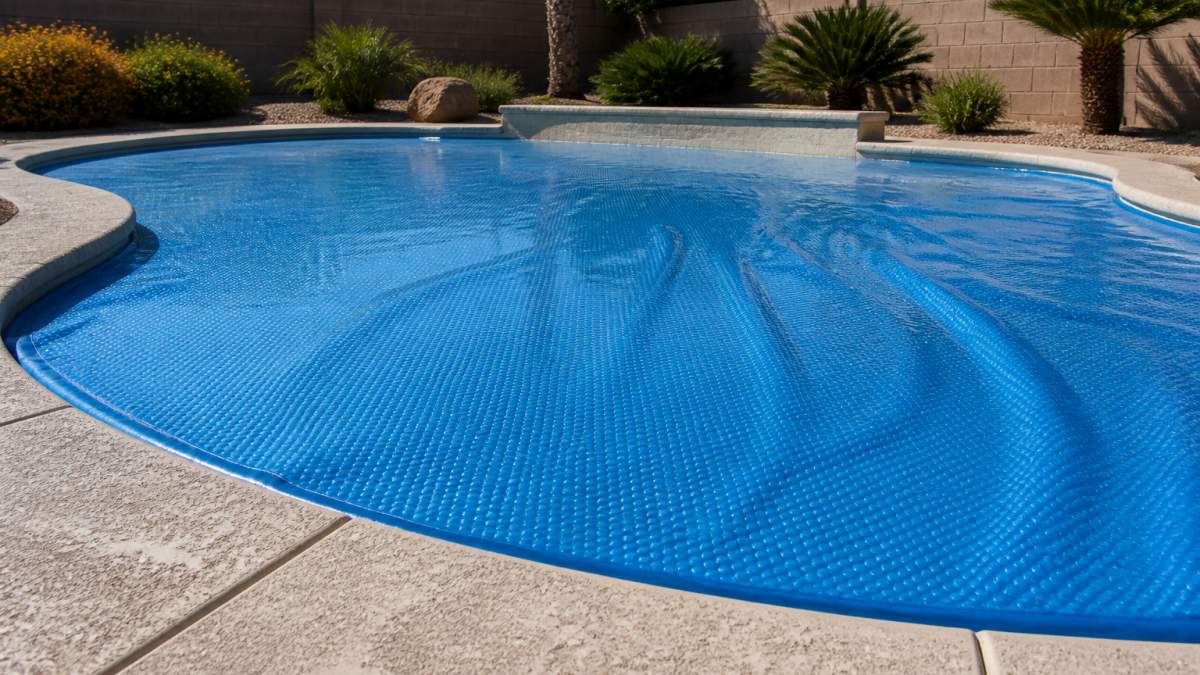
But “get a cover” is not a plan, the right choice depends on how you use the pool, your climate, your safety needs, and how much maintenance you’ll actually do.
Cover types and how they compare
- Solar (bubble) covers. Thin, floating plastic with a bubble layer. They reduce evaporation and passively warm water. Lowest upfront cost, but they degrade in UV over time and need replacement every few seasons in strong sun.
- Automatic covers. Motorized, track-mounted, and typically made of thicker vinyl or slatted material. Highest upfront cost and require professional installation, but they deploy in under a minute, add a safety barrier, and last many years with care.
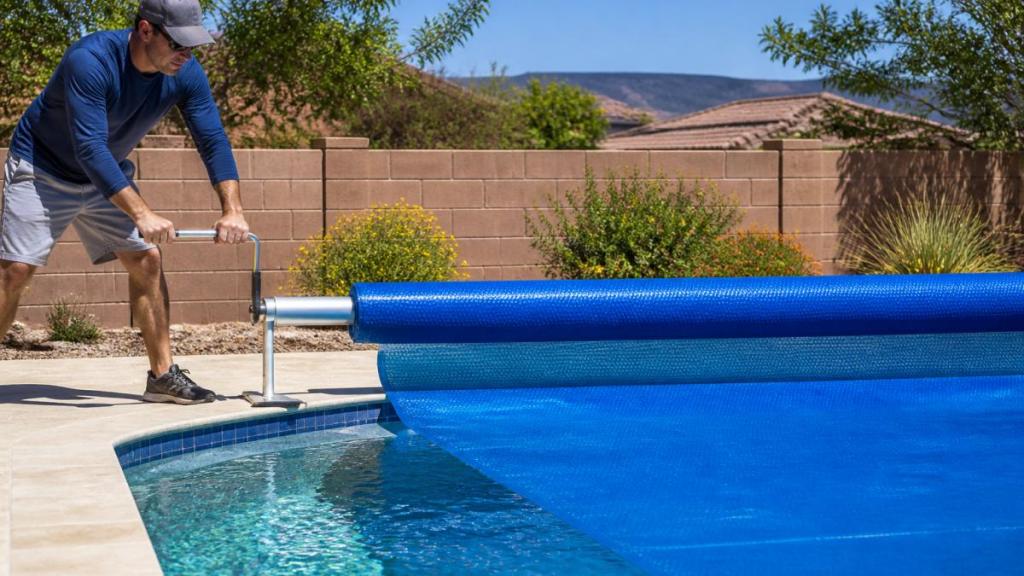
- Manual solid covers. Reinforced vinyl or mesh. Durable and effective, but heavy, require two people on larger pools, and need a reel or storage space.
Owners who swim several times a week often leave a manual cover off, erasing the savings. If that sounds like your household, an automatic cover or a lightweight solar cover on a reel fits better.
Sizing, fit, and installation
A cover only performs at its rated level when it fits. Measure length and width at the waterline, not the deck edge, and add the overlap your cover type requires.
Gaps at the edges let vapor escape and wind get under the cover, and a loose solar cover can blow into a pile, reducing effectiveness and potentially trapping a swimmer.
If you have an irregular shape, kidney, freeform, or with a spa spillover, ask the manufacturer about custom cutting. Off-the-shelf rectangular covers on a freeform pool leave large uncovered areas.
Safety
Covers are not interchangeable for safety. A solar cover is not a safety cover: it’s hard to see under, and a person or pet who falls in may not surface easily.
Check local code before relying on a cover as a barrier. With young children, pets, or neighbors with yard access, treat it as one layer alongside fencing, alarms, and door locks, not a replacement.
Maintenance and storage
- Rinse and dry before rolling. Debris and pool chemicals left on a cover shorten its life and can stain it.
- Keep water off the top. Rain and splash water collecting on a solid or automatic cover adds weight and can damage the mechanism. Use a cover pump on solid covers and check the automatic cover’s drain or pump.
- Store out of direct sun. UV is the main killer of solar covers. A reel with a cover, or storage in a shaded area, extends life noticeably.
How often to put it on and take it off
The rule of thumb: cover whenever the pool is not in use, including overnight. Most evaporation happens when the pool is uncovered and the air is dry or moving, and overnight heat loss is significant.
Off-season, a fitted winter cover eliminates most evaporation for months; in swim season, cover whenever the pool is idle more than a few hours.
Reducing Water Loss When the Pool Is Not in Use
When you’re not swimming, your pool is still losing water. Strategic steps during off-hours cut evaporation significantly.
Turning off fountains and water features
Fountains and water features look nice but accelerate evaporation.
Turn fountains off when you’re not using the pool, this saves thousands of gallons a season.
Water features also add heat through circulation and splashing, so stopping them cuts both water loss and heating costs.
Limiting sun exposure during peak hours
Peak sun hours run from 10 a.m. to 4 p.m., when rays hit hardest and evaporation peaks.
Partial shade reduces evaporation without a full cover.
This works best for pools that can’t stay covered all day: you keep usable pool time while cutting water loss during peak evaporation hours.
Liquid Pool Cover Products to Minimize Evaporation
Liquid pool covers, also called evaporation suppressants or monolayer products, are alcohols or similar surfactants that spread into a one-molecule-thick film on the water surface. The film interrupts the water-to-air interface, slowing the rate at which water molecules escape as vapor. Invisible and only a molecule thick, it lets swimmers pass through without noticing and doesn’t block sunlight or heat the way a solid cover does.
How they actually work
The active ingredient is a long-chain fatty alcohol that is insoluble in water and spreads rapidly across the surface, forming a continuous film that reduces vapor pressure.
That matters more than most product pages admit: wind, rain, splash-out, heavy bather load, and even a running fountain break the monolayer, and evaporation returns to its uncovered rate until the product redistributes or you reapply it.
Realistic performance and trade-offs
Published field data is limited and results vary widely with wind, humidity, and pool use. Expect a meaningful reduction on calm, low-use pools, with the benefit dropping sharply on windy or heavily used pools.
Compared with other methods:
- Versus a solar or solid cover: A physical cover typically outperforms a liquid cover by a wide margin because it also blocks wind and traps heat. A liquid cover’s advantage is convenience, no reel, no storage, no removal before swimming.
- Versus a windbreak: A windbreak addresses the single biggest driver of evaporation (moving air) and works continuously. A liquid cover addresses the surface film but is defeated by the same wind.
- Versus reducing water features: Turning off a fountain is free and permanent. A liquid cover is a recurring cost.
Liquid covers work best as a supplement, for pools where a physical cover is impractical, or on days when the pool is uncovered and you want some protection.
Application, dosing, and reapplication
Dosing depends on pool surface area, not volume, because the product acts at the surface. Manufacturers specify an initial dose to establish the film, then smaller maintenance doses, applied near the return jets or with an automatic dispenser.
Expect to reapply after:
- Heavy rain that overflows or dilutes the surface layer
- A large bather load or a pool party
- Strong wind events
Some owners dose every few days; others use a continuous dispenser. Follow the label and don’t over-dose, excess product can cloud water or cause foaming.
Cost and when it makes sense
Liquid covers are sold as concentrates, and a season’s supply is a modest recurring expense next to an automatic cover’s upfront cost. The economics depend on your water and heating costs: if refilling and reheating are cheap, a liquid cover may not pay for itself; if water is expensive or restricted, the savings can justify it.
Liquid covers make the most sense when:
- A physical cover is impractical (very large pool, irregular shape, frequent use)
- You want some evaporation protection while the pool is uncovered
- You are already using a cover and want a small additional reduction on uncovered days
They make the least sense when:
- Wind is your dominant loss driver (a windbreak will do more)
- You already cover the pool whenever it is idle
- Your pool has a fountain or water feature you run daily
Liquid covers are not a safety device. They do not prevent drowning and should never be relied on as a barrier. Keep fencing, alarms, and supervision in place.
Combining methods for the best result
The strongest approach is layered: a physical cover whenever the pool is idle, a windbreak on the prevailing-wind side, water features off when not in use, and a liquid cover as a supplement on uncovered days. No single product wins on every dimension, and the combination usually beats any one method alone.
How Pool Heating and Water Temperature Affect Evaporation
Heating your pool increases evaporation, warmer water molecules escape faster, creating tension between comfort and water conservation.
Higher water temperature means higher evaporation rates: a pool at 82 degrees loses more water than one at 78, and the difference compounds over weeks and months.
This is where solar heating solutions become valuable. Solar systems heat your pool using the sun’s energy without adding operating costs.
Preventing Pool Water Evaporation: Step-by-Step Action Plan
A clear action plan helps you tackle evaporation systematically.
Step 1: Measure your baseline water loss
Determine how much water your pool normally loses using the bucket test described earlier, run over several weeks to account for weather variation.
Record the date, weather conditions, and water loss amount. This baseline tells you whether your situation is normal or problematic.
Step 2: Install or upgrade your pool cover
Choose a cover type that fits your situation. Solar covers work well for heating and evaporation reduction. Automatic covers offer convenience and safety.
Install it properly so it stays secure, gaps and loose edges reduce effectiveness. The cover should extend to the pool edges and be taut across the surface.
Step 3: Control water features and heat
Turn off fountains and water features when not in use, and reduce heater temperature by 2 to 3 degrees if comfort allows. Both cut evaporation without major lifestyle changes.
Run water features only when you’re enjoying them and limit heating to swimming season when possible.
Step 4: Monitor and adjust seasonally
Check water loss monthly, compare to your baseline, and adjust for seasonal changes.
Summer requires more aggressive evaporation control, spring and fall less, and winter may let you close the pool entirely, eliminating evaporation concerns.
Pool water evaporation is inevitable, but it’s manageable. Get a free quote today to see how solar heating and evaporation control can work together for your pool.
Frequently Asked Questions
How much pool water evaporation is normal per day?
A typical pool loses between 1/4 inch and 1/2 inch of water per day due to evaporation, depending on temperature, humidity, wind, and sun exposure. In hotter months or windy climates, losses can reach 1 inch per day. To determine if your loss is normal, use the bucket test: fill a bucket with pool water, place it on the pool deck, and compare the water level drop in the bucket to the drop in your pool over 24 hours. If your pool loses significantly more than the bucket, you may have a leak.
Can a pool cover to prevent evaporation really save water?
Yes. A pool cover can reduce evaporation by 95 percent when in place. Solar covers are particularly effective because they block sunlight while trapping heat, which slows both evaporation and heat loss. Even simple manual covers significantly cut water loss when the pool is not in use. For pools used seasonally, consistent cover use from late fall through early spring can save thousands of gallons annually.
Is my pool losing water from evaporation or a leak?
Use the bucket test to distinguish between the two. Fill a bucket with pool water and place it on the deck near your pool. Mark the water level in both the bucket and pool. After 24 hours, compare how much each water level dropped. If the pool lost more water than the bucket, evaporation is normal. If the pool lost significantly more, especially if it continues losing water even when covered, you likely have a leak. Leaks often occur around drains, pipes, or the pool shell itself and require professional inspection.
Do liquid pool covers work to reduce evaporation?
Liquid pool covers, also called evaporation suppressants, form an invisible monomolecular layer on the water surface that slows evaporation by 20 to 30 percent. They work best in calm conditions and must be reapplied after heavy rain or pool use. While less effective than solid covers, they offer a low-maintenance option if you want to keep your pool accessible while still reducing water loss. Many homeowners combine liquid covers with physical covers for maximum protection.


Leave a Reply