Table of Contents
- Why Your Pool Water Gets Uncomfortably Hot
- How Misting Systems Cool Pool Water and Surrounding Air
- High-Pressure vs. Low-Pressure Systems for Pool Areas
- High-Pressure Misting Systems for Decks: Cooling Your Patio
- Evaporative Pool Cooling: How Much Can It Lower the Temperature?
- How to Cool Down Hot Pool Water: Installation and Setup
- Maintenance, Water Quality, and Winterizing Your System
- Choosing the Right Cooling System for Your Pool
- Frequently Asked Questions
Last Updated: September 9, 2026
Why Your Pool Water Gets Uncomfortably Hot
In the peak of summer, a pool can turn from a refreshing escape into a bath. When ambient temperatures climb past 95°F, the sun’s radiant energy drives water temperatures to 88°F or higher, far beyond the 78-82°F range most swimmers find comfortable (the CDC).
The problem is straightforward: a pool is a massive solar collector. It absorbs heat all day and releases it slowly at night. When nighttime lows don’t drop enough to shed that stored energy, the water temperature ratchets up day after day.
Below, we’ll show you exactly how pool water cooling misting systems solve this problem. We’ll cover how they work, the key differences between high-pressure and low-pressure setups, and what installation and maintenance actually involve.
How Misting Systems Cool Pool Water and Surrounding Air
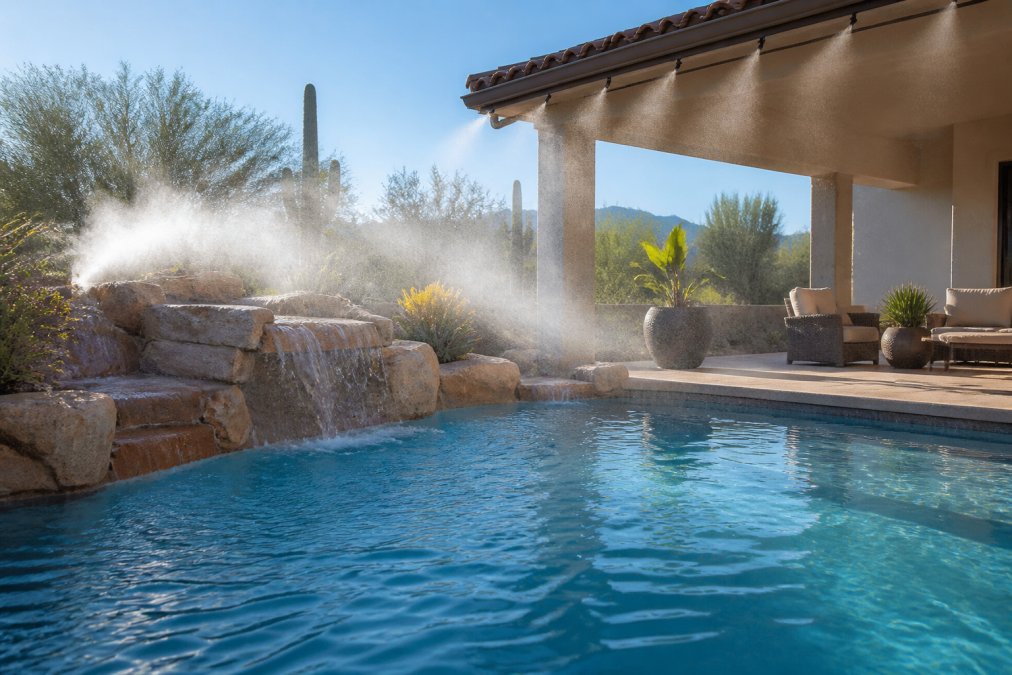
Pool water cooling misting systems use evaporative cooling to lower both water and air temperatures. The system forces water through specialized nozzles to create a fog of micro-droplets that absorb heat energy as they evaporate.
When water changes from a liquid to a gas, it pulls energy from the immediate environment, lowering the temperature of the air and water surface. A well-designed system can reduce the perceived temperature in a poolside seating area by 10 to 20 degrees.
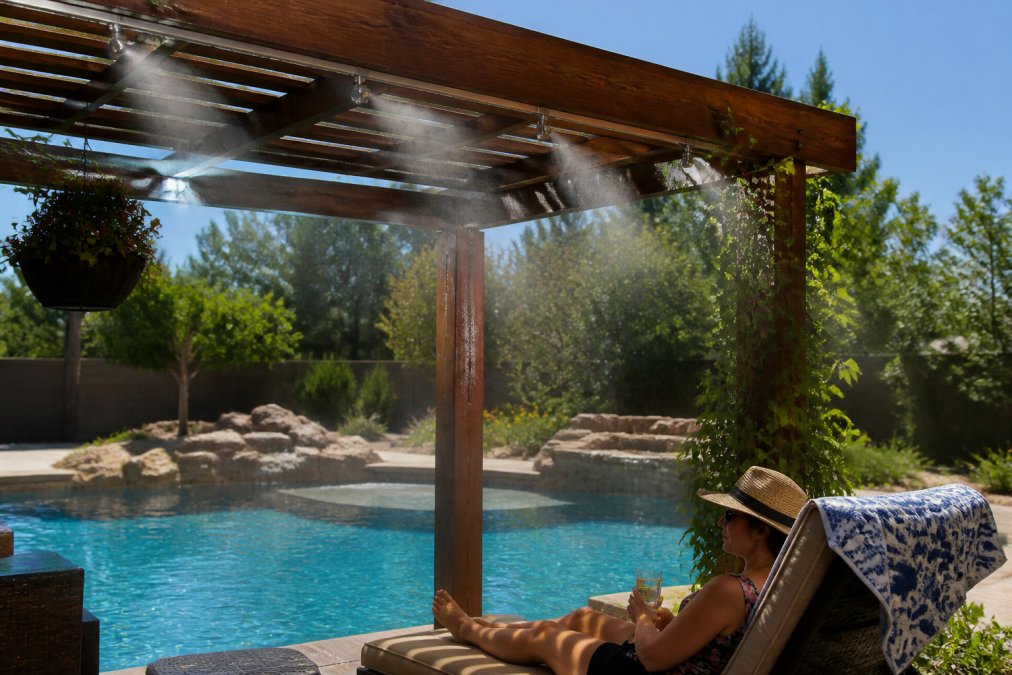
Directing mist across the water’s surface accelerates heat dissipation from the pool itself by increasing surface area for evaporation and encouraging circulation, breaking up the thermal blanket of hot air on top of the pool.
High-Pressure vs. Low-Pressure Systems for Pool Areas
Choosing between a high-pressure and low-pressure system is the first major decision you’ll face. The difference comes down to water atomization and cooling capacity.
High-pressure systems operate at 800 to 1,000 PSI, forcing water through tiny nozzle orifices to create micro-droplets so fine they evaporate almost instantly. This rapid evaporation provides maximum cooling with minimal water waste and leaves surfaces dry to the touch, making these systems the most effective for creating a distinct cooling zone around a patio or pool deck.
Low-pressure systems run at 100 to 200 PSI and produce larger water droplets. They are less expensive and easier to install, often using standard garden hoses and push-to-connect fittings, but they don’t cool as effectively and can leave a fine spray of water on nearby furniture and guests.
| System Type | Operating Pressure | Droplet Size | Cooling Effect | Best For |
|---|---|---|---|---|
| High-Pressure | 800-1,000 PSI | Micro-droplets | Strong, immediate | Patios, decks, larger areas |
| Low-Pressure | 100-200 PSI | Larger mist | Moderate | Small spaces, budget setups |
For most poolside applications, a high-pressure system is the better investment. The finer mist provides superior cooling capacity and won’t soak your lounge chairs.
High-Pressure Misting Systems for Decks: Cooling Your Patio
High-pressure misting systems for decks create an outdoor climate control zone, turning an unshaded concrete patio into a usable living space during a heat wave. The key is micro-droplets that flash-evaporate, pulling heat out of the air without wetting the area.
Installation involves mounting brass or stainless steel nozzles along the patio perimeter, typically on pergola beams or under eaves. A central high-pressure pump delivers water through UV-resistant tubing, creating a curtain of cool air that lowers the heat index around your pool.
The real advantage is the ability to target specific zones where people sit, making the system more energy-efficient than cooling a larger area with a low-pressure unit.
Evaporative Pool Cooling: How Much Can It Lower the Temperature?
Evaporative pool cooling can lower surrounding air temperature by 20 to 30 degrees Fahrenheit in dry climates, but the effect on the pool water itself is more gradual.
Misting is excellent at creating a comfortable microclimate around the pool, but reducing water temperature by several degrees requires consistent operation over time, a slower process than a heat pump or chiller.
For water that’s crept up to 90°F, misting can help bring it down to a swimmable range over a day or two of operation, especially when combined with a pool cover at night. While misting won’t replace a chiller for dramatic drops, it offers a cost-effective way to manage peak heat.
How to Cool Down Hot Pool Water: Installation and Setup
The setup process for a misting system is more straightforward than you might expect. While professional installation is recommended for high-pressure systems, understanding the steps helps you make informed decisions.
- Assess Your Area: Determine the square footage of the cooling zone to dictate the number of nozzles and pump size.
- Mount the Line: Run the main supply line along the perimeter, securing it with clips and using UV-resistant tubing.
- Install Nozzles: Space them every 24 to 36 inches; brass nozzles resist corrosion.
- Connect the Pump: Size it correctly to maintain the required PSI across all nozzles.
- Integrate Water Supply: Connect to a dedicated line and consider filtration to prevent clogging.
- Test and Adjust: Check for even mist distribution and adjust nozzle angles.
A common mistake is undersizing the pump. If the pump can’t maintain pressure, the nozzles won’t atomize the water properly, and you’ll get drips instead of mist, reducing the cooling effect and wasting water.
Skipping a water filtration system is the most common cause of premature system failure. Mineral buildup from hard water will clog nozzle orifices, turning a fine mist into a dripping mess. A simple inline filter prevents this and extends the life of your nozzles significantly.
Maintenance, Water Quality, and Winterizing Your System
Most pool owners don’t think about their misting system until a nozzle drips instead of mists. The #1 cause of premature failure isn’t pump wear or UV damage, it’s mineral buildup from the water itself.
The Hard Water Problem: Why Your Nozzles Clog
The tiny orifice in a high-pressure misting nozzle, often just 0.006 to 0.010 inches in diameter, is a magnet for dissolved minerals. When water flashes into mist, those minerals are left behind as scale, narrowing the orifice and eventually blocking the nozzle.
The severity depends on your water’s hardness, measured in grains per gallon (gpg). The U.S. Geological Survey classifies water as soft (less than 1 gpg), moderately hard (3.5 to 7 gpg), hard (7 to 10.5 gpg), or very hard (over 10.5 gpg) (usgs.gov).
If your water comes from a well or a limestone-rich municipal source, you’re likely in the hard to very hard range, and a system running daily can show significant scale buildup within a single season. The scale also creates rough surfaces where bacteria can colonize, a health concern when mist is inhaled.
Filtration: Your First Line of Defense
A basic 100-mesh inline filter is the minimum, but it catches sediment and does nothing to remove dissolved minerals. For a robust setup, consider a 5-micron sediment filter (non-negotiable for well water), a carbon filter to remove chlorine, a water softener to eliminate scale-causing minerals (extending nozzle life from months to years), or reverse osmosis for commercial settings where pristine water prevents mineral dust.
A simple test: spray a fine mist onto a dark glass pane and let it dry. If you see white spots, you have a mineral problem. If the spots are significant, a water softener is worth the investment.
Cleaning Nozzles: The Right Way
Even with filtration, nozzles will eventually need cleaning. The wrong way is to poke them with a pin, this can enlarge the orifice and permanently ruin the mist pattern. The right way is to remove the nozzle with the manufacturer’s wrench, soak it in a 50/50 vinegar-water solution (or a commercial descaler for heavy scale), use an ultrasonic cleaner for stubborn clogs, and rinse thoroughly with filtered water before reinstalling.
Seasonal Winterization: Protecting Your Investment
If you live in a climate where temperatures drop below freezing, winterization is not optional, it’s mandatory. Water expands by approximately 9% when it freezes, and that expansion will crack brass fittings, split nylon tubing, and destroy a pump’s internal seals (nist.gov).
A proper winterization procedure: disconnect the pump from power, drain it via the lowest-point plug, blow out the lines with an air compressor set to no more than 30 PSI, remove and store nozzles indoors, store the pump in a climate-controlled space (or fill the head with propylene glycol, never automotive antifreeze), and cap open lines to prevent pests.
Water Stagnation and Biofilm
A misting system that sits idle for weeks in warm weather can develop biofilm, a slimy layer of bacteria, inside the lines. When you turn the system back on, you’re aerosolizing that bacteria directly into your breathing air. This is a genuine health concern, not a theoretical one.
To prevent this: if the system hasn’t been used for more than two weeks, run it for 10 minutes with the nozzles removed, allowing water to flush freely through the lines. This purges the stagnant water and any biofilm before you reinstall the nozzles. Some commercial systems use a UV sterilizer or a silver-ion cartridge to keep lines clean, but for residential use, a simple flush is sufficient.
Never use bleach or other chlorine-based sanitizers to flush your misting lines. Chlorine can degrade the seals in your pump and react with brass fittings, accelerating corrosion. Use a food-grade sanitizer designed for beverage lines if you need to disinfect.
By addressing water quality proactively and winterizing correctly, you can expect a high-quality misting system to last 8 to 10 years with only minor component replacements. Neglecting these steps is the fastest way to turn a $1,500 investment into a dripping, clogged mess within two seasons.
Choosing the Right Cooling System for Your Pool
Selecting the right system isn’t about picking the most expensive option, it’s about matching the technology to your specific heat problem, electrical infrastructure, and how you use your outdoor space.
Step 1: Diagnose Your Primary Heat Problem
Before you buy anything, ask: Is the pool water itself too hot to swim in, or is the surrounding patio too hot to sit on?
- If the water is the problem (above 88°F), misting alone is a slow solution. A misting system might lower water temperature by 3-5°F over a full day of operation in dry conditions, but a dedicated pool chiller or a heat pump in cooling mode can drop water temperature by 10-15°F in a few hours. Misting is a supplement, not a primary water-cooling solution.
- If the patio is the problem, misting is the most cost-effective solution available. A well-designed high-pressure system can reduce the heat index in a seating area by 20-30°F, making a 100°F day feel like 75°F.
- If both are problems, you need a layered approach: a chiller or solar cover for the water, and a misting system for the air.
Step 2: Understand the Electrical and Safety Requirements
A high-pressure misting pump is an electrical device operating near water, which triggers specific requirements under the National Electrical Code (NEC).
- GFCI Protection is Mandatory. The NEC requires Ground-Fault Circuit-Interrupter protection for all outdoor receptacles (NEC 210.8). Your misting pump must be plugged into a GFCI-protected outlet. This is not optional, it’s code, and it’s a life-safety issue.
- Distance from Pool Water. NEC Article 680 governs electrical installations near pools, spas, and fountains. While a misting pump isn’t a pool pump, the general principle applies: keep all electrical components at least 5 feet from the pool’s edge, measured horizontally from the water’s edge. If the pump must be closer, it must be on a GFCI-protected circuit and housed in an enclosure rated for wet locations.
- Check Your Local Amendments. Many municipalities and counties adopt stricter versions of the NEC. Before installing, check with your local building department. Some jurisdictions require a permit for any permanent outdoor electrical installation, even for a low-voltage system.
Never run an extension cord from inside your house to power a misting pump. This is a fire hazard and a code violation. Have a licensed electrician install a dedicated, GFCI-protected outdoor receptacle.
Step 3: Match the System to Your Usage Pattern
For the frequent entertainer: You host gatherings multiple times per week. You need a high-pressure system (800-1,000 PSI) with a stainless steel or brass nozzle array and a pump rated for continuous operation (8-12 hours daily). Budget for a built-in timer or smart controller so the mist runs only when you’re outside.
For the occasional user: A low-pressure system (100-200 PSI) that connects to a standard garden hose can be adequate. These systems cost $100-$300, install in under an hour, and provide noticeable cooling in low-humidity climates, with the trade-off of larger droplets that can wet furniture.
For the tech-savvy homeowner: Several manufacturers offer Wi-Fi-enabled controllers that let you schedule sessions, monitor water usage, and control the system from your phone, integrating with Amazon Alexa or Google Home. Some advanced controllers connect to local weather stations and adjust misting intensity based on real-time conditions.
Step 4: Compare Against Alternative Cooling Methods
| Method | Upfront Cost (Installed) | Operating Cost | Water Temp Reduction | Air Temp Reduction | Best For |
|---|---|---|---|---|---|
| High-Pressure Misting | $800 – $2,500 | Low (water + electricity) | 3-5°F (slow) | 20-30°F heat index | Patio comfort |
| Low-Pressure Misting | $100 – $400 | Very Low | Minimal | 10-15°F heat index | Budget patio cooling |
| Pool Chiller (Heat Pump) | $3,000 – $7,000 | High (electricity) | 10-15°F (fast) | None | Water temperature control |
| Solar Pool Cover | $100 – $300 | None | Prevents heat gain | None | Passive water temperature management |
| Shade Structure (Pergola/Sail) | $1,500 – $5,000 | None | Indirect (shades water) | 10-15°F (shade) | Both, but passive |
The Bottom Line
For most pool owners, the smartest investment is a combination approach: a solar pool cover to prevent daytime heat gain, a high-pressure misting system for the patio, and a chiller only if you demand precise water temperature control year-round.
At Dixie Pool Solar Heating & Misting, we focus on managing your pool’s temperature year-round. While our expertise lies in solar thermal heating to extend your season from March through November, we understand the frustration of a pool that gets too hot. We help homeowners in Southern Utah find the right balance, ensuring your pool is comfortable whenever you want to swim. For more information on managing your pool’s temperature, or to discuss a custom solution, check out our guide to pool temperature management and get a free quote today.
Frequently Asked Questions
What is the most affordable way to cool down a pool?
Evaporative cooling using a misting system is often the most affordable method for residential pools. Instead of running an energy-intensive chiller, a misting system uses a high-pressure pump to create a fine fog that evaporates and absorbs heat. This lowers the water temperature and the ambient air around the pool. Operating costs are limited to the electricity used by the pump. For a long-term solution that also integrates with your pool’s existing circulation, a professionally installed misting system offers the best balance of upfront cost and ongoing efficiency.
How much can a misting system lower the temperature around a pool?
A well-designed misting system can lower the ambient temperature in the immediate cooling zone by 15 to 30 degrees Fahrenheit. The effect depends on the water atomization quality, the number of nozzles, and the local humidity levels. In drier climates, the evaporative cooling effect is more pronounced because the air can absorb more moisture. The system’s primary job is to cool the air and surfaces around the pool, which makes the area more comfortable. It also helps reduce the heat felt on the pool deck and nearby seating areas.
Is misting effective for cooling pool water directly?
Misting systems cool pool water primarily through indirect means. The fine micro-droplets evaporate, which cools the air. As this cooler air moves across the pool’s surface, it accelerates heat dissipation from the water. In some setups, a portion of the mist is directed over the water’s surface to maximize this effect. For direct water cooling, the system relies on the principle of evaporative cooling to remove heat. The result is a noticeable reduction in water temperature, especially when the system runs during the hottest part of the day.
What is the best outdoor mist cooling system for a pool deck?
The best outdoor mist cooling system for a pool deck depends on your existing setup and coverage needs. High-pressure misting systems for decks are the most effective choice because they produce a very fine mist that evaporates completely before wetting surfaces. Look for systems with a high-pressure pump rated above 800 PSI and use brass nozzles for durability. A system with UV-resistant and leak-resistant tubing will last longer in direct sunlight. Professional installation ensures the system is sized correctly for your patio cooling needs and integrates safely with your home’s electrical supply.
 Dixie Pool Solar Heating & Misting
Leave a comment