Table of Contents
- Feature Comparison: Top 10 Solar Pool Heater Features at a Glance
- Collector Efficiency and Tube-and-Web Design
- How to Size a Solar Pool Heater for Your Pool and Climate
- Pool Pump Compatibility, Flow Rate, and Diverter Valve Setup
- Solar Pool Heater Installation Cost: DIY vs. Professional
- Solar Pool Heating System Maintenance and Winterization
- Warranty Coverage, Panel Durability, and Long-Term Value
- Conclusion: Choosing the Right Solar Pool Heater for Your Home
- Frequently Asked Questions
Last Updated: September 12, 2026
Feature Comparison: Top 10 Solar Pool Heater Features at a Glance
A solar pool heater circulates pool water through sun-exposed collectors, transferring heat directly into the water without converting sunlight to electricity. For buyers, the difference between a system that works and one that disappoints comes down to ten features, which this guide from Dixie Pool Solar Heating & Misting breaks down.
Below, we’ll show what separates a well-built solar pool heater from a cheap imitator, and which features affect performance versus which are marketing noise.
| Feature | What It Affects | Why It Matters |
|---|---|---|
| Collector efficiency | Heat gain per square foot | Determines how fast water warms |
| Tube-and-web design | Surface area, durability | Higher exposure to sun, longer lifespan |
| Correct system sizing | Temperature rise | Undersized systems never reach target |
| Pump compatibility | Flow rate, circulation | Mismatched pumps stall heating |
| Diverter and bypass valves | Thermostat control | Prevents overheating and waste |
| Roof or ground mounting | Sun exposure, wind | Placement changes heat retention |
| UV-resistant materials | Panel durability | Cheap plastics crack within seasons |
| Warranty coverage | Long-term value | Protects against premature failure |
| Seasonal maintenance | Operating costs | Keeps efficiency from degrading |
| Winterization plan | Panel longevity | Freeze damage is the top killer |
The single most important insight is that collector efficiency and system sizing work together. A high-efficiency panel that’s undersized for your pool will still underperform a correctly sized system.
Collector Efficiency and Tube-and-Web Design
Collector efficiency is the percentage of available solar energy a panel converts into usable pool heat. Residential systems peak when water flows through a wide, thin web of tubes that maximizes surface contact with sunlight.
Tube-and-web design routes water through parallel tubes connected by a thin web, exposing more water to the sun per square foot than a coiled mat. UV-resistant polypropylene holds up to constant sun exposure, while cheaper plastics grow brittle and crack.
Two collector styles dominate the market:
- Solar mats: Flat, flexible, inexpensive, best for above-ground pools and short seasons.
- Rigid panels: Glazed or unglazed, mounted permanently, better heat gain and durability for in-ground pools.
The [U.S. Department of Energy’s guide to solar pool heating(/2026/09/09/energy-efficient-pool-heating-for-homes/) | energy.gov] notes that unglazed collectors are the most common choice for pool heating because pool water temperatures sit close to ambient air temperatures, so expensive glazing adds little benefit.
Tube-and-web panels also resist thermal expansion better: as water heats and cools daily, the web flexes instead of stressing rigid joints.
How to Size a Solar Pool Heater for Your Pool and Climate
Sizing a solar pool heater means matching collector surface area to your pool’s square footage and available sun. The rule: collector area should equal roughly 50% to 100% of the pool’s surface area, with the higher end for cooler climates and shorter seasons.
A few practical steps:
- Measure your pool’s surface area in square feet.
- Note your target swim season and typical sun hours.
- Match collector area to the low end if you get strong year-round sun, the high end if your season starts early.
- Account for shading and panel orientation before finalizing.
Climate and sun exposure decide how much heat you capture. South-facing, unshaded panels perform best; partial shade cuts heat gain significantly. In intense summer sun, oversized systems may push water too warm, which is where thermostat control and a diverter valve earn their keep.
A common mistake is sizing for the hottest month instead of the shoulder seasons. Size for the coldest month you want to swim in, not July, or you’ll never hit your March target.
Pool Pump Compatibility, Flow Rate, and Diverter Valve Setup
Pool pump compatibility is the most overlooked feature in solar pool heating. Every collector has an ideal flow rate, and your pump must push enough water through the panels without losing pressure elsewhere.
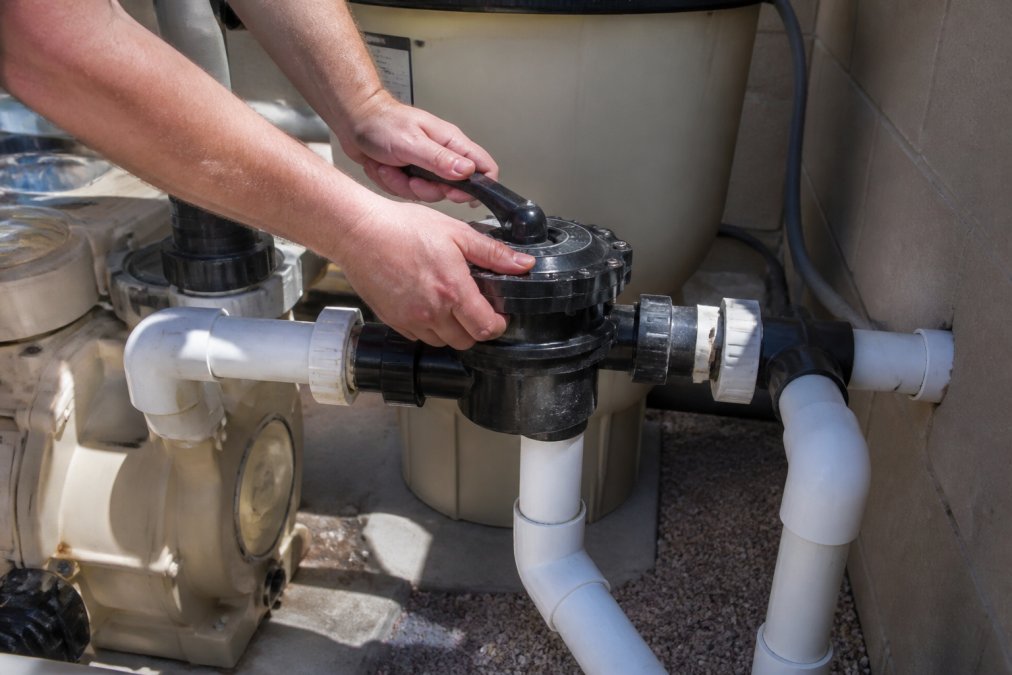
Too low a flow rate lets water linger and heat gain drops; too high and water moves through too fast to absorb heat. A diverter valve routes water to the panels only when the temperature differential favors heating, and a bypass valve protects the system when the pool is already warm.
Three setup essentials:
- A pump rated for the total head pressure of your plumbing plus panels.
- A diverter valve tied to a thermostat control.
- A bypass valve to isolate panels for maintenance.
The U.S. Department of Energy on pool pump efficiency points out that matching pump operation to actual demand cuts energy use, which matters because an oversized pump running constantly erases the savings solar heating is supposed to deliver.
Solar Pool Heater Installation Cost: DIY vs. Professional
Solar pool heater installation cost depends far less on the panels than on mounting, plumbing, and integration with your existing pool system. Most published price ranges quote equipment only, leaving homeowners to discover labor and integration line items on their own.
The collector array is a commodity; the labor is custom. Two identical pools can carry wildly different installation costs depending on roof pitch, distance from the equipment pad, whether plumbing runs through finished landscaping, and whether the existing pump handles the added head pressure.
What the labor actually covers
- System sizing and layout: Calculating collector area against pool surface area and sun hours, then deciding panel count, orientation, and tilt.
- Mounting: Roof straps, ground racks, or ballast systems, plus the penetrations and flashing that keep a roof warranty intact.
- Plumbing runs: Supply and return lines from the equipment pad to the collectors, sized to avoid pressure loss.
- Valve and control integration: Diverter valve, bypass valve, check valve, and thermostat or automatic controller wiring.
- Pump and flow-rate verification: Confirming the existing pump produces the collector’s target flow rate at the total dynamic head of the finished loop.
- Commissioning: Pressure testing, leak checks, and confirming the controller actually cycles the diverter at the right temperature differential.
DIY vs. professional: the real trade-off
DIY suits above-ground pools with flexible mat collectors, short plumbing runs, and a homeowner comfortable with PVC work and basic controller wiring. The equipment is light, mounting is simple, and mistakes are usually visible and fixable.
DIY becomes a poor bet when any of the following is true:
- The collectors go on a roof, where fall risk, roof penetration, and flashing failures are the dominant failure modes.
- The run from the equipment pad to the collectors is long enough that pipe sizing affects flow rate.
- The pool uses a variable speed pump, where the wrong speed setting can starve the collectors without any obvious symptom.
- The homeowner wants the manufacturer’s panel warranty to remain intact, since many manufacturers condition coverage on installation by a qualified installer.
That last point is what most cost comparisons skip: a DIY install can save on labor upfront and cost more over the system’s life if a warranty claim is denied because the installation didn’t meet the manufacturer’s requirements. DIY trades cash for risk, concentrated in the two areas homeowners are least equipped to self-diagnose: flow rate and roof integrity.
What professional installation typically includes
- Correct system sizing and panel placement based on measured sun exposure, not guesswork
- Pump and flow-rate integration, including speed settings on variable speed pumps
- Warranty-backed labor, so a plumbing or integration problem isn’t yours to fix alone
- Proper roof or ground rack mounting with flashing that protects the roof warranty
- Commissioning documentation showing the system hit its target flow rate and temperature differential
At Dixie Pool Solar Heating & Misting, we back our installation labor with a 2-year warranty on top of the manufacturer’s panel coverage, so a plumbing or integration problem isn’t yours to fix alone.
Skipping a professional flow-rate check is the most expensive shortcut. An undersized pump or wrong diverter setting can leave a perfectly good panel array producing almost no heat, and diagnosing it later costs more than doing it right the first time.
How to decide
If your system is a ground-mounted mat array on an above-ground pool with a short, accessible plumbing run, DIY is defensible. If it involves roof mounting, a variable speed pump, a long plumbing run, or a warranty you intend to rely on, professional installation is usually cheaper once you price in the risk of a denied claim or a silently underperforming loop.
Solar Pool Heating System Maintenance and Winterization
Solar pool heating system maintenance is minimal compared with gas or electric heaters, but it isn’t zero. Most systems need only periodic checks: inspecting panels for debris, confirming the diverter valve cycles correctly, and watching for leaks at fittings. Maintenance is light because there’s no combustion, ignition, or refrigerant, failure modes are mechanical and material, not chemical.
In-season maintenance
- Panel inspection: Look for debris, leaf litter, and bird droppings that shade the collector surface. Even partial shading on a tube-and-web panel reduces output across the whole array, not just the shaded tubes.
- Flow verification: Confirm the pump is still delivering the collector’s target flow rate. A partially clogged filter or a pump running at a reduced speed setting will quietly cut heat gain.
- Valve cycling: Watch the diverter valve move through a full cycle. A valve that sticks open sends heated water to the panels when the pool is already warm, which wastes pump energy without adding heat.
- Fitting and leak checks: Inspect unions, clamps, and the panel headers. Small drips at fittings are the most common early warning sign of a loosening connection.
- Controller check: Confirm the thermostat or automatic controller is still reading the temperature differential correctly. A drifting sensor can keep the system off during the hours it should be running.
Why winterization matters more than any other task
Water expands when it freezes, and solar collector tubes are thin-walled by design for heat transfer. That’s why freeze damage is the leading cause of premature collector failure in cold-winter regions, a single hard freeze with trapped water can split tubes that would otherwise last twenty years.
The fix depends on how the system is mounted, and this is where most guides stop short.
If the collectors are removable (typical of mat systems on above-ground pools):
- Disconnect the supply and return lines at the equipment pad.
- Drain the mats completely, tilting them so water doesn’t pool in low sections.
- Store them indoors, flat and out of direct sun, for the off-season.
- Cap or plug the open plumbing ends at the pad to keep debris out.
If the collectors are roof-mounted and stay in place:
- Isolate the array using the bypass valve so pool water no longer circulates through it.
- Drain the array through its lowest drain point. Roof-mounted arrays often need a dedicated drain valve installed at the low header for exactly this purpose.
- If the array cannot be fully drained, use a shop vac or low-pressure air to push residual water out of the headers and tubes.
- Leave the bypass valve in the isolated position through the freeze season, and confirm the controller is set so it won’t command the diverter to open during a freeze cycle.
- Inspect the roof penetrations and flashing before the first freeze, since freeze-thaw cycles widen small gaps.
Seasonal startup
Before the first swim, reverse the shutdown: reopen the bypass, flush the loop, confirm flow rate at the collectors, and verify the controller cycles the diverter. A system that sat isolated all winter can develop a stuck valve or loose union that won’t show until water moves again.
The CDC’s guidance on pool water safety and maintenance reinforces that consistent water quality and system upkeep protect both equipment and swimmers, which applies to solar loops just as much as filtration.
If you live in a region that sees only occasional overnight freezes, a freeze-protection controller setting that automatically drains or isolates the array can be cheaper than a full seasonal shutdown, but only if the array was installed with a drain point in the first place. That’s a design decision to make before installation, not after.
Warranty Coverage, Panel Durability, and Long-Term Value
Warranty coverage is where cheap systems reveal themselves. Panel durability determines whether you replace collectors in five or twenty years, and the warranty shows what the manufacturer will bet on that lifespan.
Look for three things:
- Panel warranty length: Longer terms signal confidence in UV resistance and thermal stability.
- Labor warranty: Covers the installation work, not just the parts.
- Material quality: UV-resistant polypropylene outlasts commodity plastics.
Dixie Pool Solar Heating & Misting installs Heliocol panels built to last 20+ years, backed by an industry-best 12-year warranty on all panels. That combination matters because a solar pool heater’s long-term value isn’t the sticker price, it’s the cost per season of usable heat.
What most reviews skip: after the panel warranty ends, a quality system doesn’t automatically fail. Panels that survived a decade of thermal expansion usually keep going, the warranty protects you from defects, it doesn’t predict a cliff.
Conclusion: Choosing the Right Solar Pool Heater for Your Home
Most buyers focus on price and panel count while ignoring flow rate, sizing, and winterization, the three factors that decide whether a system actually extends your season. Getting those right turns a solar pool heater from a gamble into a dependable, low-maintenance asset.
Dixie Pool Solar Heating & Misting handles sizing, pump integration, and professional installation so your system performs from day one, backed by Heliocol panels rated for 20+ years, a 12-year panel warranty, and a 2-year labor warranty. Homeowners can also take advantage of the Utah State 25% or $2,000 tax credit and the $750 gas rebate to offset the upfront cost.
Get started with Dixie Pool Solar Heating & Misting and extend your swim season from March through November.
Frequently Asked Questions
What features should I look for in a solar pool heater?
Prioritize collector efficiency, durable UV-resistant materials like polypropylene, and a tube-and-web design that maximizes heat gain. Check for a high BTU output per square foot, compatibility with your existing pool pump, and a diverter valve for thermostat control. A long warranty, such as the 12-year coverage on Heliocol panels, and low maintenance requirements also matter. In Southern Utah, systems that handle thermal expansion and occasional freezing are especially valuable.
Are solar pool heaters worth the investment?
For many homeowners, yes. Solar pool heaters can save $1,500 to $2,000 per year on heating costs compared to gas or electric systems, and they have no operating costs after installation. They extend your swim season from March through November and may qualify for a 25% Utah state tax credit (up to $2,000) plus a $750 gas rebate. The upfront cost varies by system size and installation, so get a personalized quote to see your potential savings.
How do solar pool heating panels work?
Solar pool heating panels use the sun’s thermal energy to warm water as it circulates through tubes inside the collectors. Your existing pool pump pushes water through the panels, where it absorbs heat, then returns to the pool. A thermostat-controlled diverter valve routes water through the panels only when heating is needed. This process is separate from electricity-generating PV solar and works efficiently even on cooler days as long as there is sunlight.
Do solar pool heaters work on cloudy days?
Solar pool heaters produce less heat on cloudy days, but they still capture diffuse solar energy and can warm water to some degree. Performance depends on collector efficiency and ambient temperature. In Southern Utah, where sunshine is abundant, systems typically maintain comfortable pool temperatures from March through November. If you experience extended cloudy periods, a properly sized system with good heat retention features will minimize temperature drops.
 Dixie Pool Solar Heating & Misting
Leave a comment