
Table of Contents
- Tools and Materials You’ll Need Before You Start
- Step-by-Step: How to Install a Pool Fountain for Cooling
- How to Cool Down Hot Pool Water With Aeration
- Pool Fountain Cooling Efficiency: What Actually Moves the Temperature
- DIY Pool Aerator for Cooling: Pump Compatibility and GPM Requirements
- Water Chemistry, Winterization, and Noise: What Most Guides Skip
- Troubleshooting Common Installation Issues
- Frequently Asked Questions
Last Updated: September 15, 2026
Tools and Materials You’ll Need Before You Start
Installing a pool fountain for cooling takes under an hour with basic hand tools. This guide from Dixie Pool Solar Heating & Misting covers the process, plus the chemistry and winterization details most tutorials skip.
Before you touch the return line, gather everything:
- Replacement eyeball fitting or threaded adapter sized to your return port (1.5-inch is the most common thread on residential pools)
- Fountain head or spray nozzle kit with a threaded collar
- Spare O-ring or PTFE tape for a clean seal at the threads
- Channel-lock pliers or a strap wrench (a strap wrench won’t scar plastic fittings)
- Silicone-based lubricant for the O-ring, never petroleum jelly
- Bucket and rags for the small water spill when you break the seal
A common mistake is buying a kit before measuring the return port; threads differ between above-ground and inground pools, so measure the inside diameter first.
Photograph your return fitting with a ruler held across the opening before you go shopping. Counter staff can match the thread pitch from a photo far faster than from a description.
Step-by-Step: How to Install a Pool Fountain for Cooling
The full installation takes most homeowners 30 to 45 minutes, is beginner-level, and requires no plumbing cuts.
Step 1: Remove the Existing Return Jet Eyeball Fitting
Turn off the pump at the breaker first; skipping this causes soaked homeowners and stripped threads.
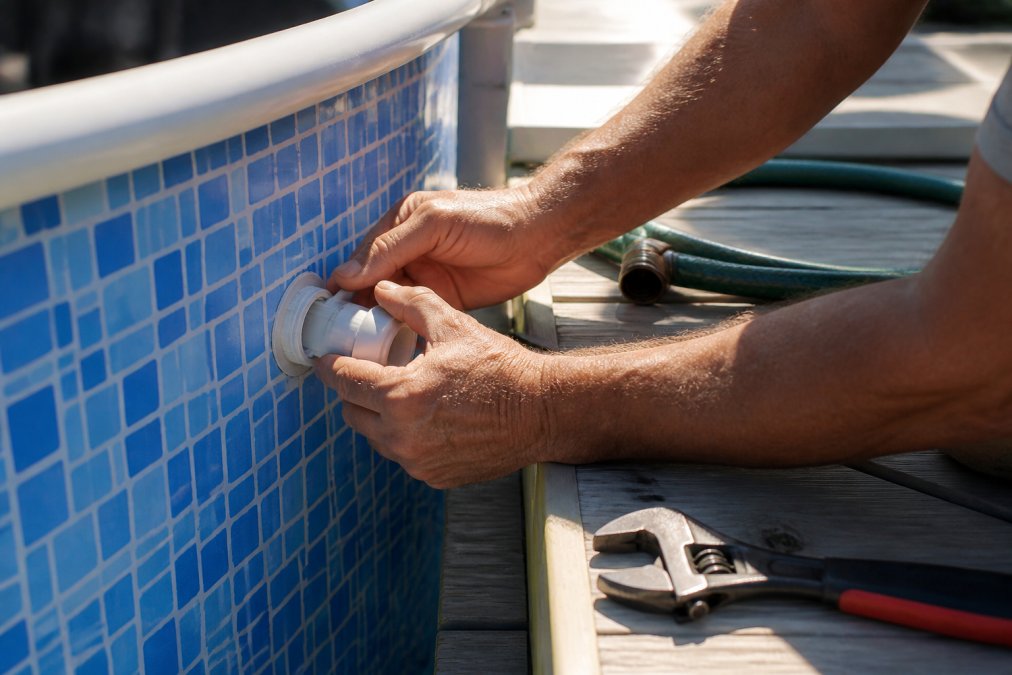
Grip the eyeball fitting, the small directional nozzle screwed into the return port, and twist counterclockwise by hand. If it resists, use a strap wrench on the outer ring only. Never force it with metal pliers; the plastic collar cracks easily and a cracked return port is a professional repair.
Once free, wipe the threads clean and check the O-ring. If it’s flattened or nicked, replace it now; a leaking return line wastes more water than the fountain evaporates.
Step 2: Assemble the Fountain Unit and Threaded Adapter
Thread the adapter onto the fountain head before entering the water, so small parts don’t end up in the skimmer.
Wrap two to three turns of PTFE tape clockwise around the adapter’s male threads, hand-tighten it into the fountain head, then give it a quarter turn with a wrench. Lubricate and seat the O-ring.
Most kits include a threaded collar for spray angle; set it mid for now and fine-tune once water flows.
Step 3: Connect the Fountain to the Return Line and Set Spray Height
Screw the unit into the return port by hand until it seats, then snug a quarter turn. Don’t overtighten; the O-ring seals, not torque.
Restore power and adjust the nozzle collar until water arcs back into the pool, not onto the deck. Too low gives splash without cooling; too high lets wind carry water away.
Aim for a fine, high arc that breaks into droplets before landing; that breakup drives evaporative cooling.
How to Cool Down Hot Pool Water With Aeration
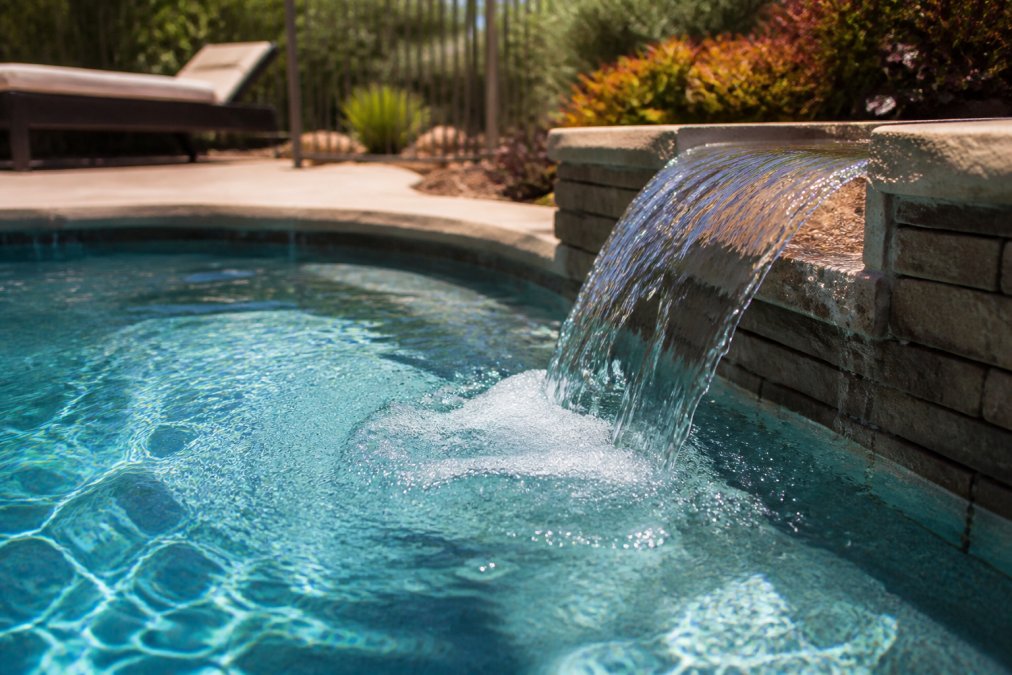
Aeration cools pool water through evaporative cooling, the same process that makes you feel cold stepping out of a pool on a breezy day (Best Management Practice #10: Cooling Tower Management). Moving air and broken droplets speed evaporation, pulling heat from the remaining water.
A pool fountain for cooling pushes water through a nozzle and lets it fall as droplets; more surface area exposed to air means faster heat loss. Run it during the hottest, driest, breeziest part of the day, and overnight if your pump schedule allows.
Many owners run the fountain during the day and rest the pump at night to balance cooling and equipment wear. Results depend on humidity, wind, and spray coverage.
Pool Fountain Cooling Efficiency: What Actually Moves the Temperature
Three variables decide how much a fountain actually cools your pool: evaporation rate, run time, and pump flow rate.
Evaporation rate is the engine. Dry air and wind accelerate it; humid, still afternoons slow it to a crawl. A fountain that cools well in arid conditions may barely register in humidity.
Run time compounds the effect: eight hours a day out-cools two hours, assuming the pump can sustain the flow.
Flow rate sets the ceiling. A fountain starved of pressure produces a weak, low spray with little droplet breakup, and cooling stalls.
The takeaway: a pool fountain is a supplement, not a replacement for shade, covers, or a properly sized pump. If your water is consistently too hot and you want to extend your swim season, solar thermal heating and cooling work best as a pair.
Running a fountain continuously during peak evaporation can drop your water level fast enough to pull air into the skimmer within a day or two. Check the waterline daily during heavy fountain use.
DIY Pool Aerator for Cooling: Pump Compatibility and GPM Requirements
Pump compatibility is where most DIY pool aerator projects fail. A fountain adds back pressure to the return line, and a pump near its limit loses flow to the filter and skimmer. Before buying, you need two numbers: your pump’s flow in gallons per minute (GPM) at operating pressure, and the fountain head’s rated flow range.
Start With Your Pump’s Curve, Not Its Horsepower
Horsepower alone tells you little; a 1 HP single-speed and a 1.5 HP variable-speed pump can deliver very different flow at the same pressure. What matters is the pump curve, the manufacturer’s chart showing GPM across total dynamic head (TDH) values. TDH is your system’s total resistance in feet of head, and it climbs with equipment, long pipe runs, dirty filters, heaters, salt cells, and solar loops.
A practical way to estimate your available flow:
- Find your pump model’s published performance curve (manual or manufacturer’s site).
- Estimate your system’s TDH. A simple pool with a short run and clean filter sits near 30 to 40 feet of head; a pool with a heater, salt cell, and long runs can push past 60.
- Read the GPM at that TDH off the curve.
Why Return-Line Back Pressure Matters
Signs Your Pump Is Struggling
Watch for these after installation:
Variable-Speed Pumps Change the Math
A pool fountain for cooling only works if your pump has flow to spare at your system’s actual total dynamic head. Match the fountain head’s rated GPM to your pump curve before you buy, not after.
Water Chemistry, Winterization, and Noise: What Most Guides Skip
Water Chemistry: Why Aeration Pushes pH Up
What to do about it:
A fountain that raises pH unchecked for weeks can scale a heater and cloud the water. Test more often than you think you need to, and don’t let pH drift above the normal range just because the spray looks fine.
Winterization: Remove Before the First Hard Freeze
The sequence that avoids damage:
Noise: Test Before You Commit to All-Day Operation
Practical steps:
Before you buy a fountain head, ask whether the seller publishes a decibel rating or flow rating. Heads with published specs are easier to match to your pump and easier to predict for noise than generic kits with no data.
Troubleshooting Common Installation Issues
| Problem | Likely Cause | Fix |
|---|---|---|
| Leak at the return port | Worn or missing O-ring | Replace O-ring, lubricate with silicone |
| Fountain won’t thread in | Mismatched adapter size | Measure port, swap adapter |
| Weak or sputtering spray | Low flow rate or air leak | Check pump basket, reseat O-ring |
| Spray blows onto the deck | Nozzle angle too high | Lower spray height, adjust collar |
| pH climbing steadily | Aeration driving off CO2 | Test and adjust pH more often |
| Fountain cracks after winter | Water left in nozzle | Remove and drain before freeze |
Keep the old eyeball fitting in a labeled bag with your pool supplies. If the fountain ever needs to come off for repairs or winter, you can restore normal return flow in two minutes.
Frequently Asked Questions
Can a fountain be used to cool pool water?
Yes. A pool fountain pushes water through the air as a fine spray, and evaporation carries heat away from the droplets before they land back in the pool. This evaporative cooling effect can drop water temperature noticeably when the fountain runs during the hottest, driest part of the day. The catch is that it works best when humidity is low, so it performs well in dry climates and less effectively in humid ones. Pair it with overnight circulation for the biggest temperature drop.
Do pool fountains require professional installation?
Most return-jet fountains are a no-tool or minimal-tool install. You unscrew the eyeball fitting, thread in the adapter, attach the fountain head, and adjust the spray. The whole job usually takes under 30 minutes. Professional help makes sense if your return fitting is seized, if you want a deck-mounted water feature tied into the plumbing, or if your pump is already near its flow limit. Call a pool pro if threads are cracked or the return line needs modification.
What is the best way to cool down my swimming pool water?
Run the fountain or aerator at night and in the early morning, when air temperature is below water temperature and evaporation is most efficient. Keep the pump running long enough to turn over the full volume of water. Shade the pool surface where possible, and reduce the use of gas heaters during heat waves. If your pool still runs too hot, a misting system or a dedicated cooling fountain on a separate timer gives you more control than a single return-jet unit.
Can I add a fountain to my existing pool?
Yes, as long as you have a standard threaded return fitting, which nearly all above-ground and inground pools do. Choose a fountain that matches your return thread size, usually 1.5-inch or 2-inch, and confirm your pump can handle the added back pressure. If the spray looks weak after installation, the fountain is restricting flow too much. In that case, switch to a lower-profile head or split the return between the fountain and a standard eyeball fitting.
 Dixie Pool Solar Heating & Misting
Leave a comment