Table of Contents
- How to Tell If Solar Pool Panels Are Working
- Dirty Filters and Flow Restriction: The Most Common Cause of Solar Pool Heater Failure
- Pump and Circulation Problems That Shut Down Your System
- Thermostat and Sensor Calibration Failures
- Solar Pool Heater Maintenance Tips to Prevent Costly Breakdowns
- DIY vs. Professional Repair: Cost-Benefit Analysis for Solar Pool Heater Failure
- Troubleshooting Saltwater Pool Solar Heaters
- Conclusion
- Frequently Asked Questions
Last Updated: September 15, 2026
How to Tell If Solar Pool Panels Are Working
A solar pool heater running cold water back into the pool usually means one of three things: a clogged filter, a pump that lost prime, or a sensor out of calibration.
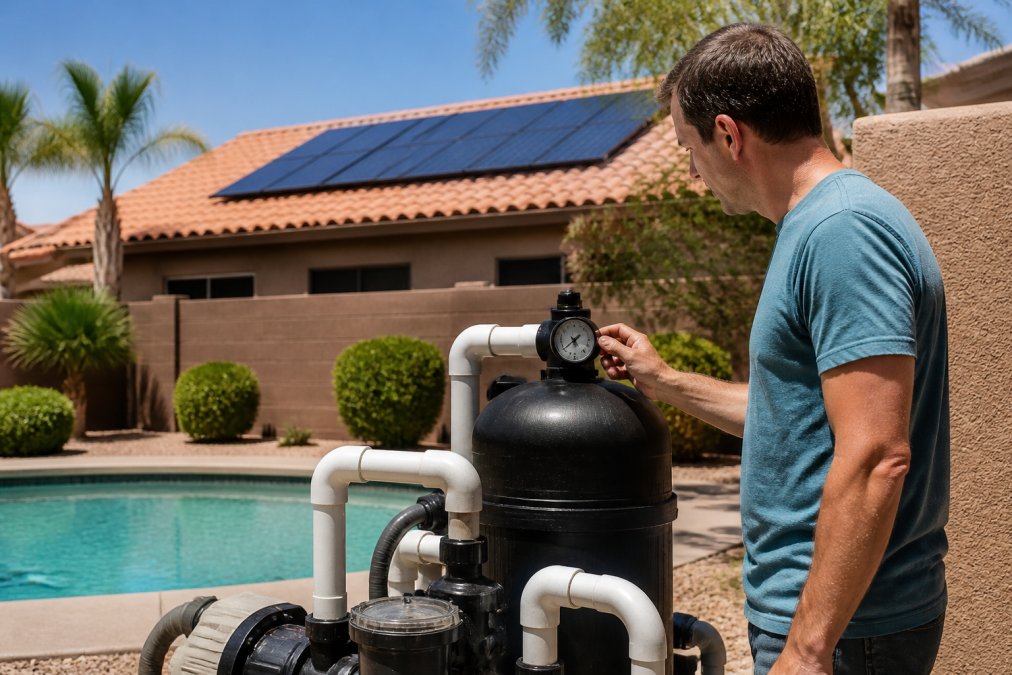
Start with temperature and pressure. If water leaving the panels isn’t noticeably warmer than the pool, the collector loop isn’t working. If the filter gauge reads above its clean baseline, flow is restricted upstream.
Quick Visual and Temperature Checks
A working solar array should feel warm to the touch on a sunny afternoon, and the return line feeding the pool should run a few degrees above pool temperature. Check the panels for obvious shading from new tree growth, debris, or a shifted roof vent. The U.S. Department of Energy guide to solar pool heating notes that collector orientation and unshaded exposure drive most of a system’s heat output, so a panel that used to work well and now doesn’t often has a new obstruction overhead.
Reading Your Pressure Gauge and Flow Rate
Filter pressure is the most useful number on your pad. Note the reading right after a backwash, that’s your clean baseline. A rise of 8 to 10 psi signals restriction; low pressure with weak return flow points to a pump or suction problem (FNS® Plus Product Support | Safety & Help Center).
Dirty Filters and Flow Restriction: The Most Common Cause of Solar Pool Heater Failure
A clogged filter is the most common cause of solar pool heater failure and the easiest to fix. As it loads with debris, flow through the collectors drops and the system quietly underperforms for weeks.
How a Clogged Filter Starves Your Collectors
Collectors transfer heat in proportion to water flow, so restricting flow restricts heat output even on a cloudless day. The controller may still read a healthy temperature split, which is why pressure is the better early warning.
Backwashing and Skimmer Basket Maintenance
- Backwash when pressure climbs 8 to 10 psi above the clean baseline
- Empty the skimmer basket weekly during heavy leaf season
- Clear the pump strainer pot before it fills past halfway
- Check the diverter valve is fully open to the solar loop
Most homeowners backwash on a fixed calendar schedule. Pressure tells you when it’s actually needed, and over-backwashing wastes water without improving flow.
Pump and Circulation Problems That Shut Down Your System
Pump failure shows up as no flow, or flow that stops and restarts. Before calling anyone, rule out the cheap causes: air in the system, a stuck check valve, a mis-set diverter, and lost prime.
Air Locks, Lost Prime, and Suction-Side Leaks
An air lock is trapped air that stops circulation through the collector loop, usually after winterization, a drain-down, or a suction-side leak. The tell: a strainer pot that never fills, gurgling at the pump, and low pressure even though the pump runs.
To clear a typical air lock: shut off the pump, close the solar diverter, open the air-bleed valve at the array’s highest point, then restart the pump and slowly reopen the diverter. If the lock returns within a day or two, you have a suction-side air leak, usually a cracked pump lid O-ring, a loose suction-line union, or a skimmer pulling air because the water level dropped below the weir.
A failed check valve lets water drain out of the panels overnight, so the pump re-primes the array every morning. You’ll see a pump running dry for 30 to 60 seconds at startup, or a gauge reading zero in the morning. The flapper or spring usually fails; on saltwater pools the spring corrodes first.
Diverter Valves and Actuator Failures
A diverter stuck half-open sends part of the flow to the panels and part straight back to the pool, so the loop never gets its designed flow rate and heat output drops. Check the handle against the plumbing diagram, and confirm any actuator has rotated to the solar position when the controller calls for heat. Actuators fail more often than the valve body, usually the motor or end-switch.
Circuit Breaker, Pump Schedule, and Flow Rate
Confirm the pump breaker hasn’t tripped and that the schedule overlaps with daylight hours. A pump running only at night circulates water through cold panels and returns it cooler.
Flow rate ties this together. Most residential arrays are sized for roughly 0.1 gallons per minute per square foot of collector, so a 400-square-foot array wants about 40 GPM (Solar Hot Water System Calculator). With a flow meter, compare the reading to the design number. Without one, use pressure and the feel of the return jets: weak returns plus low filter pressure points to a pump or suction problem; weak returns plus high pressure points to a restriction downstream of the pump.
Before replacing a pump, verify the impeller is not clogged with debris. A pump that hums but moves little water is often a blocked impeller, not a failed motor, and clearing it costs nothing.
When the Pump Itself Has Failed
A pump that trips its breaker on startup, smells hot, or won’t spin by hand with the power off has likely failed internally. Capacitor failure is common on older single-speed pumps and cheap to repair; bearing or winding failure usually means replacement. Match the replacement to the existing horsepower and service factor rather than upsizing, since an oversized pump can push flow past what the collectors and plumbing are rated for.
Thermostat and Sensor Calibration Failures
A misread temperature is a silent failure. The system runs, the pump circulates, and the pool never warms because the controller thinks the panels are colder than they are.
Differential Controller Problems
The differential controller compares panel temperature to pool temperature and switches the pump on when the panels are warmer. If that comparison is wrong, the controller either never engages the solar loop or runs it when it shouldn’t.
Thermal Sensor Drift and False Readings
Thermal sensor drift happens when a sensor’s reading slowly shifts from the true temperature. It’s common on older sensors and after a lightning-heavy monsoon season. If the controller’s panel temperatures don’t match a hand-held reading at the panel, the sensor is the likely culprit.
Replacing a sensor without confirming the controller’s set points can mask the real problem. A new sensor on a misconfigured controller will read correctly and still switch at the wrong time.
Solar Pool Heater Maintenance Tips to Prevent Costly Breakdowns
Solar pool heater maintenance tips come down to a short seasonal routine and a longer annual one. Systems that get both tend to run for their full service life with almost no intervention.
Seasonal Winterization Checklist
Monthly and Annual Inspection Routine
| Frequency | Task | What to Watch For |
|---|---|---|
| Weekly | Empty skimmer basket | Debris blocking suction |
| Monthly | Log filter pressure | Rise above clean baseline |
| Quarterly | Inspect PVC piping and joints | Cracks, warping, leaks |
| Annually | Verify sensor readings | Drift versus hand-held reading |
| Annually | Test check valve | Overnight drain-back |
| Annually | Inspect roof surface under panels | Trapped moisture, granule loss, rust staining |
How Roof Material Changes What You Should Inspect
Saltwater Systems Need a Tighter Cadence
Do not pressure-wash solar collectors. The force can lift panel gaskets and drive water into the header insulation, which is a failure mode that shows up months later as a slow leak you cannot find.
The maintenance routine is the same for every system. What changes is how often you look and what you look for, roof material sets the inspection targets, and saltwater sets the interval.
DIY vs. Professional Repair: Cost-Benefit Analysis for Solar Pool Heater Failure
The dividing line isn’t cost, it’s access. Anything you can reach from the equipment pad is fair game. Anything on the roof is not.
Troubleshooting Saltwater Pool Solar Heaters
Conclusion
Frequently Asked Questions
What are the most common reasons my solar pool heater isn’t working?
The most frequent causes of solar pool heater failure are a dirty filter restricting water flow, air locks in the plumbing, a faulty differential controller, and sensor calibration drift. A clogged filter is the number one culprit because it starves the collectors of water, causing the system to overheat or shut down. Check your filter pressure gauge first, then inspect for air in the system and verify your controller settings before calling a technician.
Can a dirty pool filter cause solar heater failure?
Yes, a dirty pool filter is one of the leading causes of solar pool heater failure. When the filter clogs, water flow rate drops below what the collectors need to transfer heat efficiently. The system may overheat, the pressure gauge will read high, and the panels can warp or develop leaks over time. Backwashing or cleaning your filter regularly and emptying the skimmer basket keeps flow rates where they need to be.
How do I know if my solar pool heater panels are damaged?
Signs of damaged solar pool panels include visible cracks, warped PVC piping, water pooling around the roof mounting points, and a sudden drop in heat output despite sunny conditions. You may also notice the system running but the pool temperature not rising. A visual inspection after heavy weather or freezing temperatures catches most damage early.
What solar pool heater maintenance tips should I follow each season?
Before swim season, check your filter pressure gauge, clean the skimmer basket, and inspect panels for debris or shading. Verify the differential controller is reading accurate temperatures and test the diverter valve to confirm water flows through the collectors. In fall, winterize the system by draining panels and pipes to prevent freeze damage. Monthly checks of flow rate and pressure catch small issues before they become expensive repairs.
 Dixie Pool Solar Heating & Misting
Leave a comment