Table of Contents
- How Solar Pool Heating Works for Small Pools
- Solar Pool Heater Sizing Guide for Small Pools
- Solar vs Gas Pool Heating Comparison
- Solar Pool Heater Installation Cost and Setup
- Space-Saving Installation for Small Yards
- Maintenance, Water Chemistry, and Longevity
- Extending Your Swimming Season and Maximizing Savings
- Frequently Asked Questions
Last Updated: September 16, 2026
How Solar Pool Heating Works for Small Pools
Solar pool heating is the process of circulating pool water through solar collectors, where heat from the sun transfers to the water before it returns to your pool. For small pools, this works especially well because there’s less water volume to warm, so temperature gains show up faster. At Dixie Pool Solar Heating & Misting, we’ve seen small-pool owners extend their swimming season from March through November with a system that runs on nothing but sunlight and your existing pump.
The Role of Your Pool Pump and Flow Rate
Your existing pool pump does the work. Water gets pushed through the collectors, absorbs thermal energy from the sun, and returns warmer to the pool. The key variable is pool pump flow rate: too slow and heat transfer suffers, too fast and you lose efficiency to friction.
Solar Pool Heater Sizing Guide for Small Pools
Sizing a solar heater for a small pool comes down to three numbers: your pool’s surface area, your daily water turnover, and your collector’s rated flow window. Most guides stop at the first number. Small pools live and die by the other two.
Start With Surface Area, Not Volume
Solar collectors heat the top layer of water that passes through them, so surface area, not gallons, drives the sizing math. The long-standing industry guideline is to size collector area at 50% to 100% of pool surface area:
- 50% to 60%, season extension in a warm, sunny climate with a solar cover
- 70% to 80%, the common middle ground for a small above-ground or plunge pool
- 90% to 100%, cooler climates, shaded yards, or a goal of swimming into the shoulder months
The Flow Rate Math Competitors Skip
Small pools have small pumps, and small pumps have a narrow sweet spot. Two numbers matter:
- Minimum flow per square foot of collector. A common target is 0.1 gallons per minute (GPM) per square foot of collector area. For 80 square feet of mat, that’s a floor of 8 GPM through the collectors.
- Turnover rate. You want the full pool volume to cycle through the collectors at least once per day of good sun. A 12-foot round pool holds about 3,400 gallons. At 8 GPM, that’s roughly 7 hours of pump run time, comfortably inside a normal daily schedule.
Before you buy, time how long it takes your pump to fill a 5-gallon bucket at the return. Multiply the result to get GPM. That number, not the pump label, is what you’re sizing against.
A Worked Example
A 15-foot round above-ground pool:
- Surface area: ~177 sq ft
- Target collector area at 70%: ~124 sq ft (two 4×20 mats, or one 4×20 mat plus a 4×10 panel)
- Minimum collector flow: ~12 GPM
- Pool volume: ~5,300 gallons
- Daily run time at 12 GPM: ~7.5 hours
If your pump can’t hold 12 GPM through the collectors, add a second mat in parallel rather than in series, parallel splits the flow and lowers the pressure drop across each collector.
When to Go Bigger or Smaller
- Go bigger if the pool sits in partial shade, you’re in a cooler climate, or you want reliable heat from early spring.
- Go smaller only if you’re pairing the system with a solar cover and a modest season-extension goal. Undersizing a small pool is the most common mistake, the water warms slowly and never quite gets comfortable.
A system sized this way raises water temperature steadily without straining your filtration system or your pump.
Solar vs Gas Pool Heating Comparison
The honest answer: solar wins on operating costs, gas wins on speed. A gas heater can raise pool temperature in hours; a solar system builds heat over a day or two of sunshine. For small pools in sunny climates, solar’s slower warm-up is rarely a problem because the water volume is small.
| Factor | Solar Pool Heating | Gas Pool Heating |
|---|---|---|
| Operating cost | Near zero after install | Ongoing fuel costs |
| Warm-up speed | Gradual, weather-dependent | Fast, on demand |
| Lifespan | 20+ years with quality panels | Shorter, service-heavy |
| Best for | Sunny climates, season extension | Cold snaps, quick heat |
| Maintenance | Minimal | Regular servicing |
Solar Pool Heater Installation Cost and Setup
Installation cost for a small-pool solar heater is driven by four things: collector type, mounting method, plumbing distance, and who does the labor. Because every yard is different, the fastest way to an accurate number is a site-specific quote, but you can estimate the shape of the cost before you call anyone.
What Actually Drives the Cost
- Collector type. Unglazed mats and domes are the least expensive per square foot and are the right choice for seasonal small pools. Glazed panels cost more but hold heat better in cooler climates.
- Mounting. A ground rack along a fence is the cheapest install. Roof mounting adds labor, roof-penetration sealing, and often a permit. A vertical wall or fence mount sits in between.
- Plumbing distance. Every additional foot of hose or pipe adds material and pressure loss. Keeping the collectors within 20 to 30 feet of the pump and filter keeps both cost and flow loss down.
- Labor. This is the single biggest swing factor. A simple above-ground mat install is a weekend DIY project. A roof-mounted panel array with a bypass valve, vacuum breaker, and automatic controller is a professional job.
DIY vs. Professional: A Decision Framework
Most small-pool owners can handle a ground-mounted mat or dome system themselves. The decision usually comes down to four questions:
- Where are the collectors going? Ground rack or fence line, DIY is realistic. Roof or a custom rack, go professional.
- How complex is the plumbing tie-in? A single hose run from the return to the mat and back is DIY-friendly. Cutting into rigid PVC, adding a three-way bypass valve, and integrating with an existing filter loop is not.
- Do you want the warranty to cover labor? Most panel manufacturers warrant the panel, not the installation. If a leak develops from a bad fitting, a DIY install leaves you holding the repair.
- How much is your time worth? A pro install on a small pool is typically a one-day job. A first-time DIY install often stretches across two weekends once you’ve made the inevitable second trip for fittings.
DIY installs that bypass the manufacturer’s plumbing requirements, wrong hose diameter, no bypass valve, panels plumbed in series when the spec calls for parallel, are the most common cause of voided panel warranties. Read the install manual before you buy hardware.
What a Professional Install Adds
Beyond labor, a pro brings three things a DIY install often misses:
- Correct flow balancing. Panels plumbed in parallel with matched runs heat evenly; panels in series with mismatched runs starve the last collector.
- A proper bypass valve. This lets you route water around the collectors when the pool is already warm, which protects the panels and saves pump energy.
- A controller or timer integration. Running the pump only during peak sun hours is where most of the operating savings come from, and it’s easier to set up correctly the first time.
The Trade-Off, Stated Plainly
DIY saves upfront labor but risks leaks, poor flow balance, and voided warranties. Professional installation costs more initially but typically delivers better thermal efficiency and a system that lasts. For a small above-ground pool with a ground-mounted mat, DIY is a reasonable bet. For anything roof-mounted, wall-mounted, or tied into rigid plumbing, the professional route usually pays for itself in avoided rework.
Space-Saving Installation for Small Yards
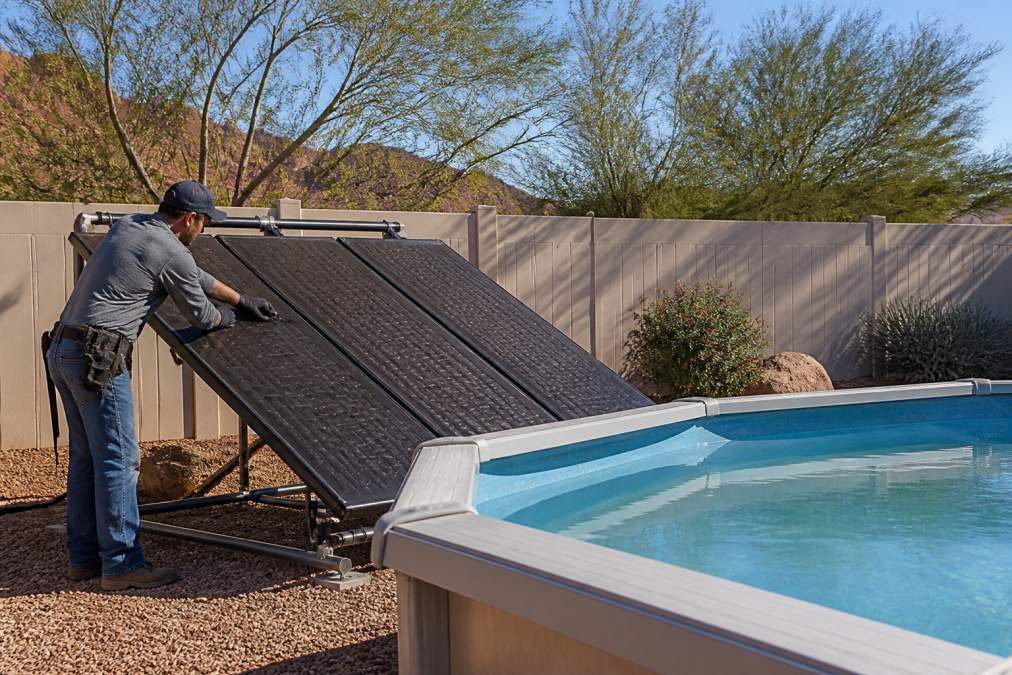
Small yards don’t have to mean no solar. The trick is choosing low-profile collectors and mounting them where they catch sun without eating your usable space.
Maintenance, Water Chemistry, and Longevity
Solar pool heating needs very little upkeep. Rinse dust and debris off the collectors a few times a season, check for leaks at the plumbing connections, and confirm the bypass valve still operates smoothly.
Extending Your Swimming Season and Maximizing Savings
The biggest payoff of solar pool heating for small pools is a longer swimming season without a fuel bill. A properly sized system can keep water comfortable from March through November in a sunny climate, and once installed, operating costs are essentially zero.
Frequently Asked Questions
Do solar heaters for small pools actually work?
Yes. Solar pool heating works by circulating pool water through collectors that absorb thermal energy from the sun, then returning warmed water to the pool. For small pools, the lower water volume means faster temperature gains. A properly sized system can raise water temperature by several degrees per day of sun, enough to extend your swimming season from March through November. The key is matching collector area and pump flow rate to your pool’s volume.
How many solar panels do I need for a small pool?
The general rule is that collector surface area should equal 50 to 100 percent of your pool’s surface area, depending on your climate and how warm you want the water. A small pool with 200 square feet of surface might need 100 to 200 square feet of collectors. In sunny climates, you can lean toward the lower end. A solar pool heater sizing guide or a professional assessment will give you the exact number for your setup.
Can I install a solar pool heater on a small above-ground pool?
Yes, above-ground pools are well suited to solar heating. Many systems use solar mats or low-profile collectors that sit on the ground or a rack near the pool. Installation involves connecting the collectors to your existing filtration system with plumbing runs and a bypass valve. The setup is simpler than for inground pools because there is no trenching. A professional can integrate the system so it works with your current pump and filter.
How much can I save on energy bills by using solar pool heating?
Solar pool heating has no operating costs because it uses the sun’s thermal energy instead of gas or electricity. Homeowners who switch from gas heating often save $1,500 to $2,000 per year on pool heating. You may also qualify for a 25% Utah state tax credit up to $2,000 and a $750 gas rebate. Actual savings depend on your pool size, local climate, and how often you heat.
Small pools are actually the ideal candidate for solar heating: less water to warm, faster temperature gains, and lower equipment cost than a full-size system. If you want to swim from March through November without watching a gas bill climb, Dixie Pool Solar Heating & Misting can size, install, and warranty a Heliocol system built to last 20+ years, with a 12-year panel warranty and a 2-year labor warranty behind it. Get a free quote and find out exactly what your pool needs.
 Dixie Pool Solar Heating & Misting
Leave a comment