Last Updated: November 25, 2026
Quick Summary
To increase pool water temperature naturally, stop heat loss first: cover the pool every night with a solar cover, run the pump during peak sun, and block wind with hedges or fences. These steps retain free solar heat and can raise pool water temperature gradually over several sunny days.
- An uncovered pool loses most of its heat overnight, and evaporation is the largest source of that loss.
- Cover at dusk before air temperature drops, then uncover mid-morning on sunny days to capture solar gain.
- Solar covers are usually 8 to 12 mil thick, while thicker pool blankets run 12 to 16 mil.
- Measure temperature at the same depth, about 18 inches below the surface, away from returns and skimmers.
- Run each method for at least five to seven days before judging whether it works.
Table of Contents
- Start With Heat Loss, Not Heat Gain
- The Fastest Way to Heat a Pool Without a Heater
- Choosing a Pool Cover to Retain Heat
- Solar Pool Heater Options and How They Work
- How Long Does It Take to Warm a Pool Naturally?
- Windbreaks, Landscaping, and Pool Area Shade
- Measuring Your Pool Water Temperature and Deciding What Works
- Get a Free Quote on a Solar Heating System
- Frequently Asked Questions
Start With Heat Loss, Not Heat Gain
Most pool owners attack this problem backwards. They look for ways to add heat before they stop the heat already escaping. Fix the losses first, and your pool holds warmth far better.
An uncovered pool loses most of its heat overnight. Warm water meets cool night air, and the surface gives that heat away. So before you spend a dollar on heating, cut the losses.
Where an Uncovered Pool Loses Its Heat
An open pool loses heat in three main ways:
- Evaporation takes the most heat. Every gallon that turns to vapor carries warmth away with it.
- Wind speeds up evaporation and strips heat off the surface.
- Cool nights pull heat from the water into the air.
The U.S. Department of Energy pool heating guide notes that evaporation is the largest source of heat loss for most pools. That single fact changes your whole strategy.
The Free Heat You Are Already Getting
Sunlight is free, and your pool is already soaking some up. The problem is that most of it leaks back out.
A pool water temperature strategy starts with keeping that free solar energy in the water. You do not need a machine to warm a pool. You need to stop the leaks.
The Fastest Way to Heat a Pool Without a Heater
A solar cover combined with full sun exposure and reduced wind helps retain pool warmth.
Here are several natural methods for retaining pool heat:
- A solar cover at night keeps the heat you already have. This is the single highest-value step.
- Full sun on the surface adds heat during the day.
- Blocking wind stops surface cooling and evaporation.
- Circulation timing moves warmed surface water through the pool.
- A solar heater adds real heat, but it is a system, not a trick.
A common mistake is running the pump at the wrong time. Run it during peak sun so warmed water spreads through the pool, not at night when it just stirs cool water.
Choosing a Pool Cover to Retain Heat
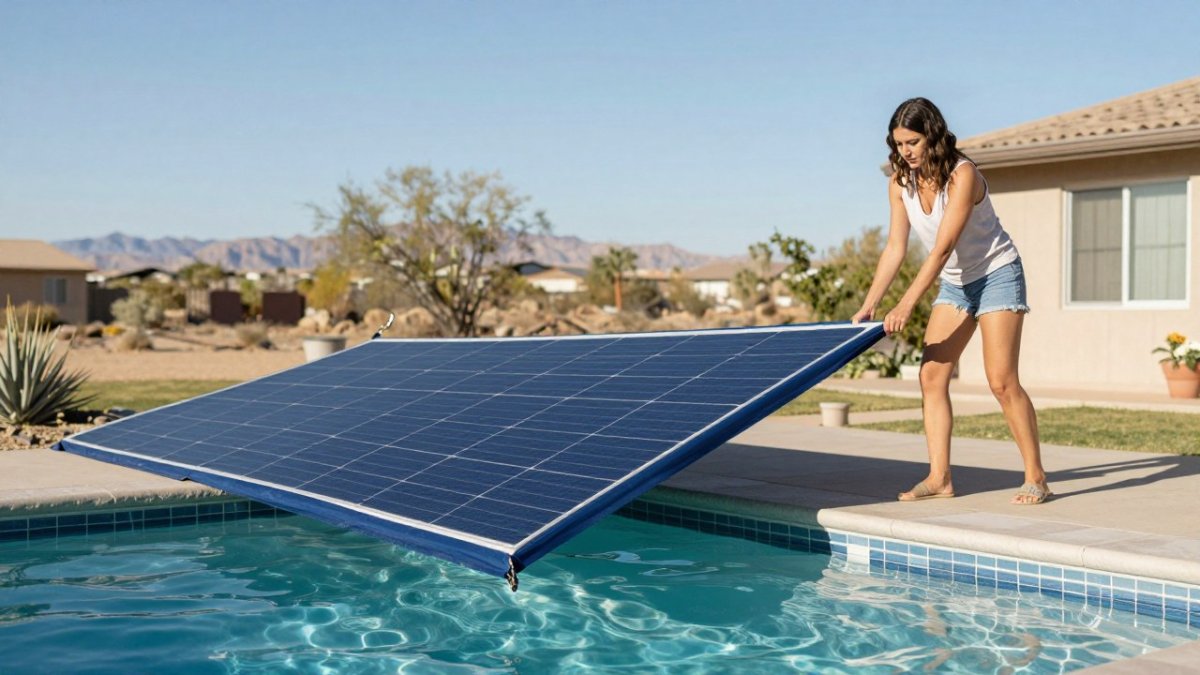
A pool cover to retain heat works by trapping warmth and blocking evaporation. Solar covers and blankets are a practical way to reduce heat loss, but the wrong cover or the wrong routine reduces that benefit.
Solar Covers, Blankets, and When to Use Each
- Solar covers are thin, bubble-style sheets, usually 8 to 12 mil thick. They let sunlight through and hold heat in. Best for daily use.
- Pool blankets are similar but often thicker (12 to 16 mil) and more durable. Best for regular overnight use and for pools with heavy foot traffic.
- Liquid covers are a chemical film. They cut evaporation but do not add heat, and they do nothing for overnight retention once the surface is disturbed.
Sizing and Fit
A cover should float freely with minimal gaps at the edges. Measure the pool’s longest and widest points, then add about 6 inches of overlap on each side so the cover can ride up the wall slightly. A cover that is too small leaves an open evaporation ring around the perimeter, which is where most heat loss happens. A cover that is too large bunches up and can trap debris.
For irregular shapes, buy a rectangular cover sized to the longest dimensions and trim it on the deck, not in the water. Reel systems help on rectangular pools; on freeform pools, a manual pull-and-fold routine is usually faster than fighting a reel.
When to Cover and Uncover
Use a cover every night and pull it back on sunny days. The routine that works best in most climates:
- Cover at dusk before air temperature drops, so the pool holds the day’s heat.
- Uncover mid-morning on sunny days to let solar gain through and to let the pool breathe.
- Leave it on during cool, windy, or rainy days when there is no solar gain to capture.
Watch out: leaving a dark or opaque cover on in extreme heat can push water too warm and stress chemistry. Test the water temperature before and after a full day of coverage, and uncover if the pool climbs above your target range.
Cover Trade-offs
- Clear or blue-tinted bubble covers transmit more solar energy than opaque or dark covers, but they also show dirt and wear faster.
- Thicker blankets last longer but are heavier and harder to handle alone.
- Any cover reduces circulation at the surface, so keep the pump running long enough to mix the water when the cover is off.
For step-by-step setup, see our guide on how to install a solar pool cover the right way.
Solar Pool Heater Options and How They Work
A solar pool heater moves pool water through sun-warmed panels and returns it warmer. It is the most effective way to raise temperature without gas or electricity.
The system uses a solar collector, a pump, and a flow control. Water circulates through panels on a sunny roof or rack, absorbs heat, and flows back to the pool. The U.S. Department of Energy solar pool heating overview explains that these systems can be very cost-effective in sunny climates.
Shade matters here. If panels sit in shade, output drops. Our guide on how shade impacts solar pool heating efficiency covers siting and fixes.
DIY Solar Setups and Safety Basics
Homemade solar heaters can work, but safety comes first:
- Mount panels securely against wind.
- Use pool-rated plumbing and clamps.
- Never mix pool water with drinking water lines.
- Check for leaks before full flow.
A common mistake is undersizing the pump. Weak flow means weak heat gain.
How Long Does It Take to Warm a Pool Naturally?
Warming a pool naturally takes days, not hours. Expect a solar cover plus sun to add gradual warmth over several sunny days.
Real gains depend on:
- Pool size and depth
- Sun hours and air temperature
- Cover use and wind
- Starting water temperature
For a realistic timeline, read how long solar pool heating takes to warm water. It breaks down the factors that speed things up.
Windbreaks, Landscaping, and Pool Area Shade
Wind is the quiet thief of pool heat. A simple windbreak can cut surface cooling and evaporation noticeably.
Good options:
- Hedges and shrubs on the windward side
- Fences or walls that block prevailing wind
- Strategic trees that shade wind without shading the pool
Balance matters. Too much shade cools the water. Aim for sun on the surface and shelter from wind. Our guide on how windbreaks reduce pool evaporation shows practical layouts.
Measuring Your Pool Water Temperature and Deciding What Works
You cannot improve what you do not measure. Track your pool water temperature daily at the same time and depth, and log the weather alongside it. That combination is what turns a pile of readings into a decision.
A Simple Measurement Protocol
- Use one thermometer and keep it in the same spot. A floating or tethered digital pool thermometer is more consistent than a hand-held probe dipped at random.
- Measure at the same depth, about 18 inches below the surface, away from returns and skimmers, so you are reading bulk water, not a sun-warmed surface layer.
- Measure at the same times: once in the early morning before sun hits the pool, and once in late afternoon after peak sun.
- Record air temperature, wind, and cloud cover at each reading. A 3-degree gain on a calm, clear day means something different than the same gain on a windy one.
A Tracking Log That Actually Decides
| Date | Morning Temp | Afternoon Temp | Air Temp | Wind | Sky | Method in Use | Notes |
|---|---|---|---|---|---|---|---|
| Baseline | 78°F | 80°F | 85°F | Breezy | Clear | No cover | Loses heat overnight |
| Day 2 | 80°F | 83°F | 88°F | Calm | Clear | Cover overnight | Warmer at dawn |
| Day 3 | 81°F | 84°F | 90°F | Calm | Clear | Cover + windbreak | Small added gain |
Air Temp
Run each method for at least five to seven days before judging it. One warm day or one cold front will distort a short test.
The Decision Rule
Compare the morning reading, that is where overnight retention shows up, against your baseline week. If a method does not move the morning number by at least 1 to 2°F over a week of similar weather, drop it or combine it with another step. If it does, keep it and layer the next method on top.
Watch out: changing two things at once (for example, adding a cover and a windbreak in the same week) makes it impossible to tell which one worked. Change one variable per test period.
What the Numbers Usually Show
Covering overnight generally gives the biggest morning gain, with wind protection adding a smaller bump. If your log shows the opposite, check for shade on the pool, a cover that does not fit, or a pump running at the wrong time.
Get a Free Quote on a Solar Heating System
Natural steps help, but a real solar system extends your season from March through November. That is where we come in.
Dixie Pool Solar Heating & Misting installs Heliocol panels built to last 20+ years, backed by an industry-best 12-year panel warranty and a 2-year labor warranty. Solar heating uses no gas or electricity to operate. Pricing depends on your pool and site; contact Dixie Pool Solar Heating & Misting for a quote.
If you want to understand the local process first, see our guide to getting a solar pool heating quote.
Ready to stop losing heat and start extending your swim season? Our team handles the full install and walks you through every rebate. Get a free quote from Dixie Pool Solar Heating & Misting and enjoy warm water from spring through fall.
Frequently Asked Questions
How do I make my pool water hotter without a heater?
The highest-impact steps are covering the pool whenever it is not in use and cutting wind across the surface. A solar cover limits evaporation, which is where most uncovered pools lose heat overnight, and a windbreak stops the same loss during the day. Running the pool pump during sunny hours moves water through any solar collectors you have. Results depend on air temperature, sun exposure, and how much shade reaches the pool.
How long does it take to warm a pool naturally?
There is no fixed number, because gain depends on surface area, water volume, sun hours, air temperature, and wind. A covered pool in full sun during warm weather warms faster than an uncovered one, and a pool with a solar pool heater warms faster still. Expect gradual gains over consecutive sunny days rather than a jump overnight. Track the temperature each morning at the same depth and time so you can see whether a method is actually moving the number.
Can a solar pool cover raise water temperature on its own?
A cover mainly slows heat loss rather than creating heat. Its biggest contribution is reducing evaporation, which cools pool water and wastes energy. Many covers also pass sunlight through to the water below. A pool cover helps retain heat, and it works best alongside sun exposure and wind protection.
Does a solar pool heater work on cloudy days or in partial shade?
Solar thermal panels collect heat from sunlight, so output drops on cloudy days and in shade. A pool that is shaded part of the day will still gain heat during its sunny hours, but the total is lower than a fully exposed pool. That is why a professional site assessment matters: panel placement, roof angle, and tree coverage all affect how much heat you actually get.


Leave a Reply