Last Updated: November 19, 2026
Quick Summary
Glazed flat-plate solar pool collectors are the best choice for low sunlight because they capture diffuse light and retain heat better than unglazed panels or evacuated tubes. Installed glazed systems typically cost $150-$300 per square foot, and shaded sites need an oversized array placed where it catches the most sun hours.
- On a clear summer day, direct beam can account for roughly 80% of the total solar resource.
- The gap between a good and poor low-light collector is largest in the 300-700 W/m² band.
- Glazed panels are designed for roughly 0.05-0.1 gallons per minute per square foot of collector area.
- Installed evacuated-tube systems commonly land in the $200-$350 per square foot range in the U.S.
- Heliocol panels carry an industry-best 12-year warranty, backed by a 2-year labor warranty.
Table of Contents
- Quick Comparison: Best Solar Pool Collectors for Low Sunlight
- How Low Sunlight Changes Collector Performance
- Collector Technologies Ranked for Weak Sunlight
- Solar Pool Heater for Partial Shade: Sizing and Placement That Works
- Solar Pool Heating on Cloudy Days: What to Expect
- Best Solar Pool Heater for Inground Pool Installations
- Best Solar Pool Heater for Above Ground Pool Setups
- Solar Heating vs. Backup Options for Low-Sunlight Seasons
- Frequently Asked Questions
Quick Comparison: Best Solar Pool Collectors for Low Sunlight
Shopping for the best solar pool collectors for low sunlight means accepting one hard truth: a collector that performs brilliantly in full sun can underperform badly under cloud cover and shade. This guide ranks collector technologies by weak-light performance, then covers sizing, placement, and backup.
Here is the short version before the detail:
| Collector Type | Weak-Light Performance | Best For | Watch-Out |
|---|---|---|---|
| Glazed flat-plate | Strongest overall | Shaded, cloudy, cool-climate pools | Higher cost per panel |
| Evacuated tube | Strong in cold, moderate in shade | Cold nights, small roof area | Fragile tubes, higher service cost |
| Unglazed mat/panel | Weak in low light | Full-sun, warm climates, budget builds | Loses efficiency fast in wind and cloud |
Glazed flat-plate collectors generally hold their output better when the sun is weak than unglazed panels. Here is why, and how to size around it.
How Low Sunlight Changes Collector Performance
Low sunlight reduces both the amount of energy hitting a collector and its intensity, so heat output drops in two ways at once. A collector rated for full sun rarely delivers that rating under haze, thin cloud, or tree shade.
Direct Sunlight vs. Diffuse Radiation
Direct sunlight is the beam that casts sharp shadows. Diffuse solar radiation is scattered light arriving from the whole sky, and it is what reaches a pool under overcast skies or partial shade.
A useful way to think about it is in irradiance tiers, measured in watts per square meter (W/m²):
| Sky Condition | Typical Global Irradiance (W/m²) | What It Means for a Pool Collector |
|---|---|---|
| Clear summer midday | 900-1,000 | Rated output; sizing tables apply |
| Hazy or thin cloud | 500-700 | Roughly half to two-thirds of rated gain |
| Solid overcast | 100-250 | Marginal gain; cover retention matters more than collector choice |
| Heavy shade / dusk | Under 100 | Little useful gain; rely on stored heat and backup |
These are typical ranges, not guarantees; a site meter reading on your actual roof beats any table. The gap between a good and a poor low-light collector is largest in the 300-700 W/m² band.
What Measured Output Tells You That Marketing Claims Don’t
A single “BTU per day” headline number tells you almost nothing about low-light behavior. Ask for performance data tied to irradiance levels rather than one peak figure. A collector that produces steady heat at moderate irradiance beats one that spikes in full sun and collapses under cloud.
In the U.S., the two reference points for third-party performance data are the Solar Rating & Certification Corporation (SRCC) and the Florida Solar Energy Center (FSEC). An SRCC OG-100 certification reports thermal output at standardized temperature differences between absorber and ambient air, letting you compare panels beyond a manufacturer’s best-case claim, and two panels with similar full-sun ratings often diverge sharply at low irradiance.
Three variables move low-light output more than any spec sheet headline:
- Irradiance: output scales roughly with incoming energy, but not linearly, heat loss becomes a larger share of the total as input falls.
- Ambient temperature: a 20°F swing between morning and afternoon changes the collector-to-air temperature difference and the loss rate, which is why glazed and evacuated-tube designs pull ahead in cool, weak-light conditions.
- Wind: moving air strips heat from any exposed absorber. Unglazed mats are most sensitive; glazed panels with insulated boxes and covers are least sensitive.
Watch out: a “BTU per day” figure quoted without the irradiance, ambient temperature, and flow rate it was measured at is not comparable to any other panel’s number.
Collector Technologies Ranked for Weak Sunlight
Ranking collectors for weak sunlight comes down to heat loss control: the technology that keeps captured heat from escaping performs best when input energy is low.
Glazed Flat-Plate Collectors
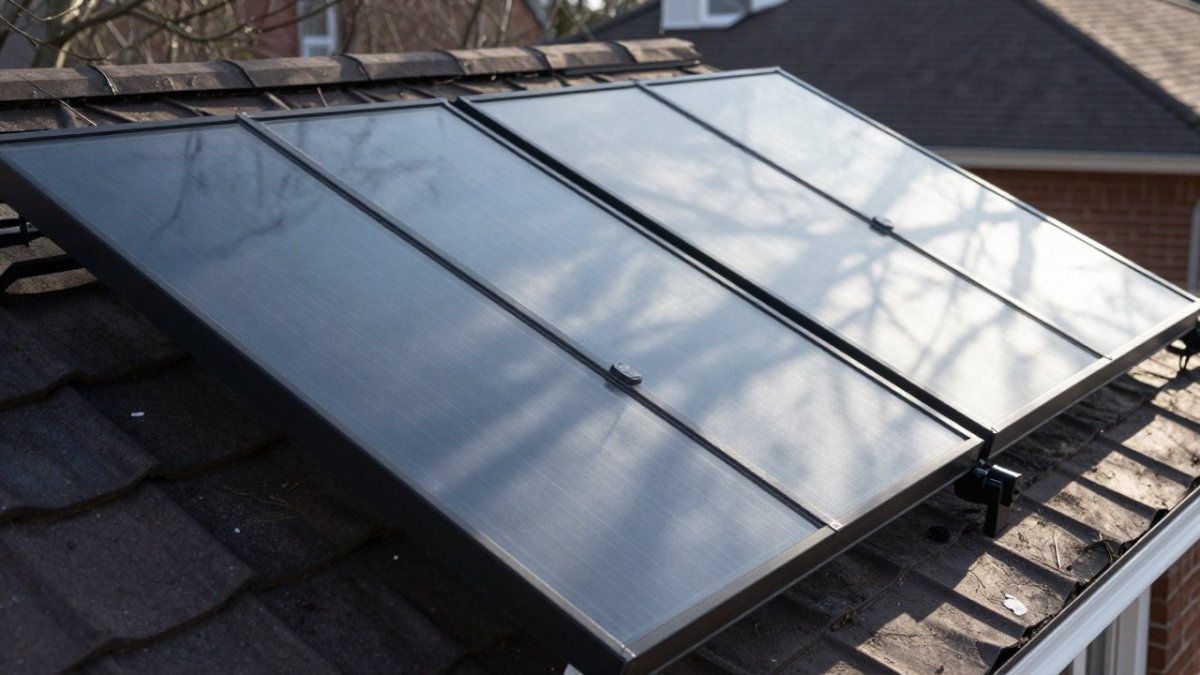
Glazed flat-plate collectors cover a dark absorber with glass and insulation, trapping heat so low-intensity light still produces a useful temperature rise. The glazing suppresses convective and radiative losses, and the insulated box limits back and edge losses, so more of the weak incoming energy stays in the water. This is the design behind the Heliocol panels we install, which are built for low-light conditions.
Practical specs to compare when shopping glazed panels:
- Flow rate: most glazed pool panels are designed for roughly 0.05-0.1 gallons per minute per square foot of collector area. Undersized flow lets the absorber run hot and lose more heat; oversized flow wastes pump energy.
- Pressure drop: a full array adds head to the solar loop. Plan for a booster pump or a variable-speed pump on a dedicated solar speed if the roof run is long or the array is large.
- Cover and hail rating: glass covers vary in impact resistance; ask for the manufacturer’s hail rating where spring storms are common.
Evacuated Tube Collectors
Evacuated tube collectors surround each absorber in a vacuum, nearly eliminating conductive and convective heat loss and making them excellent in cold air. In heavy shade, though, their round tubes intercept less diffuse light than a flat plate, and gaps between tubes let scattered light pass through. Tube breakage adds service cost, and replacement tubes are a recurring expense flat plates do not have.
Flow and cost notes for tubes:
- Flow rate: tube collectors generally want lower flow per square foot than glazed flat plates, and some designs use a heat-pipe or direct-flow arrangement that changes the plumbing layout.
- Cost: installed evacuated-tube systems commonly land in the $200-$350 per square foot range in the U.S., often higher than glazed flat plate once mounting and manifold hardware are included.
- Best use in low light: cold, clear mornings where the vacuum does the most work, not dense, persistent shade.
Unglazed Collectors
Unglazed collectors are simple rubber or plastic mats without glass or insulation. They are affordable and fine for full-sun, warm-climate pools, but they shed heat quickly in wind and cool air and gain little from diffuse light.
Where they still make sense:
- Flow rate: unglazed mats typically run at higher flow per square foot than glazed panels, which limits the temperature rise across the absorber and reduces losses, but it also means the mat adds little heat on a gray day.
- Cost: installed unglazed systems are commonly $50-$150 per square foot in the U.S., the lowest entry point of the three.
- Best use in low light: none, really, they are a full-sun, warm-climate, budget option.
Ranked Summary for Weak Sunlight
| Rank | Technology | Weak-Light Strength | Weak-Light Weakness | Typical Installed Cost (USD/sq ft) |
|---|---|---|---|---|
| 1 | Glazed flat-plate | Best diffuse-light capture and heat retention | Highest cost per panel | $150-$300 |
| 2 | Evacuated tube | Excellent in cold, clear air | Less diffuse capture in shade; fragile tubes | $200-$350 |
| 3 | Unglazed mat/panel | Lowest cost, simple install | Poor heat retention in wind and cloud | $50-$150 |
Watch out: a low price per square foot on an unglazed mat is not a bargain on a shaded lot, you will likely need two to three times the area to match a glazed array’s cloudy-day gain, which erases the savings and adds pump load.
Typical installed cost per square foot by collector type
Solar Pool Heater for Partial Shade: Sizing and Placement That Works
A solar pool heater for partial shade works when you oversize the collector array and place it where it catches the most sun hours, not the most convenient spot.
Follow these placement rules:
- Orientation: face collectors toward the equator-facing roof plane, the direction that receives the most midday sun.
- Tilt: match tilt to your latitude for year-round gain, or flatten slightly to favor summer.
- Shade audit: track shadows at 9 a.m., noon, and 3 p.m. before mounting anything.
Sizing under shade is not guesswork. Our guide on how to calculate solar pool panel square footage walks through the math step by step, and it is the fastest way to get the array size right the first time.
Solar Pool Heating on Cloudy Days: What to Expect
Solar pool heating on cloudy days still works, but expect a slower temperature rise and a lower peak than a clear day delivers. Diffuse radiation carries real energy, and a glazed collector keeps adding heat through thin cloud and haze.
What changes is the pace. Our article on how solar pool heaters work in cloudy weather explains the heat-transfer side.
Best Solar Pool Heater for Inground Pool Installations
The best solar pool heater for an inground pool is a glazed flat-plate array sized to the pool’s volume, plumbed into the existing circulation system, and mounted where it sees the most sun.
Heliocol panels are built to last 20+ years, and they carry an industry-best 12-year warranty on the panels. Dixie Pool Solar backs the labor with a 2-year warranty.
Best Solar Pool Heater for Above Ground Pool Setups
The best solar pool heater for an above ground pool is a compact glazed collector array paired with a small booster pump, mounted on a ground rack or a sunny wall.
Ground racks let you chase the sun around trees and structures, a real advantage on shaded lots. Keep the pipe run short to limit heat loss, and pair the system with a cover to hold temperatures overnight.
Solar Heating vs. Backup Options for Low-Sunlight Seasons
Solar heating handles most of the season on its own, but a backup source earns its place during the cloudiest stretches and the shoulder months.
| Option | Role in a Low-Sunlight Setup | Trade-Off |
|---|---|---|
| Solar only | Primary heat, March through November | Slower gain in heavy cloud |
| Solar plus cover | Retains heat overnight | Requires daily cover use |
| Solar plus gas backup | Fast heat on demand | Ongoing fuel cost |
| Solar plus heat pump | Efficient backup heat | Electricity use, equipment cost |
If you are weighing whether solar can carry you through the colder months, our piece on whether solar pool heaters work in winter lays out the limits honestly. Homeowners comparing low-sunlight collectors across brands should also cross-check our roundup of the 7 best solar pool heaters for shaded backyards, and if you are curious whether reflective surfaces can recover lost gain, read can reflective surfaces boost solar pool heating output.
Shaded lots and cloudy springs do not have to mean a short swim season. If your pool loses sun for part of the day, the right collector type and array size make the difference between a system that works and one that disappoints.
Frequently Asked Questions
Can solar pool collectors heat a pool on cloudy days?
They can, but at reduced output. On overcast days, solar pool collectors rely on diffuse solar radiation rather than direct sunlight, which typically delivers a fraction of clear-sky heat output. Glazed and evacuated tube collectors handle these conditions better than unglazed panels because their insulation limits heat loss when ambient temperatures are low. A pool cover overnight and a properly sized collector array make cloudy-day heating more practical, especially in spring and fall.
What is the best solar pool heater for above ground pool owners with limited sun?
For above ground pools, glazed flat-plate collectors or compact evacuated tube arrays mounted on a ground rack near the pool work best in low sunlight. Ground mounting lets you angle the collectors toward the sunniest part of the yard and avoid shade from the house or trees. Keep the pump and flow rate matched to the collector’s rated water flow rate so the system moves enough water through the solar loop to capture heat efficiently.
Are glazed or unglazed solar collectors better for cooler weather?
Glazed collectors win in cooler weather. The glass cover and insulated backing reduce heat loss to the air, so they keep producing heat when ambient temperature drops and sunlight is weak. Unglazed collectors are cheaper and work well in hot, sunny climates, but they lose efficiency quickly on cool, overcast days. If your swimming season starts in March or runs into November, glazed or evacuated tube designs hold up better.
How much direct sunlight do solar pool collectors need to work?
Most collectors need several hours of direct sunlight for full output, but they still gather heat from diffuse radiation when the sky is hazy or partly cloudy. Shading is the bigger problem: even a small shadow across a collector can cut output on that panel sharply. Site the array where it faces the sun for the longest part of the day, tilt it for your latitude, and trim or relocate anything that casts shade during peak hours.


Leave a Reply