Table of Contents
- How Solar Pool Heaters Work in Cloudy Weather
- How Much Heat Solar Collectors Capture Under Cloud Cover
- Solar Pool Heater Efficiency in Cloudy Weather: What Changes
- Solar Pool Heater Pump Schedule for Overcast Days
- Why a Pool Cover for Cloudy Weather Matters More Than You Think
- Solar Pool Heating Backup Options for Stretches of Gray Skies
- Troubleshooting and Operating Your System Through Changing Weather
- Frequently Asked Questions
Last Updated: October 12, 2026
How Solar Pool Heaters Work in Cloudy Weather
Solar pool heaters do not stop working when clouds roll in. They keep collecting heat from diffuse sunlight, just at a lower rate than on a clear day.
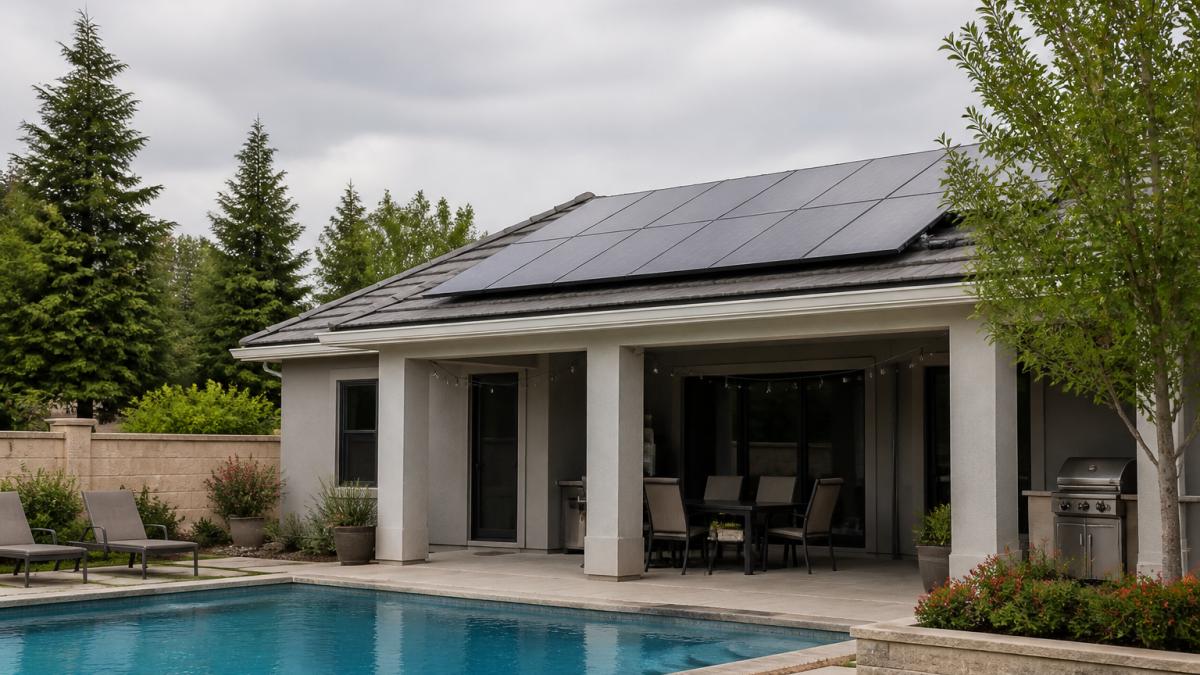
Most guides wrongly assume clouds block solar heating entirely. They don’t, they reduce it. How much depends on cloud thickness, time of year, and your system setup.
Direct Sunlight vs. Diffuse Solar Radiation
Direct sunlight is the beam that hits your collectors in a straight line from an unblocked sun. Diffuse solar radiation is sunlight scattered by clouds, haze, and the atmosphere that still reaches your panels from many angles. On a fully overcast day, nearly all the energy your collectors receive is diffuse, weaker, but not zero.
What Happens to Pool Water in the Solar Loop
Pool water moves through the solar loop the same way regardless of weather. Your pump pushes water through the filter, then through a bypass valve into the roof-mounted panels, which absorb heat and return warmed water to the pool. A controller decides whether water flows to the panels or bypasses them based on collector versus pool temperature.
How Much Heat Solar Collectors Capture Under Cloud Cover
Heat gain drops under clouds, but rarely hits zero. Thin, high clouds cut output modestly; thick, low overcast cuts it heavily. Fog is worst, scattering and absorbing light close to the ground.
| Sky Condition | Rough Heat Gain vs. Clear Sky | Practical Effect |
|---|---|---|
| Clear sky, full sun | Baseline (100%) | Fastest temperature rise |
| Thin, high clouds | Moderate reduction | Pool still warms, just slower |
| Thick overcast | Large reduction | Slow warming, may need backup |
| Heavy fog or storm | Minimal gain | Rely on cover and backup heat |
Exact numbers vary by system, panel area, and location. The pattern matters: diffuse sunlight always delivers less than direct sun, and the gap widens as clouds thicken.
Solar Pool Heater Efficiency in Cloudy Weather: What Changes
Efficiency under clouds is not a single number. It is the product of how much diffuse light reaches the collector, how much the collector converts to heat, and how much heat reaches the pool before air and wind strip it away.
Stage 1: How much solar energy reaches the collector
On a clear summer day, a south-facing collector can receive roughly 6 to 7 kWh per square meter per day in most of the lower 48. Under thin, high clouds, expect 60 to 80 percent of that; under thick, low overcast, 20 to 40 percent; heavy storm cover or dense fog can push it below 10 percent.
Stage 2: How the collector converts that light to heat
An unglazed solar pool collector, the black mat or tube style most pools use, efficiently turns absorbed sunlight into heat, but also loses it back to the air.
This is the mechanism most guides skip: cloudy weather hurts twice. It cuts incoming energy, and it usually arrives with cooler air and more wind, cutting conversion efficiency at the same time.
Stage 3: How much heat actually reaches the pool
Even heat that makes it into the collector must survive the trip back to the pool. Long pipe runs, uninsulated above-ground plumbing, and low flow rates all bleed heat before the water returns. A well-designed system with insulated runs and matched flow loses very little; a poorly designed one can lose much of its cloudy-day gain in the plumbing alone.
What this means in practice
| Sky Condition | Approx. Solar Energy vs. Clear | Approx. Collector Efficiency | Net Effect on Pool |
|---|---|---|---|
| Clear, warm, still | 100% | 70-80% | Strong warming, 2-5°F/day typical |
| Thin, high clouds | 60-80% | 60-75% | Noticeable warming, slower |
| Thick overcast | 20-40% | 40-60% | Marginal warming, cover essential |
| Heavy storm or fog | Under 10% | 30-50% | Little to no net gain |
Exact numbers vary by system, panel area, roof orientation, and location. The pattern matters: diffuse sunlight always delivers less than direct sun, the gap widens as clouds thicken, and cool, windy air compounds the loss.
The four variables that move the needle most
- Cloud thickness and duration, a passing cloud barely matters; all-day overcast does.
- Collector area, more panels capture more diffuse light, which is why undersized systems feel useless on gray days.
- Flow rate, too fast and water doesn’t absorb enough heat per pass; too slow and you lose gains to ambient losses. Match the manufacturer’s target flow per panel.
Heliocol panels handle diffuse light well because of their design. But no panel turns a cloudy day into a sunny one. Knowing which stage costs you the most tells you what to fix.
Cloudy-day efficiency is not one number. It is incoming light × collector conversion × heat delivery. Diagnose which stage is weakest before you assume the system is failing.
Solar Pool Heater Pump Schedule for Overcast Days
Your pump schedule matters more on cloudy days than sunny ones. Run water through the collectors when they are warmer than the pool, and stop when they are not.
A common approach:
- Run the pump during the warmest part of the day, typically late morning to mid-afternoon
- Let the controller manage the bypass valve automatically
- Reduce run time on heavy overcast days to avoid cooling the pool
A controller that reads collector temperature and pool temperature will shut off flow when panels are cooler than the water. Without one, you can actually cool your pool on a gray morning by pushing water through cold panels.
Why a Pool Cover for Cloudy Weather Matters More Than You Think
A pool cover for cloudy weather does more than trap heat overnight. It cuts evaporation, where most of your heat disappears.
Heat retention and overnight losses are the gap most homeowners ignore. You can gain heat all afternoon and lose it all by morning without a cover. Pair your solar system with a cover and the difference shows within days.
Solar Pool Heating Backup Options for Stretches of Gray Skies
Solar pool heating backup options make sense when clouds stick around for days. A backup heater does not replace your solar system. It fills the gap during long gray stretches so your pool stays usable.
Options include:
- A gas or electric supplemental heater for extended overcast periods
- A heat pump that works alongside your solar loop
- A larger collector area to capture more diffuse light year-round
Running a backup heater as your primary heat source defeats the purpose of solar. Use it only for the gray stretches, or your energy savings disappear.
Solar thermal panels heat water directly; PV panels make electricity first, then heat water. For pool heating, thermal is the more direct path.
Troubleshooting and Operating Your System Through Changing Weather
Most “my solar heater stopped working” calls on a cloudy day are not failures, they are the system doing what it should, or a setting that no longer matches the weather. Work through this sequence before assuming something is broken.
Step 1: Check the controller first
The controller decides whether water goes to the collectors or bypasses them. On a cloudy day, it may correctly hold water out of the panels because the collector sensor reads cooler than the pool. That is not a fault, it is the system protecting your pool temperature.
- Confirm the controller is powered and in “auto,” not “off” or “manual bypass.”
- Read the collector temperature and pool temperature on the display, if it has one.
- If collector temp is below pool temp, the system is right to bypass. Wait for the sun to lift the collector reading.
Step 2: Verify the valve is actually moving
A diverter valve that is stuck, manually pinned, or wired backward sends water the wrong way no matter what the controller says.
- Watch the valve actuator during a call for heat. It should rotate smoothly to the solar position.
- Check for a manual override lever left in the wrong position after service.
- Listen for the actuator motor. Silence during a heat call usually means a wiring or actuator problem, not a solar problem.
Step 3: Confirm the pump is moving enough water
A pump at low speed, a clogged filter, or a partially closed valve can starve the collectors. Low flow means less heat picked up per pass, and on a cloudy day the margin is already thin.
- Compare the filter pressure gauge to its clean baseline. A rise of 8-10 psi above clean usually means it is time to backwash or clean the filter.
- Check the flow meter, if installed, against the manufacturer’s target for your panel count.
- Look at the return jets. Weak flow at the pool is a quick tell that the loop is restricted.
Step 4: Feel the panels and the return line
This is the fastest field test a homeowner can run.
- On a partly cloudy afternoon, the panels should feel noticeably warmer than the air, and the return line back to the pool should feel warm to the touch.
- If the panels are warm but the return line is cool, the problem is flow or a valve, not the collectors.
- If both are cool while the sun is out, the controller is likely holding the system in bypass.
Step 5: Rule out shading and orientation
A roof with afternoon shade will always underperform one with full southern exposure, no matter the weather. Walk the roof line at midday and mid-afternoon. New tree growth, a satellite dish, or a new vent pipe can quietly cut a panel’s output for an entire season.
Operating through changing weather
Once the hardware checks out, the operating question is when to run the pump and when to let the system bypass.
- Run during the warmest window. Late morning to mid-afternoon captures the strongest diffuse light and warmest air, reducing collector heat loss.
- Let the controller manage the bypass. A controller reading collector and pool temperature shuts off flow when panels are cooler than the water. Without one, you can cool your pool on a gray morning by pushing water through cold panels.
- Shorten run time on heavy overcast days. If collectors are not gaining, extra circulation just adds pump energy and heat loss.
Before calling for service on a cloudy day, write down the controller’s collector and pool temperature readings, the filter pressure, and whether the valve moved during a heat call. That information turns a vague “it’s not working” call into a five-minute diagnosis.
When it really is a problem
Some symptoms point to a genuine fault rather than weather:
- The controller never calls for heat even on a clear, sunny afternoon.
- The valve actuator does not move at all.
- Flow at the returns is weak regardless of filter condition.
Those cases are worth a service visit. Everything else is usually the system correctly responding to clouds, cool air, and a controller doing its job.
When you want a system sized for your roof, your pool, and your season, that is where we come in. Our Heliocol panels carry a 12-year warranty, and our labor carries a 2-year warranty.
Frequently Asked Questions
Do solar pool heaters work on cloudy days?
Yes, but at reduced output. Solar pool heaters rely on solar radiation, and clouds block part of it while still letting diffuse sunlight through. On a lightly overcast day, a system may capture roughly half the heat of a clear day. Under heavy, dark cloud cover, output can drop to around a quarter or less. The water still warms, just more slowly, so you may need to run the pump longer or lean on a backup heater during extended gray stretches.
Should I run my pool pump when it is cloudy?
Run it during daylight hours, but adjust the schedule. Set the pump to circulate water through the collectors during the brightest part of the day, typically late morning to mid-afternoon, so the solar loop can absorb whatever diffuse radiation is available. If your controller has a temperature-difference setting, let it decide when the collectors are warmer than the pool water. On heavily overcast days, shortening the run time avoids circulating water through cool panels and losing heat.
Does a pool cover help retain heat on cloudy days?
A cover is one of the most effective tools for holding onto heat when the sun is hidden. Evaporation is the biggest source of overnight and cloudy-day heat loss, and a floating cover or solar blanket cuts that loss dramatically. Pairing a cover with your solar heating system means the heat you collected during brief sunny breaks stays in the water instead of escaping into the air. Use it every night and on overcast days when the pool is not in use.
What backup options keep my pool warm during long cloudy stretches?
A gas or electric heat pump can supplement a solar system when cloud cover lingers for several days. Many homeowners run solar as the primary heat source and switch on the backup only when pool temperature drops below their comfort range. A pool cover and reduced pump run time also help stretch the heat you already have. If you are planning a system, sizing the collector area generously gives you more buffer during marginal weather.
Gray skies do not have to end your swimming season. The right system, sized for your pool and paired with a cover, keeps water warm from March through November even when the sun hides. At Dixie Pool Solar Heating & Misting, we install Heliocol panels built to last 20+ years, with a 12-year panel warranty and a 2-year labor warranty, and we handle the integration so you do not have to. Get a free quote and find out how much you could save on heating costs this season.


Leave a Reply