Last Updated: October 29, 2026
Quick Summary
Reflective surfaces can boost solar pool heating output only when they bounce extra sunlight onto the collectors at the correct angle, close to perpendicular to the panel face. We treat reflectors as a support tool, not a replacement for proper system design, since poor aim, distance or glare can cancel the gain.
- Aim reflected light at the collectors, never at the pool, house or a neighbor’s window.
- Set reflector tilt for the months you swim, not for the summer solstice.
- Test the beam with foil on cardboard before buying any mounting hardware.
- Polished aluminum or stainless sheet outlasts acrylic and reflective film outdoors.
- Anchor the mount so wind cannot tip it, and recheck aim after storms.
Table of Contents
- How Reflective Surfaces Add Heat to a Solar Pool Heating System
- Solar Thermal Collectors vs. PV Panels: Why Reflectors Differently
- Solar Pool Heating Panel Placement and Reflector Geometry
- Safe Reflector Materials, Mounting, and Glare Control
- Solar Pool Heater Efficiency: Sizing, Flow Rate, and Circulation
- Solar Pool Cover Heat Retention: The Cheaper First Upgrade
- Solar Pool Heater Troubleshooting: Measuring Before and After
- Get a Free Quote on a Properly Sized Solar Pool Heating System
- Frequently Asked Questions
How Reflective Surfaces Add Heat to a Solar Pool Heating System
Reflective surfaces can raise the heat output of a solar pool heating system, but only when they bounce extra sunlight onto the collectors at the right angle. At Dixie Pool Solar Heating & Misting, we treat reflectors as a support tool, not a replacement for proper solar pool heating design.
Most reflectors fail for three reasons:
- They aim light at the pool instead of the panels
- They sit too far from the collectors
- They create glare that annoys neighbors or damages nearby surfaces
Get the geometry right, and a reflector can add some heat gain during the shoulder months. Get it wrong, and it may add little or nothing.
Reflected Sunlight vs. Direct Sunlight: What the Panels Actually Absorb
Solar thermal collectors can absorb both direct and reflected sunlight. Direct sun is generally the stronger source.
A solar thermal collector is a device that captures sunlight and transfers that heat into water flowing through it.
Reflected sunlight works best when it hits the collector face close to perpendicular.
Shade is the flip side. To see how shade affects panel output, read about how shade impacts solar pool heating efficiency.
Solar Thermal Collectors vs. PV Panels: Why Reflectors Differently
Reflectors behave differently on thermal collectors than on photovoltaic panels. Solar thermal collectors use the sun’s heat; PV panels use the sun’s light to make electricity.
Here is the practical difference:
| System | What It Captures | Reflector Effect | Main Risk |
|---|---|---|---|
| Solar thermal collector | Heat | Adds heat gain to water | Overheating on low-flow days |
| PV panel | Light for electricity | Small output gain | Hot spots and cell damage |
| Concentrated reflector setup | Focused heat | Large gain in a small area | Fire and glare risk |
Thermal collectors are designed to handle heat, while PV panels are not, so reflector use is a different question for each system type.
But there is a limit. Push too much concentrated sunlight onto a collector with slow water flow, and the panel can overheat.
Solar Pool Heating Panel Placement and Reflector Geometry
Panel placement decides whether a reflector helps at all. A reflector aimed at a shaded roof does nothing; the same mirror aimed at a sun-facing array can add real heat.
Start with these checks on the array itself:
- Confirm the panels face the sun during the hours you swim most. In most of the country that means a southern exposure with some tolerance for southeast or southwest.
- Note the roof pitch or rack tilt on the array. A steep roof pitch changes the angle the reflector has to hit.
- Measure the horizontal and vertical distance from the planned reflector location to the panel face.
- Track where shadows fall at 9 a.m., noon, and 3 p.m. in the months you actually swim.
- Mark the reflector spot only where it gets full sun for the same hours the collectors do.
A common mistake is placing the reflector close to the pool deck because it looks tidy. Too close and the reflected beam covers only one panel; too far and the light spreads so wide that little lands on the collector face.
Matching Reflector Angle to Seasonal Sun Angles
The sun sits lower in March and October than in June. A reflector fixed for midsummer will underperform in the shoulder months, exactly when you want the extra heat.
A simple approach:
- Set the reflector tilt so it aims at the panels during the months you swim, not at the summer solstice.
- Recheck the angle as the season shifts, since the sun’s angle changes with the season.
- Use a temporary mount first, then lock it in once you see results.
A reflector that works in July may send light over the top of the array by September; adjustable mounting solves this without rebuilding anything. A fixed reflector is best aimed at the hours the pump actually runs, so match the aim to the controller schedule rather than to noon by default.
Before buying anything, tape a piece of cardboard to a broom handle, cover it with kitchen foil, and walk the beam onto the collectors at the hours your pump runs. If you cannot get the bright patch to cover the array from a given spot, no amount of mounting hardware will fix that location.
One more geometry check: if your array is mounted flat on a low-slope roof, a reflector standing nearly vertical will do more than one laid back at the same tilt as the panels. Match the reflector to the array, not to the roof.
Safe Reflector Materials, Mounting, and Glare Control
Safety comes before performance. A large mirror in a backyard can focus light into a beam hot enough to damage siding, melt plastic, or start a fire.
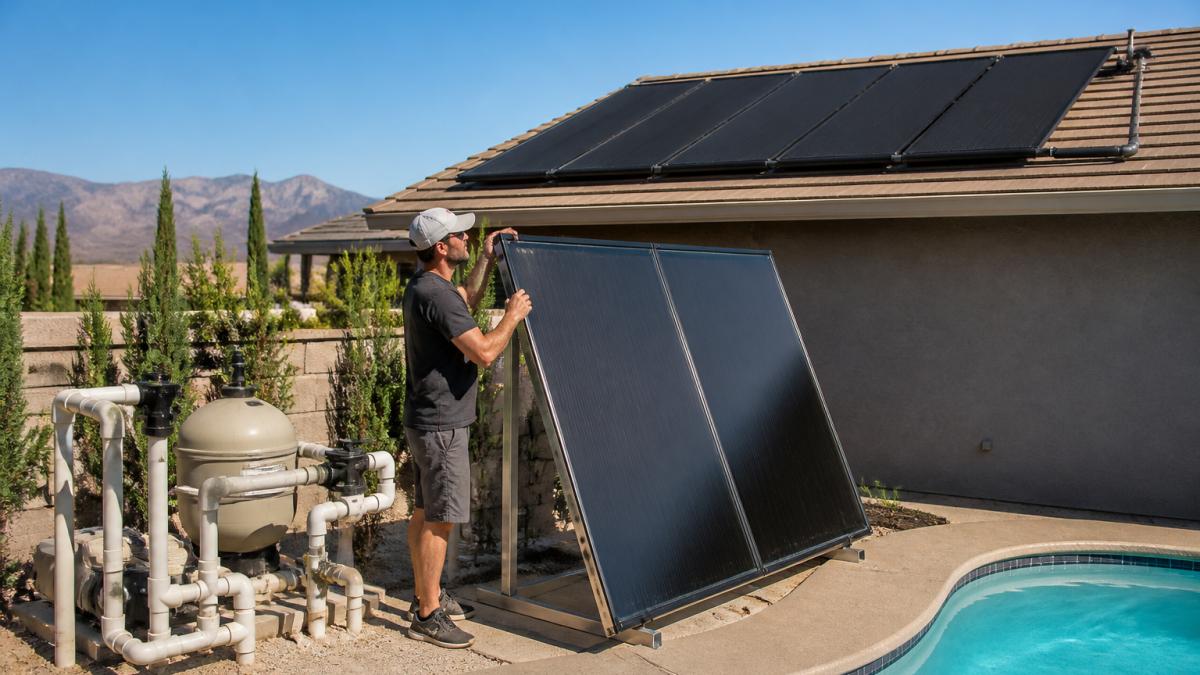
A flat mirror aimed at a neighbor’s window or a dry hedge can cause glare complaints and, in dry conditions, a real fire risk. Keep reflected light on your own collectors only, and re-aim after any change to the array or landscaping.
Material choices and what they tolerate
- Acrylic mirror sheet is lightweight and shatter-resistant, but it scratches and yellows under ultraviolet light over a few seasons. It is a reasonable choice for a temporary or seasonal rig.
- Glass mirror gives the cleanest reflection but is heavy and fragile; if it breaks on a roof or deck, cleanup and injury risk go up. Use it only where it is protected from impact.
- Polished aluminum or stainless reflector sheet holds up to weather and wind better than acrylic and does not shatter, but the reflection is slightly less crisp. For a permanent mount, this is usually the more durable path.
Avoid loose sheets, unframed panels, and anything that can flap. A reflector that moves in the wind changes its aim and can crack.
Mounting and wind loading
A reflector is a sail. Even a modest panel catches wind, and an unanchored mount can tip, slide, or become a projectile in a storm. Practical rules:
- Anchor the mount to a fixed structure or ballast it with enough weight that wind cannot tip it; do not rely on a single stake in soft ground.
- Frame the reflective surface so edges cannot catch wind and peel.
- Keep the reflector out of walkways and away from where children or pets play.
Glare control
Glare control is the part most guides skip. Stand where your neighbor would stand and look at the reflector at different times of day. If it blinds you, re-aim it. Additional steps:
- Aim the beam so the reflected patch lands entirely on the collector face, not on the roof deck, siding, or pool water.
- Check sightlines from second-story windows, decks, and the street, not just from your own yard.
- Keep the reflector away from dry grass, wood fences, and anything that can scorch.
Material and mounting checklist:
- Use a rigid, weather-resistant reflective panel, not a loose sheet
- Anchor the mount so wind cannot tip it
- Aim light only at the collectors, never at the pool, house, or a neighbor
A safe reflector is rigid, anchored, aimed only at the collectors, and checked from your neighbor’s point of view. If any of those four fails, fix it before you worry about heat gain.
Solar Pool Heater Efficiency: Sizing, Flow Rate, and Circulation
Solar pool heater efficiency depends on three things working together: collector area, water flow rate, and circulation time. A reflector cannot fix a system that is undersized or running too little water.
Sizing comes first. Collector area should match pool size and your target temperature rise.
Flow rate comes next. Water must move through the collectors fast enough to carry heat away.
Circulation ties it together. The controller should run the pump when the collectors are hotter than the pool, so the system works harder without wasting energy.
If you want a deeper walkthrough, our guide on optimizing solar pool heater efficiency covers sizing and flow in detail. And the U.S.
Solar Pool Cover Heat Retention: The Cheaper First Upgrade
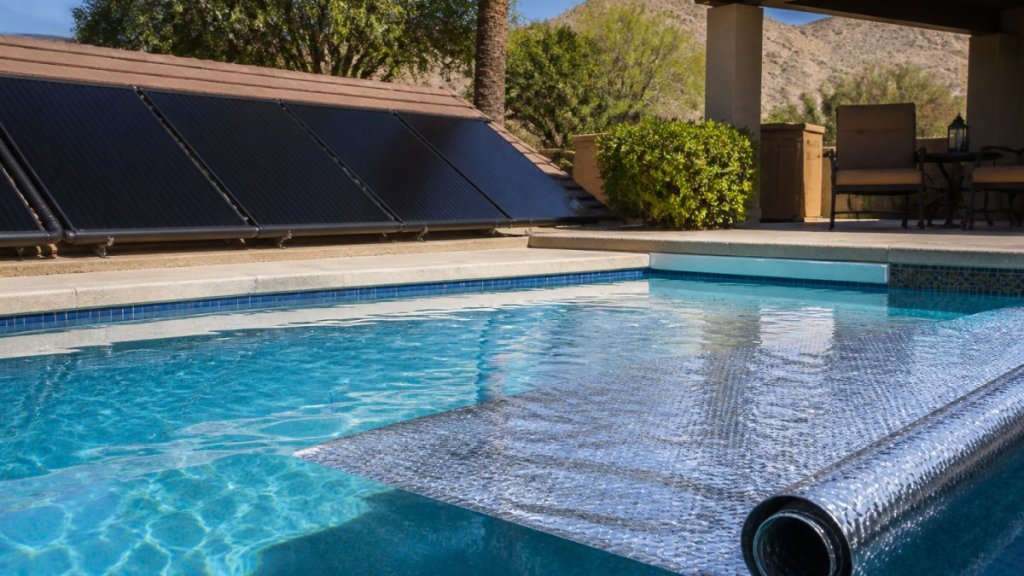
A solar pool cover can reduce heat loss at night, when much of a pool’s warmth is typically lost.
A cover traps heat at the water surface and reduces evaporation, which is a significant source of heat loss.
A cover and a reflector solve different problems. The cover keeps heat in. The reflector adds heat in.
Solar Pool Heater Troubleshooting: Measuring Before and After
Solar pool heater troubleshooting starts with measurement, not guesswork. You cannot know if a reflector helped unless you record temperatures before and after.
Use this simple method:
- Note the pool water temperature each morning for a week.
- Record the outside air temperature at the same time.
- Log the weather: sun, clouds, wind.
- Add the reflector and repeat for another week.
- Compare the morning readings, not the afternoon peaks.
Morning temperature is the honest number. It shows what the system held overnight. Afternoon spikes can fool you.
A reflector’s effect shows up as a small, steady gain, not a dramatic jump. If you see no change at all, check aim, distance, and shade first.
If results stay flat, compare your symptoms against our roundup of common problems with solar pool heating systems. For the full list of things that affect output, see our breakdown of factors affecting solar pool heater performance.
Get a Free Quote on a Properly Sized Solar Pool Heating System
Reflectors are a useful add-on. They are not a substitute for a system built to the right size for your pool.
That is where we come in. Dixie Pool Solar Heating & Misting installs Heliocol panels built to last 20+ years, backed by an industry-best 12-year warranty on all panels and a 2-year labor warranty.
If you are ready to size a system correctly, get a free solar pool heating quote and see what fits your pool.
Frequently Asked Questions
Can mirrors increase the output of a solar pool heater?
Mirrors and reflective panels can add heat gain by bouncing extra sunlight onto collector surfaces, but the gain varies with the system and conditions. Reflectors work best when aimed at the lower portion of a collector array during the shoulder seasons, when the sun sits lower in the sky. Concentrated reflection can overheat panels or create glare, so test one small reflector first and measure water temperature before adding more.
Do reflective surfaces help solar pool heating panels collect more heat?
They can, because a reflective surface increases the sunlight reaching the collector beyond what direct solar exposure alone provides. The effect depends on surface area, reflector material, distance from the panels, and sun angle. Treat reflectors as a supplement to solar pool heating panel placement and system sizing, not a replacement for either.
Where should reflectors be placed near solar pool heating panels?
Place reflectors on the sun-facing side of the array, angled to bounce light onto the lower half of the collectors, and keep them clear of walkways, windows, and neighboring properties. Avoid aiming reflected sunlight at the panels during peak summer hours when output is already high. The sun sits lower in the sky during the shoulder seasons, which can change how reflectors perform across the year.
Are solar pool covers more effective than reflectors for retaining heat?
A solar pool cover can reduce evaporation, which is a significant source of overnight heat loss. Reflectors add heat gain during daylight; covers help keep heat in after sunset.
Adding reflective surfaces to a solar pool heating setup can help, but only after sizing, flow, and shade are handled. If you want a system designed to capture heat properly from day one, Dixie Pool Solar Heating & Misting can help. Our Heliocol panels, 12-year panel warranty, and low-maintenance design are built for homeowners who want a longer swim season without gas bills. Get started with Dixie Pool Solar Heating & Misting and get a system sized for your pool.


Leave a Reply