Last Updated: October 24, 2026
Quick Summary
A professionally sited Heliocol panel system is the best solar pool heater for most shaded yards, because panels can be split across a roof and a ground rack to chase the sunniest hours. Collectors need roughly four to six hours of direct midday sun, so a smaller array in full sun beats a larger shaded one.
- Walk the yard at 9 a.m., noon, and 3 p.m. to find your sunniest collector zone.
- Target collector area equal to roughly 50% to 100% of the pool’s surface area.
- A heat pump handles deep shade best but runs on electricity, unlike solar.
- Pair any shaded system with a solar cover to retain heat overnight.
- Heliocol panels carry a 12-year panel warranty plus a 2-year labor warranty.
Table of Contents
- Quick Comparison: Best Solar Pool Heaters for Shaded Backyards
- How Much Sun Does a Solar Pool Heater Need?
- Best Solar Pool Heater Picks for Partial Shade
- Solar Pool Heater Installation Location: Where to Place Collectors in a Shaded Yard
- Solar Pool Heater vs Heat Pump: Which Handles Shade Better?
- Solar Pool Cover Heat Retention: Stretching Every Degree You Gain
- Installation Options, Setup, and Plumbing Basics
- Get a Free Quote for Your Shaded Backyard System
- Frequently Asked Questions
Quick Comparison: Best Solar Pool Heaters for Shaded Backyards
Shade is the single biggest reason solar pool heating underperforms, and most buying guides ignore it. A solar pool heater circulates pool water through sun-warmed panels, and its output depends almost entirely on how many hours of direct sunlight those panels receive.
At Dixie Pool Solar Heating & Misting, we install Heliocol solar thermal systems for homeowners whose yards are not perfect sun traps, and partial shade changes the plan, not the decision.
| Option | Best For | Shade Tolerance | Mounting |
|---|---|---|---|
| Heliocol panel system (professional install) | Most shaded yards, in-ground pools | Good with correct siting | Roof or ground rack |
| Above-ground solar heating mat | Small above-ground pools | Fair, needs full sun | Ground or deck |
| Compact panel array | Tight lots, limited roof space | Fair, modular siting | Ground rack |
| Universal panel kit | DIY-friendly in-ground setups | Fair, fixed sizing | Roof or ground |
| Heat pump (alternative) | Deep shade, heavy tree cover | Excellent, sun-independent | Equipment pad |
| Solar cover + panels combo | All shaded pools | Improves any system | Floating cover |
How Much Sun Does a Solar Pool Heater Need?
Most solar pool heaters need roughly four to six hours of direct, unobstructed sunlight per day, and midday shade costs far more than shade in early morning or late afternoon. Panels that see sun only from 7 to 10 a.m. will struggle, because the strongest solar gain happens closer to midday.
That is the practical answer to how much sun does a solar pool heater need: count hours of direct sun on the panel surface, not on the pool.
If your yard is heavily shaded, read our breakdown of how shade impacts solar pool heating efficiency before you size a system, and if you are worried about gray spring days, see whether solar pool heating works on cloudy days.
Best Solar Pool Heater Picks for Partial Shade
The right pick depends on your pool type, how much unshaded footprint you can find, and whether the collector can be split across multiple sun patches.
A quick sizing rule most installers use: target a collector area equal to roughly 50% to 100% of the pool’s surface area for a seasonal heater in a sunny yard, and lean toward the high end (or add a solar cover) when shade cuts your direct-sun hours.
Best for Above-Ground Pools
Solar heating mats and compact panel kits suit above-ground pools because they sit low and can be repositioned as the sun angle shifts. Place the mat on a south-facing patch of lawn or a low deck rail where it catches midday sun, and keep hose runs short so the pump does not lose flow. These systems are the least forgiving of shade, a mat in dappled shade for half the day may only add a few degrees, so pair them with a solar cover.
Best for In-Ground Pools
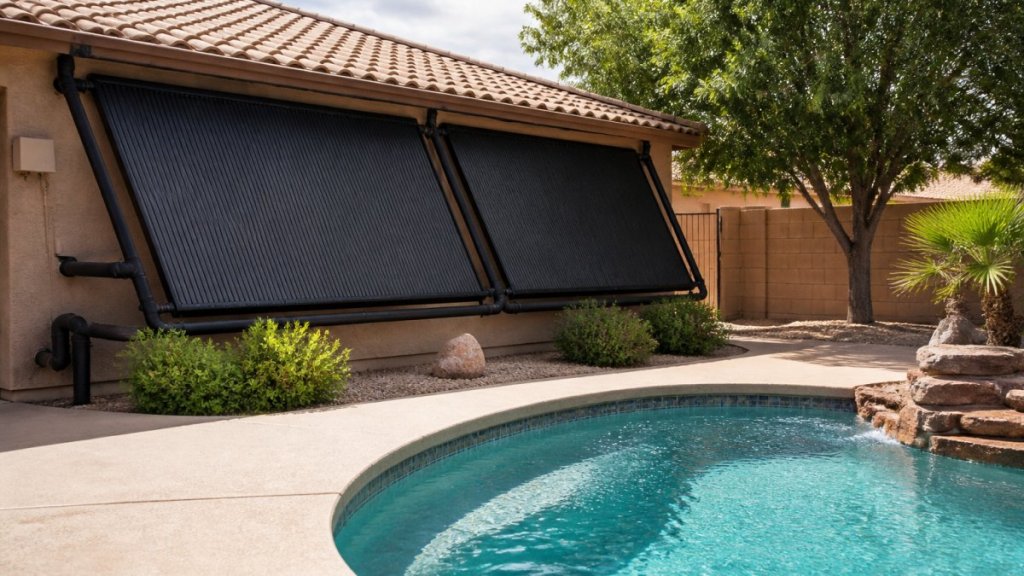
For in-ground pools, a professionally installed Heliocol panel system is our top pick for shaded yards. Heliocol panels are industrial-made and built to last 20+ years, with an industry-best 12-year panel warranty plus a 2-year warranty from Dixie Pool Solar on all other labor. The shade advantage is siting flexibility: panels can be split across a roof and a ground rack to chase the sunniest hours, which a single fixed array cannot do.
Best Compact Option for Tight Spaces
Compact, modular panel systems fit narrow side yards and small lots where a full roof array will not work. An installer can spread collectors across several small sun patches rather than one large shaded area, for example, two panels on a garage roof and three on a ground rack along a fence line. Expect lower total heating capacity, so pair a compact array with a solar cover, and size the pump so added head from longer pipe runs does not drop flow below the collector manufacturer’s minimum.
Best Sun-Independent Alternative for Deep Shade
If your yard has heavy, year-round tree cover, a heat pump is the honest pick. It pulls warmth from ambient air rather than direct sunlight, so it keeps working under shade and on cloudy days. The trade-off is operating cost: a heat pump runs on electricity, while a solar pool heater has no operating cost once installed. Many owners run the heat pump only in the shoulder months and rely on a solar cover the rest of the season.
Best Hybrid Setup for Marginal Sun
For yards that get four to five clean hours of midday sun, a hybrid approach works well: solar panels for the bulk of heating, a solar cover to retain it, and a heat pump as backup for cloudy stretches. This recovers most of the performance a shaded lot seems to lose without a full electric-heating bill.
Before you buy, measure the unshaded footprint you can actually dedicate to collectors. A smaller array in full sun routinely outperforms a larger array in dappled shade, collector area only helps when the panels see direct light.
Solar Pool Heater Installation Location: Where to Place Collectors in a Shaded Yard
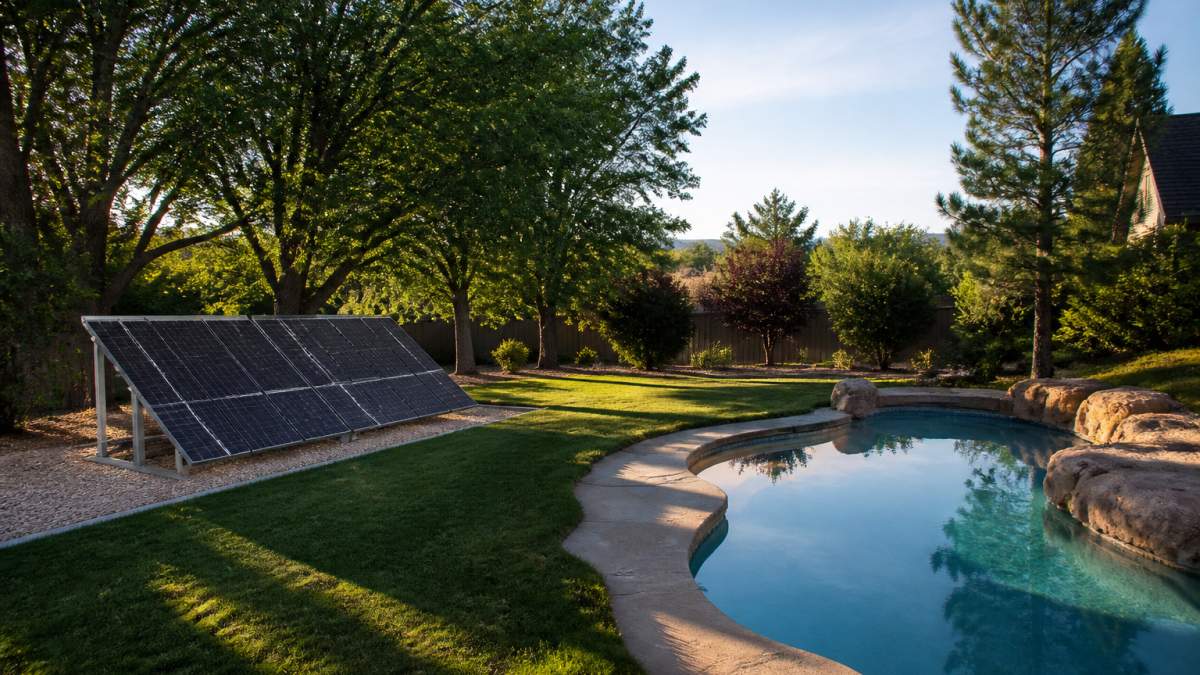
Panel placement decides performance in a shaded yard: find the patch of your property that holds direct sun longest and put collectors there, even if that means a ground rack instead of the roof. A shaded roof plane is worse than a sunny ground rack.
Step 1: Run a Seasonal Shade Audit
Walk the yard at 9 a.m., noon, and 3 p.m. on a clear day, and repeat the audit once in early spring and once in late summer.
A simple tool helps: a sun-path app or a compass plus a paper sketch of the yard. Mark south, then sketch the shadow line at each audit time. The overlap of the lit areas across all three audits is your realistic collector zone.
Step 2: Choose Roof, Rack, or Remote Placement
Roof installation wins when the roof is the only unshaded surface, but it locks the collector to one plane and one tilt. A ground rack lets you tilt panels toward the sun, clear low obstructions like fences and hedges, and is easier to service. Remote placement, collectors on a garage, shed, or sunnier part of the property, lets you chase sun the pool area itself does not get.
Step 3: Set Orientation and Tilt
South-facing orientation is the target, but a southeast or southwest spot with five clean hours often beats a due-south spot with tree cover. For tilt, set the collector angle roughly equal to your latitude for year-round heating, or 10 to 15 degrees lower if you mainly heat in summer. A steeper tilt helps in spring and fall when the sun sits lower, which matters in a shaded yard where every shoulder-season hour counts.
Step 4: Avoid the Common Mistakes
The most common mistake is mounting panels on the biggest roof plane without checking midday shade, a large shaded array produces less heat than a smaller sunny one. The second is ignoring the pump: a collector array adds flow resistance, and hose connections must be sized to keep water moving. The third is forgetting seasonal storage and freeze protection for above-ground mats.
Do not size the array to the roof before you size it to the sun. In a shaded yard, the lit footprint, not the roof area, sets your realistic collector count.
If your yard is heavily shaded, read our breakdown of how shade impacts solar pool heating efficiency before you size a system, and if you are worried about gray spring days, see whether solar pool heating works on cloudy days.
Solar Pool Heater vs Heat Pump: Which Handles Shade Better?
A heat pump handles shade better than solar, full stop. Heat pumps pull warmth from ambient air rather than direct sunlight, so they keep working under tree cover and on cloudy days.
So why choose solar in a shaded yard at all? Homeowners with heavy, year-round tree cover should compare the numbers honestly; our guide to whether a heat pump pool heater is worth it walks through the ROI side.
For everyone in between, a hybrid approach works well: solar panels for the bulk of heating plus a cover to retain it.
Solar Pool Cover Heat Retention: Stretching Every Degree You Gain
A solar pool cover is the cheapest performance upgrade in a shaded yard, because most heat loss happens at the water surface overnight.
Use a floating cover or solar blanket sized to your pool, and reel it out every evening. Combined with panels, a cover can meaningfully stretch your season without adding operating cost, and it reduces chemical use and water loss.
Installation Options, Setup, and Plumbing Basics
Installation ranges from a DIY mat laid on the lawn to a full professional panel system tied into your pool pump. The plumbing basics are the same: water flows from the pump through the collectors, absorbs heat, and returns to the pool.
Roof installation needs mounting hardware and careful leak prevention; a ground rack is simpler to service and easier to reposition for shade. For a full walkthrough of costs, permits, and setup, read our solar pool heater installation guide.
Get a Free Quote for Your Shaded Backyard System
Shade does not disqualify your pool from solar heating, but the system has to be designed around your specific yard.
Dixie Pool Solar Heating & Misting installs Heliocol panels backed by a 12-year panel warranty and a 2-year labor warranty, with little to no maintenance after installation and no operating costs for solar heating.
Get started with Dixie Pool Solar Heating & Misting and extend your swimming season from March through November, even with trees overhead. Request your free solar pool heating quote and we will map the sunniest spots in your yard.
Frequently Asked Questions
Can a solar pool heater work if the roof or yard is shaded?
Yes, but performance drops with the amount of shade. A solar pool heater needs direct sunlight to warm the water, so collectors placed in partial shade will produce less heat than ones in full sun. The practical fix is to mount collectors on a ground rack or roof section that gets the most direct sun, or to pair a smaller collector array with a pool cover to hold the heat you do gain. In heavily shaded yards, a hybrid setup with a heat pump may make more sense.
How much direct sunlight does a solar pool heater need each day?
Most solar pool heating systems are sized around roughly 6 hours of direct sunlight per day during the swim season. That does not mean the panels must sit in sun all day; morning and late-afternoon shade is less costly than midday shade. If your yard only gets 4 to 5 peak sun hours, you can often compensate with a slightly larger collector area and a solar cover to reduce overnight heat loss.
Is a heat pump or solar pool heater better for a shaded backyard?
A heat pump does not depend on sunlight, so it keeps working in shade, but it uses electricity and adds operating cost. A solar pool heater has no operating cost and lasts 20+ years with little maintenance, but it needs sun exposure to perform. For a yard with 5 or more sun hours, solar usually wins on lifetime cost. For heavy shade, a heat pump or a solar-plus-heat-pump hybrid is the more reliable choice.
Where should solar pool collectors be installed for the best performance?
Place collectors where they get the most direct sun, ideally facing south with no tree or building shadow during the middle of the day. Roof installation saves yard space, while ground or rack mounting lets you chase the sunniest patch in a shaded yard. Keep the run to the pool pump short to reduce plumbing losses, and confirm your pump has enough flow for the panel count before finalizing the layout.


Leave a Reply