Last Updated: November 26, 2026
Quick Summary
Pool misting systems are effective in humid climates, but they deliver a much smaller temperature drop than in dry air, often just 2-5°F near the nozzles. Performance depends on fine droplets from high-pressure nozzles, smart placement, and airflow, so pair misting with fans and shade on the most humid days.
- In dry heat, mist lines can cool the air by up to 20-30°F near the nozzles.
- High-pressure systems beat low-pressure kits in humid air because smaller droplets evaporate faster.
- Mount nozzles along the patio edge facing inward, at a height that puts fog in the seating zone.
- Run short misting cycles rather than continuous operation so surfaces can dry between passes.
- Use the gap between air temperature and wet-bulb temperature to decide whether misting will help today.
Table of Contents
- How Evaporative Cooling Works When the Air Is Already Humid
- Expected Temperature Reduction in Humid Versus Dry Conditions
- Why a High Pressure Patio Misting System Beats Low-Pressure Options in Humid Air
- What a 1000 PSI Misting System Delivers at the Pool Deck
- Misting System Water Use: What to Expect at the Pool
- Misting System Wet Surfaces: Managing Overspray and Drainage
- A Practical Humidity and Wet-Bulb Decision Guide
- When Misting Isn’t Enough: Alternative Cooling for Humid Pools
- Frequently Asked Questions
How Evaporative Cooling Works When the Air Is Already Humid
Pool misting systems cool the air by turning water into vapor, not by spraying cold water on people.
Evaporative cooling is the process where water absorbs heat from the surrounding air as it changes from liquid to vapor. Each droplet that fully evaporates pulls warmth out of the air around it. Droplets that stay liquid just land on you as water.
Relative Humidity and Air Saturation
Relative humidity measures how full the air already is with water vapor (Discussion on Humidity). Warm air can hold more moisture than cool air, and humid air is closer to its limit.
When the air is near saturation, it has little room left to absorb new vapor. Fewer droplets evaporate, so less heat leaves the air. The mist still feels wet, but the cooling effect drops.
Dry Heat Versus Humid Air: What Changes
In dry heat, misting works fast. The air is hungry for moisture, so droplets vanish quickly and the temperature around the mist line falls noticeably.
In humid air, the same system has to work harder for a smaller result. The air is already partly full.
That gap is the whole story of this article. Misting still helps in humid climates, but only when the system is built and placed to squeeze out every bit of evaporation it can.
Expected Temperature Reduction in Humid Versus Dry Conditions
The honest answer: expect a smaller drop in humid air than in dry air, and expect the best results close to the nozzles. In dry conditions, a well-placed mist line can cool the air around it by a wide margin.
The ranges below are general illustrations of how evaporative capacity shifts as humidity climbs. Wind, shade, and system design all change the result.
| Condition | Relative Humidity | Typical Cooling at the Mist Line | What You Feel |
|---|---|---|---|
| Dry heat | Low | Large drop, up to 20-30°F near nozzles | Sharp, dry chill |
| Moderate humidity | Middle range | Noticeable drop, roughly 10-15°F | Cool, comfortable air |
| High humidity | High | Modest drop, often 2-5°F | Light relief, damp air |
| Near saturation | Very high | Minimal drop | Mostly wetness |
Two things matter more than the headline number. Distance from the mist line changes comfort fast, and airflow changes it even faster. A fan moving air across a wet patio surface does more in humid weather than a bigger pump ever will.
Why a High Pressure Patio Misting System Beats Low-Pressure Options in Humid Air
A high pressure patio misting system wins in humid air for one reason: smaller droplets evaporate faster. Low-pressure kits push out coarse drops that fall to the ground before they can vaporize.
High-pressure systems force water through tiny nozzles. The result is a fine fog that hangs in the air long enough to absorb heat. Low-pressure systems, often sold as kits, produce a heavier spray that wets surfaces and people.
Nozzle Size, Droplet Size, and Mist Evaporation
Nozzle size controls droplet size, and droplet size controls evaporation. A smaller orifice makes a finer mist with more surface area per drop. More surface area means faster evaporation, even when humidity is high.
- Smaller nozzles: finer mist, faster evaporation, better humid-air performance
- Larger nozzles: heavier spray, more wetness, better suited to dry heat
- Nozzle count: more nozzles spread the same water over more air
If you want to compare nozzle, pump, and filter options side by side, our guide to the best misting system components for backyard pools breaks down what to look for.
What a 1000 PSI Misting System Delivers at the Pool Deck
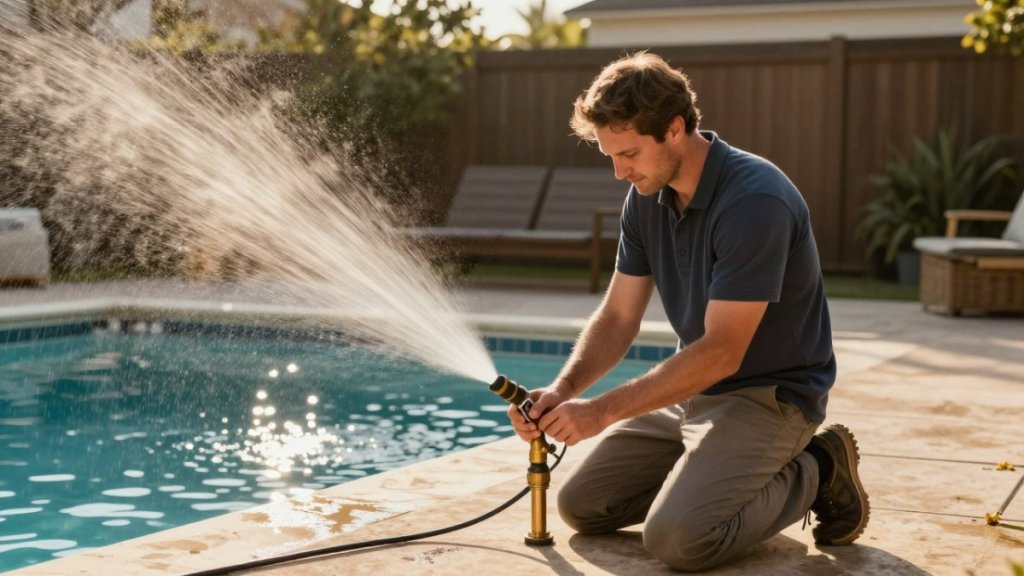
A high-pressure misting system delivers the fine fog that humid-climate cooling depends on. The high pressure breaks water into tiny droplets, and those droplets evaporate instead of dripping.
Placement is where most installations go wrong. A common mistake is mounting nozzles too high or too far from where people sit. Mist needs to travel through the air people actually occupy.
Our team at Dixie Pool Solar Heating & Misting sees the same pattern in humid weather: systems sized for dry climates get installed unchanged and then disappoint. For the full picture on pressure, pumps, and layout, see our pool water cooling misting systems guide.
Misting System Water Use: What to Expect at the Pool
Misting system water use depends on nozzle count, pressure, and run time, not on humidity. A misting line consumes water continuously while it runs, and humid air does not reduce that draw. In fact, a humid day may push you to run the system longer for the same relief, so water use can climb exactly when cooling is hardest to get.
How to Estimate Gallons per Day
Track it simply. Note your nozzle count, estimate flow per nozzle from the manufacturer’s spec, and multiply by run hours. That gives gallons per day. Compare that to your pool’s evaporation loss and top-off habits.
A worked example makes the math concrete.
- Run misting during the hottest hours only
- Shut it off when the deck empties
- Check for drips and worn nozzles, which waste water silently
Water use is a cost, but it is usually a small one next to the comfort it buys on a hot afternoon.
Water Quality and Mineral Buildup
Municipal water carries dissolved minerals, and those minerals stay behind when droplets evaporate. Over a season, they collect on nozzle tips, filters, and nearby surfaces as a white film. Hard water accelerates the problem.
- Install and change the inline filter on the manufacturer’s schedule; a clogged filter drops pressure and coarsens the mist.
- Clean nozzle tips regularly with the recommended method; a partially clogged nozzle sprays unevenly and wets surfaces.
- Expect mineral film on glass, railings, and furniture near the mist line in hard-water areas, and wipe it before it etches.
Watch out: skipping filter changes is the most common cause of sudden wet-deck complaints, because clogged nozzles distort spray patterns before they fail outright.
Seasonal Upkeep and Winterizing
In most of the country, a pool misting system is a seasonal tool. Before the first freeze, drain the lines, blow them out if the manufacturer recommends it, remove and store nozzles, and shut off the supply. In freeze-prone areas, trapped water can crack fittings and pumps. At the start of the season, flush the lines, replace filters, inspect nozzles for mineral damage, and test pressure before the first hot weekend.
Comparing Misting With Fans and Shade
Water use is only one line item. Fans consume electricity and move air without adding moisture, which makes them a strong partner in humid weather. Shade structures cut radiant heat without any operating cost. Misting earns its place when airflow is already good and the air is not near saturation. The practical comparison is comfort per dollar across the season: misting adds water and maintenance, fans add electricity and noise, and shade adds upfront cost but almost no upkeep.
Misting System Wet Surfaces: Managing Overspray and Drainage
Misting system wet surfaces are the main complaint in humid climates, and overspray is usually the cause. When droplets are too large or nozzles point at hard surfaces, water collects instead of evaporating. The fix is droplet size, angle, and airflow, but the practical work is in placement, run timing, and drainage.
Why Humid Air Makes Wet Surfaces Worse
In dry heat, a coarse droplet can still evaporate before it lands. In humid air, the same droplet has little room to vaporize, so it reaches the deck, the furniture, and the people sitting there. That is why a system that feels dry in arid conditions can leave a pool deck slick in humid weather. The water is not the problem by itself; the problem is liquid water arriving where it cannot evaporate.
Three variables decide whether your deck stays dry:
- Droplet size: finer mist from smaller nozzles evaporates faster and lands less. Coarse spray from low-pressure kits wets surfaces.
- Nozzle angle and height: nozzles aimed down at pavers deposit water on the deck. Nozzles aimed horizontally into the seating zone let droplets travel through air and evaporate.
- Airflow: moving air sweeps saturated air away and keeps evaporation going. Still air lets moisture pool on surfaces.
Placement Rules That Keep the Deck Drier
Most wet-deck complaints trace to a handful of installation mistakes. A common pattern is mounting nozzles too low and too close to hard surfaces, or pointing them at furniture and railings where water collects.
- Mount the mist line along the patio edge, facing inward, at a height that puts the fog in the seating zone rather than on the pavers.
- Keep nozzles at least a few feet from walls, railings, and furniture backs so droplets have air time to evaporate.
- Space nozzles so their cones overlap slightly; gaps create dry pockets that tempt homeowners to overrun the system.
Watch out: pointing nozzles at pool coping or deck drains concentrates water in low spots and accelerates algae growth on wet pavers. Our article on why algae grows in pool misting lines covers the causes and the cleanup.
Drainage and Slip Risk on Pool Decks
Pool decks are already wet zones, so the goal is not a bone-dry surface, it is avoiding standing water and slick film. A few practical steps reduce both:
- Confirm the deck slopes away from the pool and toward drains; puddles that linger after the mist shuts off signal a drainage problem, not a misting problem.
- Keep drain grates clear of leaves and debris so overspray can leave the deck.
- Choose textured or broom-finished pavers over smooth tile in the mist zone; smooth surfaces show water and get slick faster.
If your deck has poor drainage or a covered corner where air pools, expect more surface wetness regardless of nozzle choice. In those spots, lean on fans and shade first and treat misting as a supplement.
Operating Intervals That Limit Wetness
Humidity-specific operation matters as much as hardware. On moderately humid days, short run cycles, a few minutes on, then off to let surfaces dry, often feel better than continuous misting, because continuous operation saturates the air near the deck and stops evaporation. On the most humid days, run the system only during peak heat and pair it with airflow; otherwise you are adding water faster than the air can absorb it.
A Practical Humidity and Wet-Bulb Decision Guide
Use wet-bulb temperature to decide whether misting will help today. Wet-bulb temperature is the lowest temperature air can reach through evaporation alone. The bigger the gap between the air temperature and the wet-bulb temperature, the more cooling misting can deliver.
Here is how we would size up a day before turning the system on:
- Check the forecast relative humidity for your swim window
- Note the air temperature at the pool deck
- Compare the two: a wide gap means misting will help
If the gap is wide, run the mist line during peak heat. If it is narrow, lean on airflow and shade first. Misting becomes a supplement, not the main event.
When Misting Isn’t Enough: Alternative Cooling for Humid Pools
Misting falls short on the most humid days, and that is when other cooling options earn their place. Shade structures, fans, and evening swims all help.
Covering the pool overnight slows heat gain. Partial drains and refills lower water temperature, though they cost water.
For homeowners who want the pool usable from March through November, water temperature matters more than air comfort. Our guide to ways to lower pool temperature without a chiller covers the cooling side, and our team at Dixie Pool Solar Heating & Misting can help you balance heating and cooling across the season.
Humid air limits what any misting system can do, but it does not make misting useless.
Frequently Asked Questions
Do pool misting systems work in high humidity?
They work, but with a smaller cooling effect. Evaporative cooling depends on how much more moisture the air can absorb, and humid air is already close to saturation. Cooling is noticeably smaller in humid air than in dry air. That difference is still noticeable on a hot deck, especially when airflow from a fan keeps mist moving and evaporating rather than settling.
Does a misting system use a lot of water?
Misting system water use depends on nozzle count and run time. A high-pressure setup with fine nozzles uses far less water than a low-pressure system that produces large droplets, because the water is meant to evaporate rather than soak the ground. Check the nozzle flow rating and multiply by your run time to estimate daily use before you buy.
Do misting fans get everything wet?
They can if the droplets are too large or the airflow is too weak. High-pressure misting breaks water into finer droplets that evaporate more quickly, which limits wet surfaces. Low-pressure kits and oversized nozzles produce droplets that fall before they evaporate, leaving slick pool deck surfaces. Pair high pressure with good ventilation and aim nozzles slightly upward so the mist has time to flash off before reaching furniture or walkways.
How much cooler can a misting system make a pool area?
Cooling is greater in dry heat than in humid air, and is concentrated near the nozzles and where a fan moves air through the mist. Comfort also depends on wind, system placement, and whether the pool deck is shaded. Measure the difference yourself with a thermometer at the mist line and at the far end of the patio.


Leave a Reply