Table of Contents
- Is Your Solar Pool Heater Not Working? Start With These Warning Signs
- Solar Pool Heater Troubleshooting: A Step-by-Step Diagnostic Checklist
- Solar Pool Panel Leak Repair: What Homeowners Can Do Safely
- Solar Pool Heater Maintenance That Prevents Costly Repairs
- When to Call a Professional for Solar Pool Heater Repair
- Frequently Asked Questions
Last Updated: October 21, 2026
Is Your Solar Pool Heater Not Working? Start With These Warning Signs
The signs your solar pool heater needs repair rarely appear overnight. It usually gives you signals first, and most homeowners miss them until the pool turns cold in the middle of swim season. At Dixie Pool Solar Heating & Misting, catching a small issue early is the difference between a quick fix and a full panel replacement.
Here is the core problem: solar heating is quiet by design. There is no burner, no flame, no obvious noise. When performance drops, the only clue is often a pool that feels cooler than it should. The signs your solar pool heater needs repair usually show up as small changes in temperature, water flow, or panel condition long before a hard failure.
Below, we break down exactly what to check, what each symptom means, and when to stop and call a pro.
The most reliable early warning is a pool that no longer reaches its usual temperature on a sunny day. Trust that signal over everything else.
Solar Pool Heater Troubleshooting: A Step-by-Step Diagnostic Checklist
Solar pool heater troubleshooting starts with three checks: water flow, leaks, and collector condition. Work through them in that order. Flow problems are the most common cause of a heater that runs but does not heat, and they are also the easiest to rule out. The checklist below is built so a homeowner can safely complete the first pass, then hand off anything involving the roof, pressurized lines, or electrical controls.
Check Water Flow and Valve Alignment
Water flow is the first thing to verify. A solar pool heating system only heats when water actually moves through the panels.
- Confirm the pump is running and the filter is not clogged.
- Find the three-way valve that diverts water to the solar loop.
- Check that the valve handle points toward the panels, not away from them.
- Listen for gurgling or air in the lines, which signals a flow problem.
- Compare the pressure gauge reading to its normal baseline; a sudden drop or spike often points to a flow restriction.
A valve left in the wrong position is one of the most common reasons a system appears to be “not working.” It is also the cheapest fix you will ever make.
Inspect for Leaks in Pipes and Collectors
Walk the pipe run from the pump to the roof. Look for wet spots, dripping connections, and water stains on the roof deck. Small leaks at pipe connections often start as a slow drip and grow into a real water loss problem.
Check the return line too. If the water coming back to the pool is cool or the same temperature as the pool, the loop may be losing heat or not flowing at all.
Assess Collector Condition and Debris Buildup
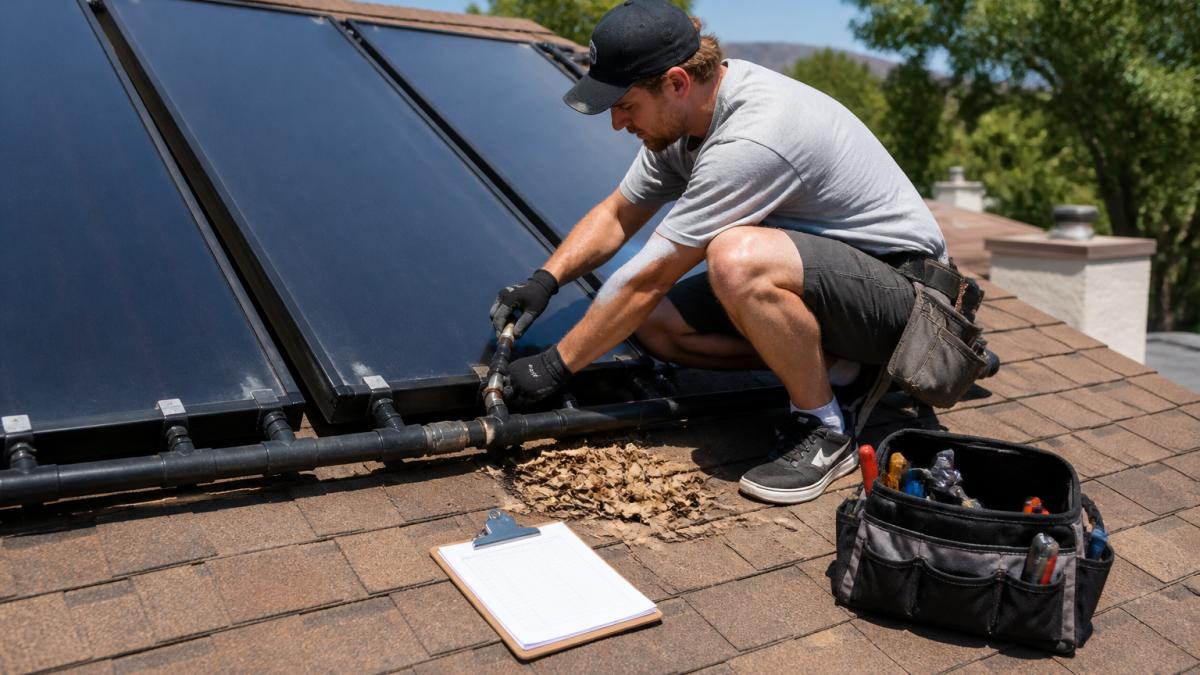
Strip collectors and roof panels collect dirt, leaves, and debris over time. That buildup blocks sunlight and cuts heating performance without any mechanical failure at all.
- Look for shade from overhanging branches.
- Clear leaves and dirt from the panel surface.
- Check for cracked or cloudy panel glazing.
- Confirm panels are not loose or lifted after a storm.
Symptom-to-Cause Chart: What Each Sign Usually Means
Use this chart to translate what you are seeing into a likely cause and a next step. It is not a diagnosis, but it narrows the problem before you call anyone.
| Symptom | Likely cause | Safe next step |
|---|---|---|
| Pool stays cool on a sunny day | Valve misaligned, pump not running, or clogged filter | Recheck valve position and filter; confirm pump runs during daylight |
| Return water feels the same as pool water | Low flow, air in lines, or collector bypass | Check for gurgling, confirm valve alignment, inspect accessible connections |
| Weak flow at returns | Clogged filter, failing pump, or restricted valve | Clean filter, verify valve position; call a pro if flow does not recover |
| Visible drip at a pipe joint | Loose fitting or worn seal | Shut off pump, hand-tighten only, photograph the leak |
| Wet roof deck or ceiling stain | Leak under mounting hardware or in a collector | Stop the pump, bypass the solar loop, call a professional |
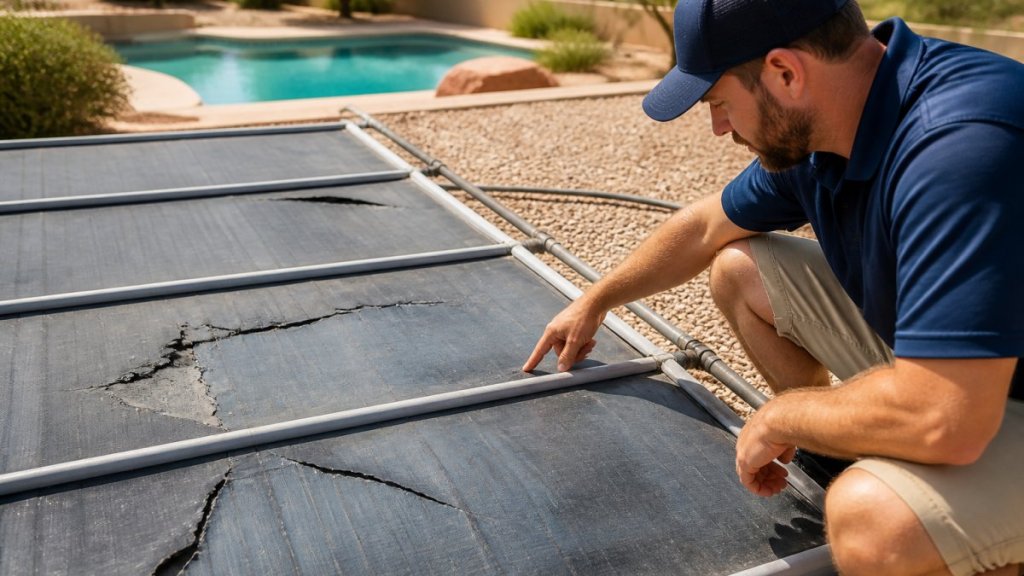
| Cracked or cloudy panel glazing | Storm, hail, or age-related breakdown | Note the location and call for assessment; do not patch pressurized collectors |
| System runs but never warms | Controller setting, sensor fault, or failed valve actuator | Confirm the controller is calling for heat; leave sensor and actuator work to a technician |
Distinguish a Fault From Normal Solar Behavior
Not every cool pool is a repair. Solar output depends on sunlight intensity, pool temperature, pump run time, and controller settings. A system that heats well in midsummer but struggles in spring and fall is often behaving normally for the season, not failing. Before you assume a breakdown, confirm the pump runs during the sunniest hours, the controller is set to call for heat, and the panels are clear of shade and debris.
If your system heats fine in July but struggles in March and October, the issue is often sun angle and debris, not a broken part. Clean the panels and recheck before assuming a repair is needed.
Stop and call a professional if you see an active leak, standing water near roof mounting hardware, a pump that runs hot or trips a breaker, or any sign of damage to electrical controls. Do not climb on a wet roof or open a pressurized collector.
Solar Pool Panel Leak Repair: What Homeowners Can Do Safely
Solar pool panel leak repair is where we tell most homeowners to stop and call a professional. A leak you can see is one thing. A leak inside a pressurized collector or under roof mounting hardware is another.
Safe homeowner steps:
- Shut off the pump before touching any connection.
- Note the exact location of the leak.
- Tighten only hand-tight fittings, never force a connection.
- Photograph the leak for your technician.
Do not climb on a roof in wet or windy conditions, and do not attempt to patch a pressurized collector yourself. A bad patch can fail under pressure and cause system damage that costs far more than the original leak.
Solar Pool Heater Maintenance That Prevents Costly Repairs
Most solar pool heater maintenance is simple and takes an afternoon or two per season. The systems we install are built to run with little to no maintenance or expenses required after installation, but a few habits protect your investment.
- Skim debris off collectors after storms or heavy leaf fall.
- Check valve alignment at the start of each swim season.
- Watch for rust or corrosion at metal fittings and mounts.
- Look for hail damage or storm damage after severe weather.
- Confirm return water feels warmer than pool water on a sunny day.
The U.S. Department of Energy guide to solar pool heating notes that solar pool heating is one of the most cost-effective solar technologies for homeowners, which is exactly why protecting the system with basic upkeep pays off.
Ignoring a small roof leak can rot decking and mounting hardware. By the time water shows up inside, the repair is no longer just a pipe fitting.
When to Call a Professional for Solar Pool Heater Repair
Call a professional when the problem involves the roof, pressurized components, or anything you cannot safely reach. That includes persistent leaks, cracked collectors, storm damage, and a system that still will not heat after you have checked flow and cleared debris. The harder question is how urgent the call is, and whether the system should keep running in the meantime.
Repair Urgency: When to Shut Down or Bypass the Solar Loop
Some symptoms can wait for a scheduled visit. Others should trigger a shutdown right away.
- Shut off the pump and bypass the solar loop immediately for an active leak, standing water near roof mounting hardware, a ceiling stain under the panels, or a pump that runs hot, smells electrical, or trips a breaker.
- Bypass the loop and schedule service within a few days for cracked or cloudy collector glazing, loose panels after a storm, or a system that runs but never warms the pool.
- Monitor and schedule routine service for slow performance drops, minor debris buildup, or seasonal output changes that match normal sunlight patterns.
Bypassing the loop keeps water circulating to the pool filter while isolating the solar panels, which limits further water loss or damage until a technician arrives. If you are unsure how to bypass your system, leave the pump off and call for guidance rather than guessing at valve positions.
Repair or Replace? A Practical Decision Framework
Component replacement and internal diagnostics are jobs for someone with the right tools and roof safety gear. A qualified technician can tell the difference between a faulty valve and a failed collector, and can confirm whether repair or replacement makes more sense. In practice, the decision usually comes down to four factors:
- Age of the collectors. Panels near the end of their service life are rarely worth repeated repairs.
- Scope of the failure. A single failed valve or actuator is a repair; widespread glazing breakdown or multiple leaking collectors usually points toward replacement.
- Warranty coverage. Check whether parts and labor are still covered before authorizing work, since coverage can change the math significantly.
- Downstream risk. A leak that has reached roof decking or mounting hardware raises the cost of waiting and favors a prompt, thorough fix.
At Dixie Pool Solar Heating & Misting, our Heliocol panels carry an industry-best 12-year warranty, and we back our labor with a 2-year warranty. That coverage matters most when something actually goes wrong. If you are unsure whether your issue is a quick fix or a real repair, our team can help you sort it out. Consumer guidance on hiring home contractors
When in doubt, shut down and bypass. A day without solar heating costs far less than a roof leak or a failed pump.
Frequently Asked Questions
How do I know if my solar pool heater is working properly?
Check that the water returning to your pool is noticeably warmer than the water going out to the panels, especially on sunny days. You can also feel the panels themselves, they should be cool to the touch when water is flowing. If you see a temperature difference of 2-5°F or more, the system is likely working. If not, check for valve alignment, pump operation, and debris on the panels.
Why is my pool not warming up with solar heating?
Common causes include misaligned valves diverting water away from the solar loop, a dirty filter restricting flow, debris covering the panels, or a pump that isn’t pushing enough water. Start by confirming the three-way valve is set to solar and the pump is running during daylight hours. If those check out, inspect the panels for shade or dirt buildup. Persistent issues may require a professional diagnosis.
Can a hole in a pool solar panel be repaired?
Yes, small holes or cracks in solar pool panels can often be repaired with a patch kit designed for the panel material. However, the repair’s durability depends on the damage extent and panel condition. For leaks at pipe connections or multiple damaged panels, replacement may be more cost-effective. Always turn off the system and relieve pressure before attempting any repair, and consider professional help if you’re unsure.
When should I call a professional to repair a solar pool heater?
Call a professional if you notice persistent leaks despite tightening connections, significant panel damage from storms, corrosion on metal components, or if the system fails to heat after basic troubleshooting. Also seek help if you’re uncomfortable working with pool plumbing or if the repair involves roof-mounted panels. A certified technician can diagnose complex issues and ensure safe, lasting repairs.
A solar heater that stops performing is usually telling you something specific, whether it is a misaligned valve, a slow leak, or dirty collectors. Catching those signs early keeps small problems from turning into expensive ones. If your system needs a closer look, Dixie Pool Solar Heating & Misting can inspect your setup, confirm what is wrong, and get your pool back to temperature. Reach out for a free quote and let our team keep your swim season running from March through November.


Leave a Reply