Last Updated: November 3, 2026
Quick Summary
Pool aeration lowers water temperature by throwing a fine spray across the surface, which increases evaporation and pulls heat out of the pool. The effect is strongest on hot, dry, breezy days and weakest in humid, still conditions. Aim the spray across the full surface for the best cooling.
- Evaporation removes heat from pool water as droplets leave the surface.
- Run the aerator for two to four hours during the hottest part of the day.
- Aim the spray across the full pool surface rather than one corner.
- Cooling is weakest on humid, still evenings, so check the forecast first.
- Test pH and chemistry after the first few runs, since aeration can shift it.
Table of Contents
- What Is a Pool Aerator and How Does It Work?
- How Pool Aeration Cools Water Through Evaporation
- Benefits of Pool Aeration for Water Temperature Beyond Cooling
- Pool Aeration’s Effect on Water Chemistry, pH, and Oxygen
- Pool Aerator Attachments and Setup Options
- How to Cool Down a Hot Pool Using Aeration: Step-by-Step
- Energy Use vs. Cooling Benefit: Is Pool Aeration Worth the Power?
- Planning Your Next Step: Choosing a Pool Heating or Cooling Plan
- Frequently Asked Questions
What Is a Pool Aerator and How Does It Work?
A pool aerator is a pump-driven device that pushes air or water into the pool and creates a gentle surface spray. Most aerators connect to your existing pool circulation system, so they run on the same pump you already use. The spray breaks the water surface into small droplets that hang in the air briefly before falling back in.
That spray is the whole trick. Each droplet gives off a little heat as it evaporates, and that heat loss pulls energy out of the pool water. Pool owners often turn to aeration on hot afternoons when the water feels too warm for comfortable swimming.
A pool aerator is a device that mixes air into pool water and throws a fine spray across the surface to increase evaporation and cooling.
How Pool Aeration Cools Water Through Evaporation
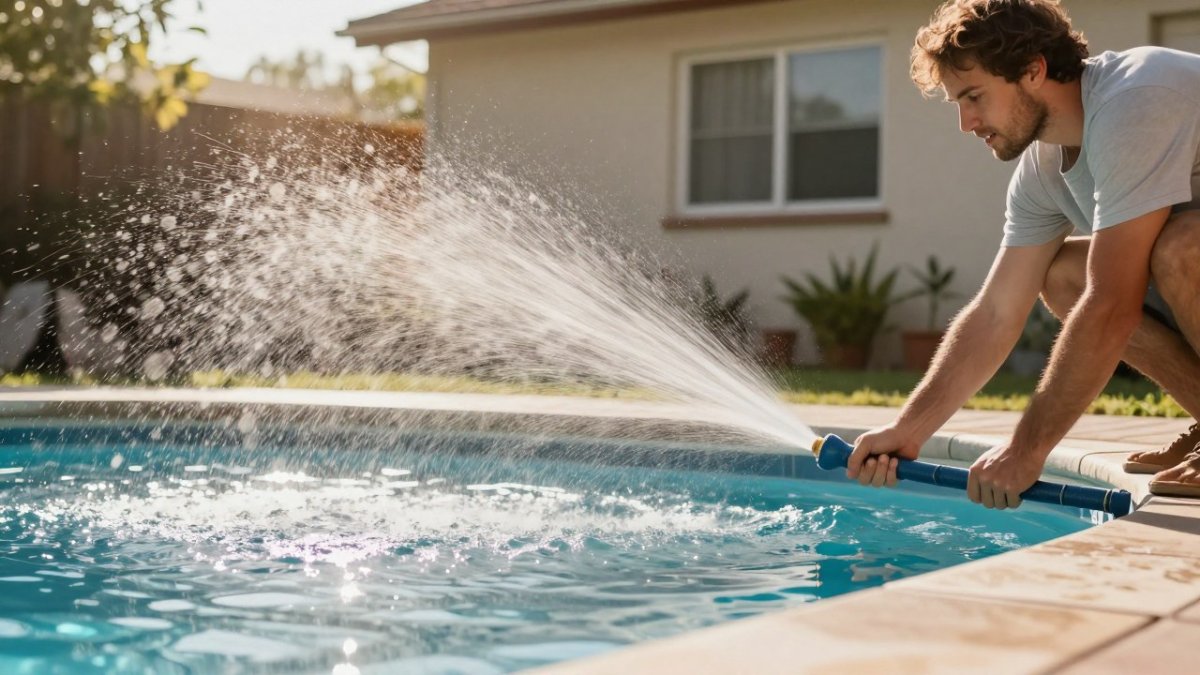
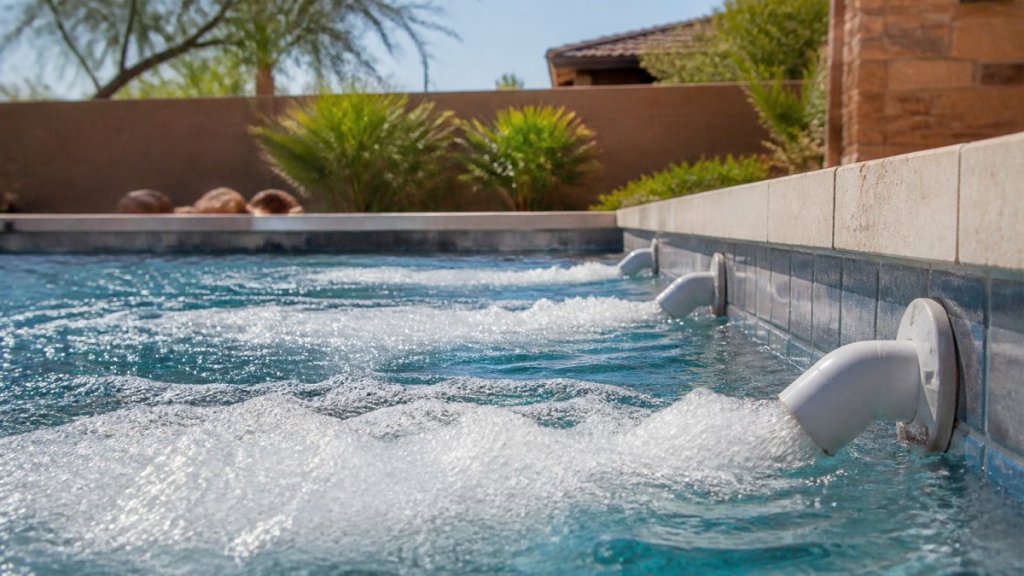
Evaporation is the engine behind aeration, and understanding the mechanism tells you when it will work and when it will not. Water needs energy to change from liquid to vapor, and it takes that energy from the water left behind (usgs.gov). This is the latent heat of vaporization.
A still pool evaporates slowly because only the flat surface is exposed. An aerator changes the geometry: it throws water into thousands of small droplets, and each droplet has surface area on all sides. More surface area means more molecules can escape per minute, so the evaporation rate climbs sharply.
The catch is that evaporation only proceeds as fast as the surrounding air can absorb moisture. The driving force is the difference between the water’s vapor pressure and the vapor pressure already in the air. On a hot, dry day, the air is far from saturated, so droplets give up water quickly and the pool cools.
Wind matters almost as much as humidity. Moving air sweeps away the humid layer that forms just above the spray, keeping the vapor-pressure gap open. A breezy afternoon can cool noticeably faster than a still one at the same temperature and humidity.
Surface area and droplet size are the levers you control. A fine, wide spray exposes more water than a tight, high jet, even though the tall jet looks more dramatic. Adjust the nozzle so the spray lands across most of the pool surface rather than dumping into one corner.
A simple way to read your conditions: if the air feels dry and there is a light breeze, aeration will cool well; if the air feels heavy and still, expect little and save the pump hours. Tracking morning and late-afternoon temperatures over a week tells you more about your pool’s real cooling rate than any general rule of thumb.
Watch out: on a humid, still night the aerator can run for hours with almost no temperature change while still drawing pump power and accelerating water loss, check the forecast before you expect a meaningful drop.
Benefits of Pool Aeration for Water Temperature Beyond Cooling
Cooling is the headline benefit, but aeration does more than that. The moving water circulates heat more evenly, so the top layer does not trap heat while the deeper water stays cool.
Aeration also keeps the surface moving, which can help the water stay closer to one temperature. If you want more non-mechanical options, read how to lower pool temperature naturally.
Pool Aeration’s Effect on Water Chemistry, pH, and Oxygen
Spraying water into the air changes the water’s chemistry in a few ways. The most useful change is oxygenation. As droplets fall back into the pool, they pick up dissolved oxygen, which helps keep the water fresh.
Aeration can also affect pH, so it is worth testing your pH more often when the aerator runs daily. Keeping the chemistry balanced matters more than the cooling itself if you want clear, comfortable water.
Pool Aerator Attachments and Setup Options
For best results, position the aerator where the spray can reach the sunniest part of the pool. Keep it away from the skimmer so debris does not clog the nozzle.
How to Cool Down a Hot Pool Using Aeration: Step-by-Step
This method works best when you start early in the afternoon, before the water reaches its peak temperature.
- Check the water temperature. Note the reading so you can measure how much it drops.
- Set the pump to run during the hottest hours. Early to mid-afternoon usually gives the best results in summer.
- Turn on the aerator and adjust the nozzle. Aim the spray across the full surface, not just one corner.
- Run it for two to four hours. Stop once the water feels comfortable. Running it all day adds pump cost with diminishing returns.
- Retest the water temperature. Compare it to your first reading to see how much you gained.
- Test pH and chemistry. Aeration can shift pH, so check it after the first few runs.
- Repeat on hot days only. Cooler days do not need aeration.
Results vary with humidity, wind, and how hot the pool started, so track your own readings over a week.
The steps below walk through a typical aeration session, with the timing and checks the article recommends.
| Step | What to do | Time or frequency |
|---|---|---|
| Check the water temperature | Note the reading to measure the drop later | Before starting |
| Set the pump schedule | Run during the hottest hours | Early to mid-afternoon |
| Adjust the aerator | Aim spray across the full surface | Once per setup |
| Run the aerator | Stop once water feels comfortable | Two to four hours |
| Retest temperature | Compare to the first reading | After the run |
| Test pH and chemistry | Aeration can shift pH | After the first few runs |
| Repeat on hot days | Skip cooler days | As needed |
Energy Use vs. Cooling Benefit: Is Pool Aeration Worth the Power?
Aeration is not free cooling. The spray is driven by your pool pump, and that pump is usually the largest electrical load in a backyard pool system. To weigh this against dedicated units, compare the best pool cooling systems for summer. The real question is not whether aeration cools water, it does, but whether the temperature drop justifies the kilowatt-hours.
Start with the cost side. A pump’s energy use is its wattage multiplied by runtime, divided by 1,000 to get kilowatt-hours, then multiplied by your electric rate. If your pump draws 1,500 watts and runs four extra hours for aeration, that is 6 kWh. At a residential rate of about 15 cents per kWh, that run costs roughly 90 cents.
Now the benefit side. Evaporative cooling removes heat in proportion to how much water evaporates, and evaporation rate depends on humidity, wind, and the surface area the spray exposes. On a hot, dry, breezy afternoon, a well-aimed aerator can pull surface temperature down by a few degrees over several hours. On a humid, still evening, the same runtime may produce a drop so small you cannot feel it.
A practical way to judge worth is cost per degree. Track the water temperature before and after a timed run, note the kWh used, and divide. If a 90-cent run drops the pool two degrees, you are paying about 45 cents per degree, usually a good deal for occasional comfort. If the same run drops it half a degree on a humid night, you are paying nearly $2 per degree for a change swimmers will not notice.
Compare aeration against alternatives before committing. Other cooling and heating approaches exist, each with different costs and trade-offs, so compare options based on your pool’s needs. You can compare practical no-chiller cooling options before you decide.
Watch out: running the aerator continuously to chase a bigger drop usually backfires. Evaporation accelerates, you top off the pool more often, and the pump runs hotter in summer heat, so you pay more for water, chemicals, and equipment wear while the temperature gain flattens out. Short, timed runs on the hottest, driest days give the best return per dollar.
Planning Your Next Step: Choosing a Pool Heating or Cooling Plan
Your best plan depends on your goals. If you only need occasional relief on hot days, aeration may be enough. If you want to control water temperature all season, you may need a broader approach. Think about how many months you swim, how hot your summers run, and how much you want to spend on equipment and power.
If you also want to extend your swim season into spring and fall, solar heating can complement aeration. Dixie Pool Solar Heating & Misting offers solar thermal systems designed to extend the swimming season from March through November. Visit our website for current pricing or to request a quote tailored to your pool.
Our team at Dixie Pool Solar Heating & Misting can help you decide which combination of cooling and heating suits your pool and your budget. Reach out to talk through your options.
Frequently Asked Questions
Does a pool aerator actually cool the water?
Yes. The spray causes evaporation, and evaporation pulls heat out of the water. Results depend on air temperature and humidity, so the effect is strongest on hot, dry days.
How long should I run a pool aerator to cool the water?
Most people run it for two to four hours during the hottest part of the day. Test the water before and after to see what works for your pool.
Will aeration change my pool chemistry?
It can. Spraying water releases carbon dioxide, which may raise pH over time. Test your water regularly while the aerator is running.
Does running an aerator cost a lot of electricity?
The cost depends on your pump’s wattage, how many hours you run it, and your electric rate. Short daily runs cost far less than running it all day.
Frequently Asked Questions
Do pool aerators really work to cool pool water?
Yes, but the effect depends on evaporation. As water is sprayed into the air, a small amount evaporates, and that process pulls heat out of the remaining water. The cooling is gradual and works best in hot, dry conditions where humidity is low, Expect a modest drop in temperature rather than a dramatic one, and run the aerator during the hottest part of the day or overnight for the most noticeable result. Pair it with a pool cover at night to limit heat loss from evaporation when the aerator is off.
How much can a pool aerator cool a pool?
The exact drop varies with ambient air temperature, relative humidity, wind, and how long the aerator runs. Because cooling comes from evaporation, a pool in a dry climate will generally cool more than one in humid air. Results are typically a few degrees rather than a large change, so a pool that sits well above a comfortable range may need additional cooling or shade. Track your water temperature for a week with the aerator on and off to see what your specific pool achieves.
Should I water immediately after aeration?
Wait until the water has settled and you have checked your pool chemistry before adding water. Aeration increases evaporation, so the water level will drop more quickly than usual. Top off the pool to the normal skimmer line, but avoid adding large volumes of cold or untreated water in one go, since that can shift chemistry and temperature abruptly. Check pH and sanitizer levels after aeration, because increased gas exchange can affect pH balance.
What is the difference between a pool aerator and a pool cooler?
A pool aerator uses water spray and evaporation to lower temperature, while a pool cooler is typically a chiller that actively removes heat from circulating water. Choose based on how hot your pool gets and how much control you need.


Leave a Reply