
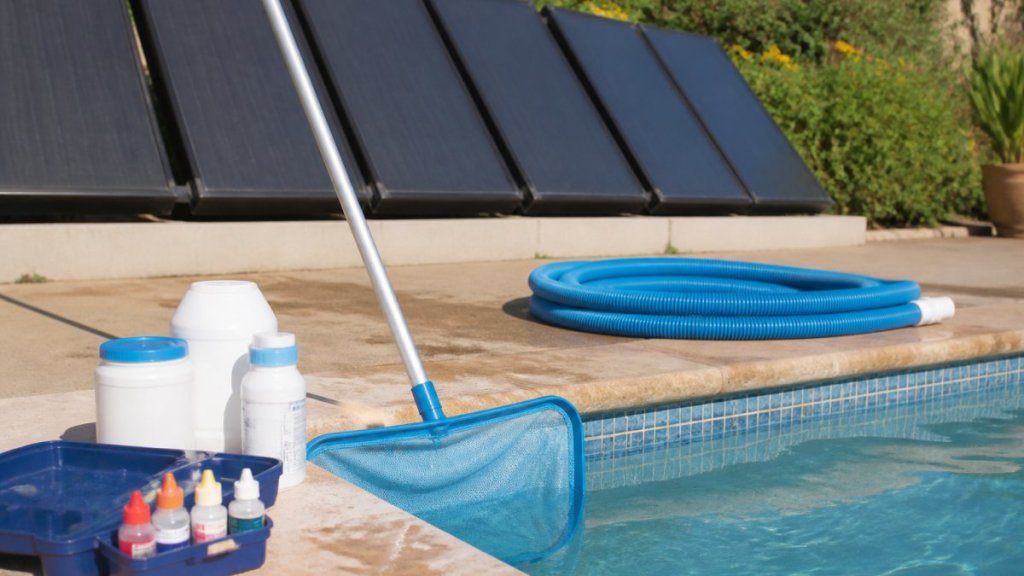
Last Updated: October 27, 2026
Quick Summary
Sustainable pool maintenance is worth it because it cuts water loss, chemical demand, and pump energy while costing mostly time. Skim and brush weekly, test water twice a week, and backwash only when filter pressure rises 8 to 10 psi. A variable-speed pump and solar heating add upfront cost but pay back over a few seasons.
- Skim the surface two to three times a week and brush walls and floor once a week.
- Test pool water at least twice a week during swim season and keep pH between 7.4 and 7.6.
- Backwash only when the filter gauge reads 8 to 10 psi above the clean starting point.
- Keep backwash discharge under about 5 percent of pool volume per month.
- Heliocol panels carry a 12-year warranty and extend the swimming season from March through November.
Table of Contents
- Start With a Weekly Routine That Saves Water and Chemicals
- Test and Balance Water Chemistry Before Adding Anything
- Pool Water Conservation Tips That Cut Evaporation and Backwashing Waste
- Pool Filter Maintenance: Clean Less Often, Save More Water
- Choose an Energy-Efficient Pool Pump and Run It Smarter
- Solar Pool Heating: The Sustainable Way to Extend Your Season
- Get a Free Quote for Solar Pool Heating and Sustainable Upgrades
- Frequently Asked Questions
Start With a Weekly Routine That Saves Water and Chemicals
Sustainable pool maintenance starts with a simple truth: most pools don’t need more chemicals, they need less debris. Every leaf you skim out is organic matter that won’t break down into the compounds that eat your chlorine and feed algae.
A weekly routine is the foundation of sustainable pool care, and it costs nothing but time.
Here’s the routine that does the most good:
- Skim the surface two to three times a week with a hand net. Catch leaves before they sink and rot.
- Brush the walls and floor once a week. Brushing lifts algae before it takes hold and keeps plaster healthy.
- Vacuum or run the automatic cleaner weekly to pull settled dirt off the bottom.
- Empty the skimmer baskets every few days. A clogged basket chokes circulation and wastes pump energy.
- Check the water level and top off only when needed. More on that below.
Watch out: Vacuuming alone leaves a thin film on the walls where algae starts. Five minutes with a brush saves you a chemical shock treatment later.
Test and Balance Water Chemistry Before Adding Anything
Balanced water is the cheapest chemical you’ll ever buy.
Test your pool water at least twice a week during swim season. Use a liquid test kit or strips, and check these core readings:
- pH: keep it between 7.4 and 7.6. Low pH corrodes equipment and stings eyes. High pH clouds water and weakens chlorine.
- Total alkalinity: target 80 to 120 ppm. This buffers pH so it doesn’t swing wildly.
- Stabilizer (cyanuric acid): 30 to 50 ppm for most pools. Stabilizer shields chlorine from the sun, but too much locks it up and makes it useless.
- Free chlorine: 1 to 3 ppm for a typical residential pool.
Each level affects the ones after it. Chasing pH before fixing alkalinity is like painting over rot.
For pools in hot, sunny climates, chemistry drifts faster. See this guide to maintaining pool chemistry in hot weather for deeper guidance.
Once the numbers are stable, add only what the test calls for. Resist the urge to toss in extra shock “just in case.” That’s how chemical demand creeps up.
Here are the core water chemistry readings the article says to check at least twice a week during swim season.
| Reading | Target range | Note |
|---|---|---|
| pH | 7.4 to 7.6 | Low corrodes equipment; high clouds water |
| Total alkalinity | 80 to 120 ppm | Buffers pH so it doesn’t swing |
| Stabilizer (cyanuric acid) | 30 to 50 ppm for most pools | Too much locks up chlorine |
| Free chlorine | 1 to 3 ppm | Typical residential pool |
Pool Water Conservation Tips That Cut Evaporation and Backwashing Waste
A pool loses water every day, mostly to evaporation. Wind, sun, and dry air pull moisture off the surface, and that means topping off with fresh water that throws off your chemistry. The sustainable fix is not one heroic gesture, it is a measurable plan you can track week to week.
Build a water budget you can actually track
Start by finding out how much water your pool normally loses. Pick a week with no rain and no swimming, mark the water line on the skimmer throat or tile with a grease pencil, and measure the drop after 24 hours. A common pattern is roughly a quarter inch per day in hot, dry, windy weather and less in humid, still conditions. Multiply that daily loss by your pool’s surface area to estimate gallons lost per day, then compare it to your water bill’s monthly usage.
Set two simple targets and write them on the pump timer:
- Evaporation: cut uncovered surface loss by roughly half with a cover or windbreak.
- Backwashing: keep discharge under about 5 percent of pool volume per month by cleaning on pressure, not on a calendar.
Match the plan to your pool and climate
Water loss is not the same everywhere. A large, dark-bottomed pool in full sun with constant wind can lose several times what a shaded, smaller pool loses. Before you buy anything, note four variables: pool surface area, daily sun hours, prevailing wind exposure, and how many swimmers use it each week.
In arid, windy regions, a windbreak, a fence, hedge, or screen wall on the upwind side, can meaningfully reduce surface evaporation at low cost. In humid climates, evaporation is slower, so covers pay back more on heat retention and debris control than on water alone.
The water-saving moves that add up
- Use a pool cover. A floating cover or automatic reel cuts evaporation substantially and keeps heat in overnight. It also keeps debris out, which means less skimming and less filter strain.
- Lower the water temperature slightly. Warmer water evaporates faster.
- Run the pump during cooler hours to reduce surface evaporation from splashing and wind.
- Fix leaks promptly. A slow drip at a fitting wastes more than you’d think.
- Backwash only when the filter gauge reads high, not on a fixed schedule. Backwashing dumps pool water down the drain.
- Redirect downspouts and runoff away from the pool so dirty water doesn’t flow in.
Log your top-off volume and pump runtime for one month. Once you have a baseline, a cover, a windbreak, and pressure-based backwashing usually show a visible drop in both water and energy use, and that record is your proof the plan is working.
The goal isn’t deprivation. It’s keeping the water you’ve already paid for and treated, and knowing, with numbers, that you’re doing it.
Pool Filter Maintenance: Clean Less Often, Save More Water
Here’s the counterintuitive part: a slightly dirty filter cleans better than a spotless one. The debris trapped in the media actually catches finer particles.
Follow the pressure gauge, not the calendar. When the reading climbs 8 to 10 psi above the clean starting point, it’s time to act.
A simple filter routine looks like this:
- Check the pressure gauge weekly
- Empty skimmer and pump baskets every few days
- Backwash only when pressure rises, not weekly
- Deep-clean cartridge filters at the start and end of the season
- Inspect O-rings and fittings for wear each spring
Watch out: Backwashing a sand filter too often sends hundreds of gallons of treated water down the drain and can disturb the sand bed. Let the gauge be your guide.
A well-maintained filter also takes load off your pump. Clean flow means the pump runs less to move the same water.
Choose an Energy-Efficient Pool Pump and Run It Smarter
The pool pump is the biggest energy user on most pool systems, so it is also where the largest savings hide. A variable-speed pump lets you run at low speed for longer, moving the same water for a fraction of the energy, but the savings only show up if you run it on a measured schedule instead of a habit.
Why slower is cheaper: the mechanism
Pump energy rises steeply with speed. Halving the speed can cut power use dramatically while still turning over the pool water, because flow and pressure drop faster than speed does. That is why a variable-speed pump run at low rpm for most of the day usually beats a single-speed pump that blasts the pool for a few hours. The catch is that low speed moves less water per minute, so you run it longer, and the total energy still comes out lower.
Set a runtime target and measure it
A practical starting point most practitioners use is one full water turnover per day, split into a long low-speed block and a short higher-speed burst for cleaning or skimming. To make that measurable:
- Read the pump’s wattage at your chosen low speed (the drive display or a clamp meter shows it).
- Multiply watts by hours run, then divide by 1,000 to get daily kilowatt-hours.
- Compare that number to your old pump’s daily kWh from the same calculation, or to your electric bill before and after.
Track it for a month. If the pool stays clear and the filter pressure stays normal, you can trim runtime further in shoulder seasons when the pool gets less use. If water clouds or pressure climbs, add a little low-speed time before you reach for chemicals.
Pair the right pump with smarter habits
- Run the pump in the cool morning or evening hours.
- Set a low-speed schedule for daily circulation and a short high-speed burst for cleaning.
- Trim run time in shoulder seasons when the pool gets less use.
- Keep the filter clean so the pump never fights a clog.
The lifecycle math
Variable-speed pumps cost more upfront than single-speed models, but the energy savings usually pay that back over a few seasons. To see your own payback, subtract the annual kWh of the new pump from the old pump’s annual kWh, multiply by your electric rate, and divide the upfront price difference by that annual savings. That gives a rough payback in years, and it is the kind of lifecycle math that makes sustainable pool maintenance worth it.
A pump upgrade is only as sustainable as its schedule. Measure watts, log runtime, and let the filter gauge and water clarity tell you when to adjust, not the calendar.
Solar Pool Heating: The Sustainable Way to Extend Your Season
Solar pool heating uses the sun to warm your water, with no gas bill and no operating cost after installation. It pairs naturally with the water- and energy-saving habits above.
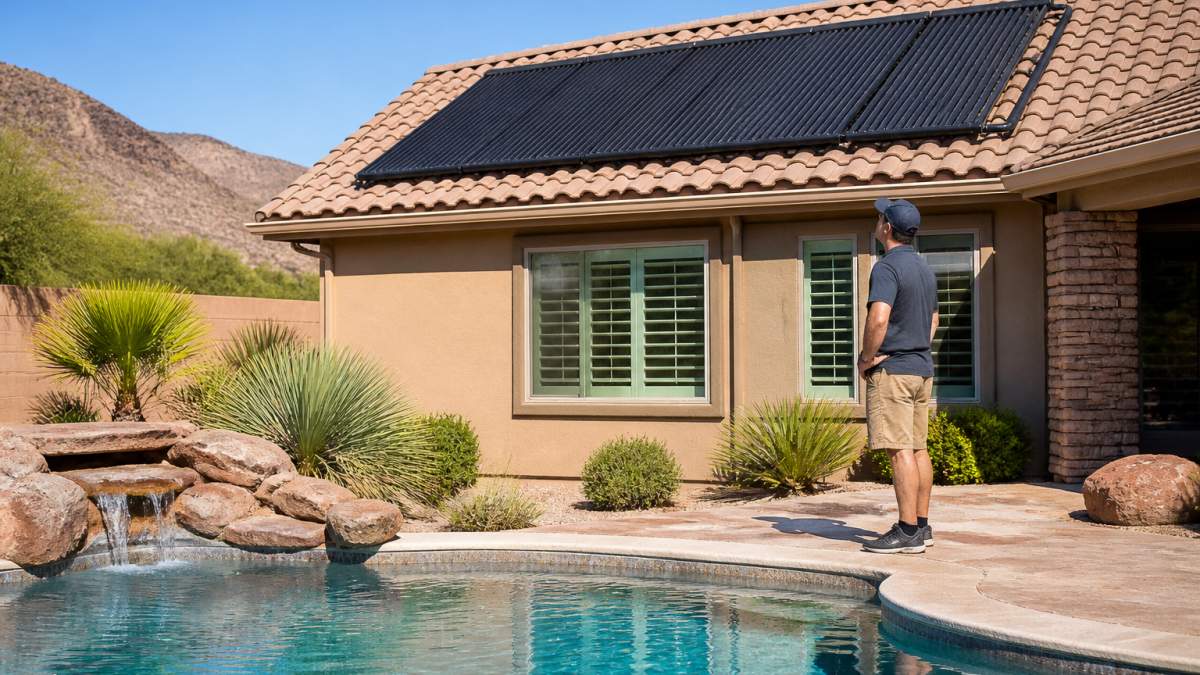
Solar thermal panels absorb heat from sunlight and transfer it to water circulating from your pool. Learn how to optimize solar pool heater efficiency to get the most from your system.
The panels extend the swimming season from March through November.
Get a Free Quote for Solar Pool Heating and Sustainable Upgrades
Sustainable pool maintenance isn’t about spending more. It’s about spending smarter: less water lost to evaporation, less chemical demand, less energy burned by the pump, and a heating system that runs on sunlight instead of gas.
Dixie Pool Solar Heating & Misting provides solar thermal heating to help homeowners reduce energy bills and extend the swimming season from March through November.
If you’re ready to learn more about solar heating, get a solar pool heating quote.
Frequently Asked Questions
How can I maintain my pool in a more sustainable way?
Consider solar pool heating, which uses solar thermal energy rather than electricity-generating PV solar.
How often should I clean my pool filter?
Clean cartridge filters every 4-6 weeks during heavy use, and backwash sand or DE filters only when the pressure gauge reads 8-10 psi above the clean starting pressure. Over-cleaning wastes water and shortens filter life. A pressure gauge is your best guide. If you backwash, do it for two minutes, not until the water runs clear for five, and consider a cartridge filter if water conservation is a priority in your area.
Can a pool cover reduce water and energy use?
Yes. A cover cuts evaporation, which is the largest source of water loss for most pools, and it keeps heat in the water overnight. That reduces the run time needed from a heater or solar pool heating system. A solar cover is the least expensive option; a liquid cover is easier to apply. Either way, less evaporation means less fill water and fewer chemicals to balance the pool.
Are solar pool heaters a sustainable option for homeowners?
Solar pool heating uses the sun’s thermal energy to warm water. Heliocol panels installed by Dixie Pool Solar Heating & Misting carry a 12-year warranty and have a 20+ year lifespan.
The real question isn’t whether sustainable pool maintenance is worth it. It’s whether you want to keep paying for water, chemicals, and energy you don’t have to. Get started with Dixie Pool Solar Heating & Misting and turn your pool into a lower-cost, longer-season asset.


Leave a Reply